How to Make Videos Go Viral A Modern Playbook for Success
Discover how to make videos go viral with actionable strategies for hooks, platforms, and distribution. A guide for real-world results.
Forget everything you've heard about viral success being a lucky break. It’s not a lottery ticket. It’s a calculated blend of audience psychology, platform knowledge, and strategic execution.
So, how do you really make a video go viral? The proven method comes down to mastering the 3-second hook, creating content that algorithms love, and having a smart plan to get it in front of the right people.
The Real Blueprint for Going Viral Today
Going viral isn't a random event—it's an engineered outcome. The days of uploading a video and just hoping for the best are long over. Today’s biggest hits follow a repeatable framework that you can absolutely apply to your own marketing.
This whole approach is built on understanding why people share stuff. It taps into raw human emotions: surprise, humor, relatability, and pure curiosity. A truly viral video doesn't just rack up views; it becomes part of the conversation, compelling people to hit that share button.
The process really boils down to three core stages: grabbing instant attention, feeding the platform's algorithm what it wants, and seeding your content to build that crucial initial momentum.
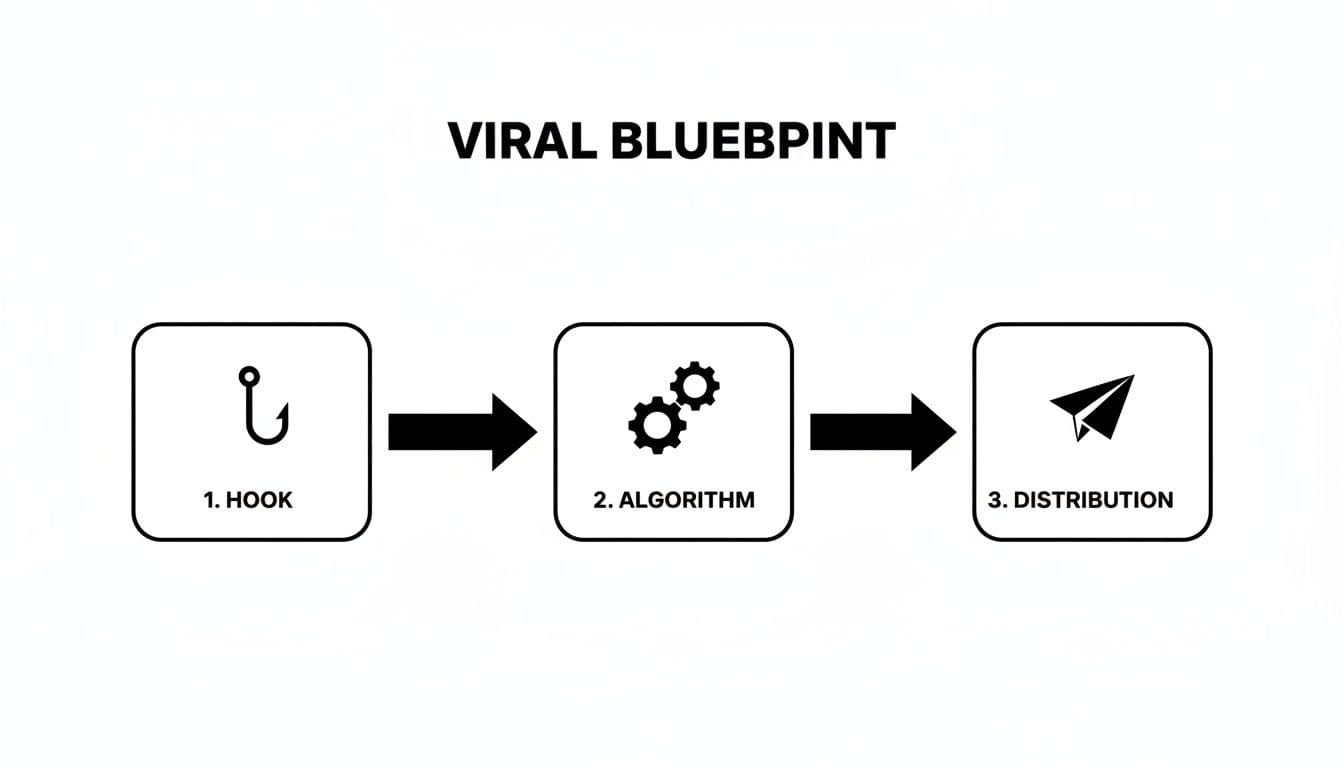
This chart shows how it all flows together. You start with a powerful hook, create something the algorithm will favor, and then push it out strategically. The key insight here is that each step builds on the last. A weak hook means the algorithm never even sees your video, and without a solid distribution plan, even the best content dies on the vine.
Mastering the Core Components
To actually pull this off, you need to shift your mindset. Stop thinking about "creating a video" and start "designing a shareable experience." Every single element, from the thumbnail to the final call-to-action, has to be intentional.
Here's what this modern approach is all about:
- Audience-First Ideation: Don't ask, "What video can I make?" Instead, ask, "What would my audience feel an urgent need to share?" This one question reframes the entire creative process.
- Platform-Specific Nuances: A video that blows up on TikTok might completely tank on YouTube Shorts. You have to understand the culture and technical quirks of each platform. For a deep dive, this guide on how to go viral on TikTok is a great resource for understanding its algorithm.
- Data-Informed Iteration: Stop guessing. Use tools to A/B test your hooks, captions, and thumbnails. See what actually performs, then double down on those winning elements in your next video.
To help you keep these core ideas straight, here's a quick reference table that breaks down the modern viral blueprint.
| The Modern Viral Video Blueprint | | :--- | :--- | :--- | | Component | Why It Matters | Key Action | | The Hook | Captures attention in the first 3 seconds before viewers scroll away. | A/B test opening lines, visuals, and on-screen text to find what stops the scroll. | | Algorithm Alignment | Ensures the platform shows your video to a wider, relevant audience. | Focus on watch time and engagement signals (likes, comments, shares) that the platform values. | | Distribution Strategy | Provides the initial momentum needed to trigger the algorithm's amplification. | Seed your video in relevant communities, forums, and cross-promote on other channels. |
This table summarizes the system. It's not about one magic trick; it's about executing well on these three fronts.
The most powerful realization for any marketer is that virality is a skill, not a lightning strike. It’s about building a system that consistently produces content with high-share potential, not just chasing a single, elusive hit.
By focusing on these strategic pillars, you replace hope with a reliable process. For marketers, this is where tools like Proom AI can be a game-changer. They can drastically speed up this workflow, letting you turn simple product images into compelling video ads that are built with these viral principles baked in from the start.
Winning the First Three Seconds to Stop the Scroll
In the endless scroll of a social media feed, you don’t get minutes to earn someone's attention—you have seconds. The first three seconds of your video aren't just a part of its success; they're the single most important factor. If you can't hook a viewer right away, they're gone. Just like that.
We’re all operating in a brutal "hook economy" now, where those initial moments carry almost all the weight. Industry data shows that capturing attention in that tiny window determines 80-90% of a video's success. This is why knowing how to write viral hooks that stop the scroll isn't just a nice-to-have skill; it's the entire game.
It’s the difference between a video that fizzles out with a few hundred views and one that takes off.
Frameworks for Irresistible Hooks
A great hook isn't a happy accident. It’s psychology. Forget the slow fade-in or the fancy logo—you need to drop the viewer directly into the most compelling part of your story from the very first frame.
Here are three battle-tested frameworks I’ve seen work time and time again.
- The Bold Statement or Question: Kick things off with a provocative claim or a question that makes people tilt their heads. It creates an instant itch of curiosity they have to scratch.
- The Relatable Problem: Start by showing a pain point your audience knows all too well. When people see their own struggles on screen, they feel seen and immediately lean in for the solution.
- The Transformation Teaser: Show the stunning "after" before you even mention the "before." This creates an information gap that forces viewers to stick around just to see how you got there.
Use these as your starting point for brainstorming. They’re designed to make a thumb stop dead in its tracks.
Real-World Hook Examples
Theory is one thing, but let's look at how this plays out for actual businesses.
E-commerce Example (Relatable Problem) Imagine an e-commerce brand that sells kitchen organizers. They could open a video with a jarring shot of a messy, chaotic drawer. Text flashes on screen: "If your kitchen looks like this, you need to see this." It works because it’s painfully relatable, promising a quick, satisfying fix.
Real Estate Example (Transformation Teaser) A real estate agent could start a video with a breathtaking, wide-angle shot of a brand-new, luxurious kitchen. The voiceover comes in hot: "You will not believe what this kitchen looked like just 30 days ago." Who wouldn't stick around to see that transformation? It builds immediate intrigue.
The best hooks create a tiny mystery or promise an immediate reward. They make a silent pact with the viewer: "Give me three more seconds, and I’ll show you something amazing, useful, or shocking."
A-B Testing Hooks with AI
So how do you know which hook will actually land? You test them. This used to be a pain, but AI tools have completely changed the game here, letting you move faster and get smarter with your content.
Instead of guessing, you can use a tool like Proom AI to generate multiple script variations for the same video. Take a set of product photos, for instance, and ask it to create three different hooks: one using a bold claim, another hitting a relatable problem, and a third teasing a transformation. You can easily test different opening lines using an AI-powered hook generator for your video scripts.
From there, you can run these short variations as ads to a small, targeted audience. The data doesn't lie. You'll quickly see which hook gets the highest view-through rate and the most engagement. This data-driven approach takes the guesswork out of the creative process and gives you a repeatable system for winning those all-important first three seconds.
Choosing the Right Platform for Viral Success
Trying to go viral without picking the right platform is like fishing in a desert. It just doesn't work. Virality isn't some universal language; it's a collection of local dialects, and each platform speaks its own. A video that becomes an overnight sensation on TikTok could easily fall flat on YouTube Shorts. Honestly, the secret to making videos go viral often boils down to choosing the right stage for your performance.
Short-form video is the undisputed king of virality, with TikTok, Instagram Reels, and YouTube Shorts leading the charge. The numbers are staggering: 90% of Gen Z and Millennials are hooked on short-form content. And while TikTok gets a lot of the credit, YouTube Shorts now boasts over 2 billion monthly active users, pulling ahead of TikTok's 1.59 billion.
This is the 'hook economy' in action. You have about three seconds to stop the scroll. Fail, and you're gone. Success means becoming a native in that platform's culture, not just dropping in a generic video and hoping for the best.
TikTok: The Trend Incubator
Think of TikTok as the wild west of viral content. It’s built on raw authenticity, user-generated trends, and a healthy dose of delightful chaos. Overly polished, corporate content often gets ignored here. Users want to see real people in relatable situations, sharing content that feels spontaneous—even if it was meticulously planned.
The algorithm is a force of nature, capable of turning an unknown creator into a star in less than 24 hours. The key is speed. You have to jump on trending sounds, filters, and formats the moment they start taking off. A brand can find massive success by adapting a popular meme format to showcase a product, while a slick, traditional ad would get skipped instantly.
- Audience: Primarily Gen Z and younger Millennials.
- Content Style: Authentic, trend-driven, humorous, and often low-fi.
- Best For: Brands that can move fast, embrace imperfection, and tap into cultural moments as they happen.
Instagram Reels: The Polished Performer
Instagram Reels exists in a much more aesthetically driven world. While it shares the short-form DNA with TikTok, the user expectation is different. People come to Reels for higher-quality visuals and a more curated, polished feel. Think beautiful transitions, cinematic shots, and inspirational content.
Reels are woven directly into the Instagram ecosystem, making them a potent tool for brands with a strong visual identity. A luxury real estate agent, for instance, will almost always find more traction with a stunning, aspirational home tour on Reels than they would on TikTok. The audience here appreciates quality and a story told through gorgeous visuals.
Choosing your platform is an act of strategic self-awareness. It's about honestly assessing your brand’s personality—are you the spontaneous, funny friend (TikTok), the stylish, inspirational mentor (Reels), or the helpful, knowledgeable expert (YouTube Shorts)?
Ready to create video ads?
Turn your photos into scroll-stopping ads in minutes. No video editing skills required.
Try For FreeYouTube Shorts: The Knowledge Hub
YouTube Shorts is the new kid on the block, but it has a massive unfair advantage: it's plugged directly into the world's second-largest search engine. This makes it an absolute powerhouse for educational, evergreen content. While trends still matter, Shorts often go viral by delivering quick, valuable information. We're talking "how-to" guides, life hacks, and condensed tutorials.
The audience on YouTube is already conditioned to learn. They show up looking for answers. If your brand can deliver a powerful, useful tip in under 60 seconds, you've got a great shot at success. A video like "Fix Your Messy Kitchen in 60 Seconds" has built-in search value, giving it a much longer shelf life than a fleeting TikTok trend. For a deeper dive, check out our guide on how to get more views on YouTube Shorts.
Platform Virality Matrix: TikTok vs. Instagram Reels vs. YouTube Shorts
Deciding where to focus your energy can be tough. Each platform offers a unique path to virality, tailored to different audiences and content styles. This matrix breaks down the core differences to help you align your strategy with the right stage.
| Platform | Audience Demographic | Dominant Content Style | Best For |
|---|---|---|---|
| TikTok | Gen Z, Younger Millennials | Raw, authentic, trend-focused | Fast-moving brands, humor, community challenges |
| Instagram Reels | Millennials, Gen X | Polished, aesthetic, aspirational | Lifestyle brands, e-commerce, visual storytelling |
| YouTube Shorts | Broad (All Ages) | Educational, evergreen, "how-to" | Informational content, tutorials, long-term value |
Ultimately, choosing the right platform means understanding what kind of value you're providing and who you're providing it for.
You don't have to be exclusive to one platform, either. The smartest approach is to tailor your core content for each one's unique culture. This is where tools like Proom AI really shine. You can take a single set of images—say, from an interior design project—and generate multiple videos from it. Create a fast-paced, trend-driven cut for TikTok, a beautiful, cinematic showcase for Reels, and a "3 Quick Design Tips" video for Shorts, all from the same assets.
This lets you speak each platform's native language, massively increasing your chances of going viral everywhere.
How to Create Video Content That Actually Connects
Let's get one thing straight: great production value has almost nothing to do with expensive cameras or a Hollywood-sized budget. It’s about telling a story that makes people feel something.
If you want to create videos that actually have a shot at going viral, you have to connect on a human level. This holds true even if all you're working with are a few static images and a tight deadline.
Forget the myth that you need a pristine studio. Some of the most-shared videos were filmed on a whim, with messy backgrounds and less-than-perfect lighting. What did they have in common? A story that felt real. This is exactly where so many marketers stumble—they get obsessed with polish and completely forget about the one thing that matters: a message that resonates.
The real goal is to take simple assets—photos from an interior design project, a new product shot—and spin them into a dynamic narrative. Using a tool like Proom AI, you can stitch those images together to tell a transformation story, give a behind-the-scenes peek, or create a quick, problem-solving tutorial that grabs attention.
You don’t need perfection to connect with an audience. You need authenticity, scroll-stopping visuals, and strategic storytelling. The most viral content often starts with someone just turning on the camera and sharing something real.
Mastering the Pace and Rhythm of Your Edit
The way you cut your video together is just as crucial as what's in it. Pacing sets the energy and emotional tone of your story, and for short-form video, fast is almost always better. A snappy edit with cuts every 1-2 seconds keeps the viewer’s brain firing on all cylinders, preventing them from getting bored and swiping away.
Think of your edit like a good conversation. You wouldn't leave long, awkward pauses. Every single cut should reveal a new piece of information or show a different angle, constantly pushing the story forward.
Here’s a quick guide to pacing with purpose:
- To Build Hype: Use rapid cuts, quick zooms, and high-energy music. This combo is perfect for creating a sense of urgency around product launches or event promos.
- To Tell a Story: Hook them with quick cuts at the start, but don't be afraid to slow the pace slightly to let an emotional moment or a beautiful visual really land.
- To Educate: Keep the cuts fast to hold attention, but lean on on-screen text and super clear visuals to make sure the information is easy to absorb.
This fast-paced style is a secret weapon for boosting audience retention—a key signal algorithms use to decide if your video is worth showing to more people.
The Unseen Power of Music and Sound
Never, ever underestimate the power of audio. The right song or sound effect can completely flip how a viewer interprets your video.
A trending sound on TikTok or Instagram Reels can instantly make your content more discoverable by plugging it into an ongoing cultural conversation. It's not a coincidence that videos using trending audio often see a huge lift in reach.
When you're picking your audio, think about the emotional journey. Does the music build tension? Does it feel triumphant or nostalgic? The sound should be the supporting actor to your visuals, not a distraction.
Why Captions Are Non-Negotiable
Get this: a massive chunk of users—some studies say up to 85%—watch videos with the sound off. If you’re skipping captions, you’re throwing away a huge piece of your potential audience right from the start.
But captions aren't just for accessibility; they're a powerful tool for engagement.
On-screen text can do so much more than just transcribe what's being said. It can:
- Reinforce Key Messages: Use bold or highlighted text to make sure your main points stick.
- Add Context or Humor: Slip in some extra commentary or a witty aside that's not in the voiceover.
- Guide the Viewer's Eye: Animate your text to pop up and draw attention exactly where you want it.
The platforms reward videos that hold attention, and captions are one of the simplest and most effective ways to do that. They make your content digestible anywhere, from a quiet library to a noisy subway car.
Building Consistency with a Recognizable Face
Finally, think about creating a consistent brand voice with a recurring presenter. This could be you, another person on your team, or even a custom AI influencer you generate with a tool like Proom AI.
When viewers start seeing a familiar face, it builds trust and recognition over time.
This simple move transforms your one-off videos into a cohesive series. Someone who enjoys one video is far more likely to watch another from the same "creator," which is how you build real momentum. A consistent presence turns your account from just another source of random content into a brand people actually want to follow, dramatically boosting your long-term odds of going viral.
Smart Distribution to Engineer Viral Growth
Look, making a killer video is only half the job. If you really want it to go viral, you have to be just as obsessed with your distribution plan as you were with the creative. An amazing video that nobody sees is like a silent firework—all that potential for a massive bang, but it just fizzles out.
Smart distribution is the spark. It’s the calculated game of getting your content in front of the right people at the right time, giving the algorithm the exact signals it needs to kickstart a sharing frenzy. This isn’t about just blasting links everywhere. It's about engineering that first burst of momentum that makes the platform stand up and take notice.
Sparking User-Generated Content
One of the most powerful engines for virality isn't something you build yourself—it's one that runs on user-generated content (UGC). When you create a format, a sound, or a challenge that other people can’t wait to copy, you’re not just pushing a video; you're pushing an idea. That’s where you find exponential growth.
Think about it. A custom sound that's easy to lip-sync to. A simple video format that people can put their own spin on. When users make their own versions, they become your de facto distribution team, showing off your concept to their unique audiences. The authenticity that comes with it is pure gold.
The data backs this up. Brands that lean into fan creations see huge jumps in reach. For instance, a single TikTok filter was used over 6,000 times, racking up millions of views. Another classic example is Sophia James's "Group 7" hack, which exploded to 84 million views and 9 million likes. UGC is a powerhouse.
Optimizing Your Video Metadata
Before you even think about hitting "publish," you need to give your video every possible advantage to be discovered. That means dialing in every single piece of metadata. The algorithms are smart, but they still need you to tell them what your content is about and who it’s for.
- Hashtags: Don't just spray and pray with the most popular tags. Your best bet is a mix: broad, high-volume tags (#interiordesign), niche community tags (#scandidecor), and a unique branded tag for your own stuff.
- Keywords: On platforms like YouTube, your title and description are everything. Put yourself in your audience's shoes and use the exact terms they would search for.
- Captions: We already know captions are crucial for keeping people watching. But on some platforms, they’re also indexed, giving the algorithm even more context about your video. It’s a win-win.
The Power of the Golden Hour
The first hour your video is live is everything. This is your "golden hour," when the algorithm is watching like a hawk to see how people react. A sudden rush of likes, comments, shares, and saves in that initial window screams "high-quality content" and tells the platform to push it out to a much wider audience.
The real goal of your distribution strategy isn't just to get views. It's to generate a concentrated burst of high-quality engagement as fast as possible. That initial velocity convinces the algorithm to take over and do the heavy lifting for you.
To nail this, you need a plan before you post. For a much deeper dive on this, check out our full guide on how to increase social media engagement. This isn't just about posting; it's about having your audience primed and ready to go.
Seeding Your Content in the Right Communities
To fuel that golden hour, you have to be proactive. "Seeding" your video in the right online communities is how you manufacture that initial burst. Don't just sit back and wait for people to find it—take it directly to them. Find the subreddits, Facebook groups, or Discord channels where your ideal audience already hangs out.
But here’s the crucial part: don't just drop a link and bail. That's just spam, and it never works.
Instead, be a part of the community. Frame your video as something genuinely helpful or a conversation starter. If you're in a DIY home decor group, you might post something like, "Hey everyone, I made this short video showing a new trick for peel-and-stick wallpaper—hope it helps someone here!"
This approach actually adds value, sparks real discussion, and drives high-intent traffic back to your video. It’s how you build that critical early momentum. And with a tool like Proom AI, you can easily create several different versions of a video from one set of images, letting you test which one hits hardest with different communities. By A/B testing your seeding tactics, you'll quickly figure out what actually works for your audience and can double down on the strategies that drive real growth.
Your Viral Video Questions, Answered
Even with the best strategy, going viral can feel like a black box. You've got questions, and I've heard them all before. Let's clear the air on some of the most common ones so you can get back to creating with confidence.

We're going to ditch the myths and talk about how these platforms actually work today.
How Long Does It Take for a Video to Go Viral?
There's no countdown clock, but the magic window is often the first 24-48 hours. This is when the algorithm is watching your initial engagement like a hawk. If it sees people sharing, saving, and watching all the way through, it starts pushing your video out to a much wider audience.
But don't get discouraged if it doesn't pop off immediately. Some of the biggest hits are "slow burns"—videos that simmer for days or even weeks before something clicks and they just explode. The real key is consistency; the more shots you take, the more chances you have to hit the jackpot.
Can I Go Viral Without a Big Following?
Yes. A thousand times, yes. This is the single best thing about platforms like TikTok and YouTube Shorts. Their algorithms are built to reward incredible content, not just big accounts.
A killer video from an account with zero followers can absolutely rocket to millions of views if it hits a nerve. It’s the great equalizer. Virality is a game of emotion and engagement, not follower counts.
The algorithm doesn’t care how many followers you have. It only cares how glued to the screen people are right now. A sky-high share rate from 100 people is infinitely more powerful than a mediocre response from 100,000.
What Metrics Really Define a Viral Hit?
Stop obsessing over the view count. It’s the ultimate vanity metric. A million views with zero impact is just noise. The numbers that truly show your video is resonating are much deeper:
- Share Rate: This is gold. A share is a personal endorsement. Someone is putting their own reputation on the line to show your content to their friends. It's the strongest signal you can send.
- Save Rate: Saves tell the algorithm your content is so valuable people want to bookmark it for later. It’s a huge indicator for educational, inspirational, or tutorial-style videos.
- Audience Retention: How long are people sticking around? If you can keep them watching past that critical 3-second mark and hold them, the algorithm sees your video as a winner worth promoting.
Focus on these, and the views will follow.
How Important Are Trending Sounds and Effects?
They’re not just important; they’re a cheat code for discoverability. Using a trending sound isn’t about being a copycat—it’s about jumping into a conversation that’s already happening at massive scale.
The platform is already pushing that sound out to millions of users. By cleverly adapting it to fit your brand’s message, you’re essentially hitching a ride on a rocket that’s already taken off. It’s one of the fastest ways to get in front of a pre-built, highly engaged audience you’d otherwise never reach.
Ready to stop guessing and start creating videos built to get noticed? Proom AI transforms your static images into captivating, share-worthy video ads in minutes. You can generate multiple hooks, test different formats, and build a content engine that actually gets results. Try it for free at https://proom.ai.
Ready to create video ads?
Turn your photos into scroll-stopping ads in minutes. No video editing skills required.
Try For Free