Script for Advertising: Craft High-Converting Ads
Script for advertising that converts: 5 proven frameworks used by $1M+ brands. Hooks, CTAs & pacing formulas. Create winning ads in 30 minutes →
A killer script for advertising is the single most important part of any video ad that actually works. Forget the fancy cameras, the talent, and the editing suite for a minute. Your script is the strategic blueprint. It’s what makes sure your story connects, your message lands, and—most importantly—your audience clicks.
Everything else is built on top of it.
Why Your Script Is the Foundation of a Winning Video Ad
It's easy to get distracted by flashy visuals or a trending soundtrack and think that's what makes an ad go viral. And sure, those things help. But they're just decorations on the core message.
The real engine driving performance, the thing that grabs someone's attention in the first three seconds and holds it all the way to the call-to-action, is the script. I've seen amazing-looking videos fall completely flat because the script was weak. On the flip side, a powerful script can make an ad work even with the simplest visuals.
This script-first mindset has never been more critical. Just look at where the money is going. Global ad spending is on track to blow past $1.14 trillion by 2025, and digital is eating up the lion's share of that budget—about 75% of it.
What does that digital spend look like? It's overwhelmingly fueled by short, punchy video ads on platforms like TikTok, Instagram, and YouTube. For most businesses, this means the average ad dollar is being spent in an arena where a 6-to-15 second script is the make-or-break factor for ROI. You can explore more insights on global ad spending trends to see just how fast this is all moving.
The Blueprint for Your Message and ROI
Think of your ad script like an architect's blueprint. It dictates every single decision that follows, from the shots you need and the pacing of the edit to the tone of voice and the text you put on screen. Winging it is a recipe for a disjointed mess of pretty images that don't accomplish anything.
A well-crafted script ensures every second is optimized to do a job. This focused approach gives you a few massive advantages:
- Clarity of Message: It forces you to boil your value proposition down to its most potent form, cutting out the fluff that just confuses people.
- Emotional Connection: A story-driven script builds a bridge to your audience, making your brand far more memorable than a boring list of features ever could.
- Predictable Performance: By leaning on proven formulas (hook, problem, solution, CTA), you're not guessing. You're building a reliable framework for turning viewers into customers.
- Efficient Production: A clear roadmap for the whole team saves a ton of time and money by preventing those painful, costly reshoots and re-edits.
A great advertising script doesn’t just sell a product; it sells a feeling, a solution, or a transformation. It finds the intersection between what your brand offers and what your audience truly desires.
Adapting to Modern Attention Spans
Let's be real: people are scrolling through their feeds at lightning speed. Your ad has maybe two or three seconds to stop their thumb. This is where a meticulously planned script for advertising becomes non-negotiable. It lets you front-load your most compelling hook and deliver value instantly.
This new reality has made tools like Proom AI indispensable for modern marketers. Instead of spending days in brainstorming sessions, you can use AI to generate and refine dozens of script ideas in minutes. This allows you to quickly test different hooks, benefit statements, and calls-to-action, letting you build more effective, data-informed ads at a scale that just wasn't possible before.
Anatomy of a High-Converting Advertising Script
Every killer ad script—whether it's a 6-second bumper that's over in a flash or a more involved 2-minute story—is built on the same psychological foundation. Once you get these core components, it’s like having a cheat code for creating ads that don’t just rack up views, but actually drive sales.
Think of these elements less like a checklist and more like the building blocks of a conversation. They guide a viewer from being a passive scroller to someone who’s ready to take action. A great script for advertising nails the flow between each of these parts.
Let's break down the four essential parts of any script that's built to win. This table gives you a quick overview of what each component does and how to phrase it effectively.
Core Components of a Winning Script
| Component | Purpose | Example Phrasing |
|---|---|---|
| The Hook | Grab attention and stop the scroll in the first 3 seconds. | "Still wrestling with that broken spreadsheet?" |
| The Problem | Connect emotionally by showing you understand their struggle. | "Another Friday night stuck at your desk, when you should be home." |
| The Solution | Introduce your product as the clear answer to their pain. | "Get your weekends back and make decisions in half the time." |
| The CTA | Tell them exactly what to do next with a clear, urgent instruction. | "Click 'Learn More' to start your free trial—no credit card needed." |
Mastering the interplay between these four sections is what separates an ad that gets skipped from one that converts. Now, let's dig into each one.
The Irresistible Hook
You’ve got about three seconds. That's it. Your hook’s only job is to stop the thumb and earn the next five seconds of attention. A powerful hook isn’t about being loud or flashy; it’s about being intensely relevant to the person you're trying to reach.
A hook that really works often does one of these things:
- Asks a pointed question: "Are you still wasting hours on manual data entry?"
- Makes a bold, counterintuitive claim: "This is the last project management tool you'll ever need."
- Shows a jaw-dropping result: Think of a before-and-after shot that looks almost too good to be true.
The goal here is to create instant intrigue and make the viewer feel like you’re talking directly to them.
Agitating the Problem
Okay, you have their attention. Now you need to make them feel understood. This is where you bring up a problem they’re dealing with right now and twist the knife just a little. Don't just state the issue; paint a vivid picture of the frustration, the wasted time, or the sheer annoyance it causes.
For example, instead of a flat statement like, "Our software saves you time," try something that hits closer to home: "Another Friday night stuck at your desk, wrestling with that broken spreadsheet? You should be home by now."
This approach forges an emotional connection. It shows you don't just see a potential customer; you see their specific struggle and you get it.
Presenting the Solution and Its Benefits
With the problem feeling real and urgent in their mind, you sweep in with your product or service as the hero. This is a critical moment, and it’s where a lot of scripts fall flat by rattling off a list of features instead of focusing on benefits.
A feature is what your product is (e.g., "AI-powered analytics"). A benefit is what your product does for them (e.g., "Make confident business decisions in half the time").
People don't buy features; they buy better versions of themselves. You aren't just selling a tool; you're selling a transformation—an easier workflow, a more successful business, a less stressful life.
The most effective ad scripts sell an outcome, not a product. They promise relief from a pain point, a shortcut to a goal, or access to a desired status.
The Compelling Call to Action
You’ve done the hard work. They’re hooked, they feel understood, and they see your product as the answer. Don't fumble the ball now. You have to tell them exactly what to do next. A weak, wishy-washy Call to Action (CTA) can kill all the momentum you just built.
A strong CTA is always:
- Clear and direct: "Click 'Shop Now' to get your 20% discount."
- Low friction: "Start your free trial today—no credit card required."
- Urgent (when it makes sense): "This limited-time offer ends Friday."
It's that final nudge that turns a passive viewer into an active customer.
To see how these four pieces come together in the wild, it’s worth checking out some examples of high-converting SaaS ads that absolutely nail this formula. And for a complete walkthrough of the entire ad creation journey, our guide on how to create video ads covers everything from the script to the final cut. By studying what works, you’ll build a much stronger instinct for your own scripts.
Tailoring Your Script for Different Platforms and Ad Lengths
If you're writing one generic script for advertising and blasting it across every platform you can think of, you're not just being inefficient—you're actively burning your budget. Think about it. The mindset of someone doom-scrolling on TikTok is worlds away from someone patiently watching a pre-roll ad before a YouTube tutorial they actually want to see.
A great script isn't just about the words. It's about how and how quickly you deliver your message, respecting the context of where it's being seen. Each platform, and each ad length, has its own set of rules.
To help visualize this, here’s a look at the core decision-making process that goes into any high-converting script. It's the blueprint that guides you from that all-important first impression to the final call-to-action.
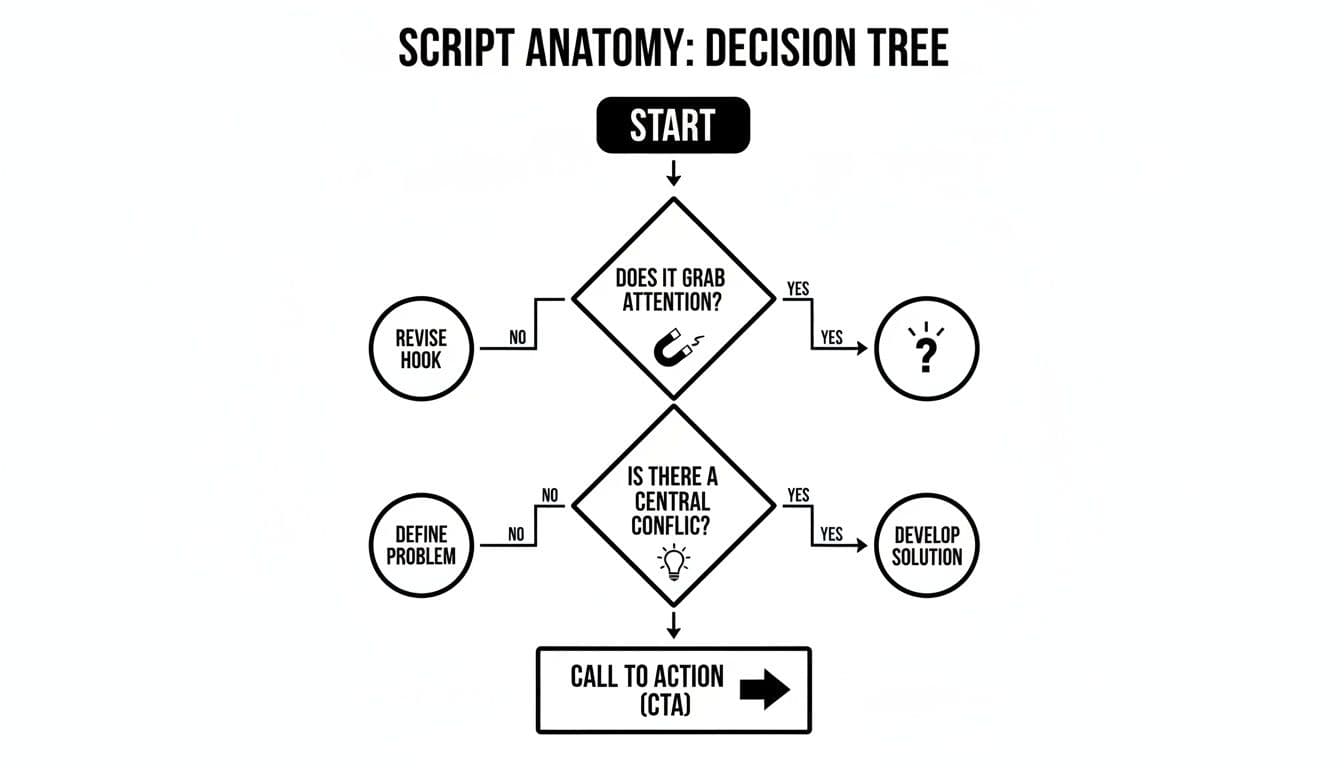
No matter the length, this fundamental journey is what works: grab attention, poke at a pain point, present your fix, and tell them what to do next.
Crafting the Ultra-Short 6-Second Script
Six seconds. It feels like nothing, but these "bumper" ads can be brutally effective if you know how to use them. There's zero time for a story. You have to land a single, powerful idea.
The formula is dead simple: Brand + Key Message + CTA Hint. The goal here is pure brand recall, planting one simple thought in the viewer's head.
- Example (Coffee Brand):
- Visual: A quick shot of a person looking exhausted, then instantly wide-eyed and energized after one sip of coffee.
- Voiceover: "Tired of tired? Get WakeUp Brew."
- On-screen text: Brand logo + "Available Everywhere."
The script is just four words, but it nails the problem (being tired), the solution (our coffee), and implies how to get it. That's it. Job done.
Winning with the 15-30 Second Sweet Spot
This is your workhorse. It's the most common ad length for a reason, hitting the sweet spot for platforms like Instagram, Facebook, and YouTube. Here you've got just enough breathing room to follow the classic "Hook, Problem, Solution, CTA" model without making it feel rushed. It's all about the pacing.
In this format, your first three seconds are everything. They must present the hook and hint at the problem immediately. The rest of the ad serves to prove your initial claim and give viewers a clear next step.
Let's break this down for a made-up project management app called TaskFlow:
- (0-3 seconds) Hook/Problem: "Stop letting deadlines sneak up on you." (Visual: A calendar with red "OVERDUE" alerts flashing).
- (4-10 seconds) Agitate Problem: "Chaotic projects, missed updates, and stressed-out teams. Sound familiar?" (Visual: Quick cuts of frustrated people at their desks).
- (11-20 seconds) Solution/Benefit: "Meet TaskFlow. It organizes everything in one place, so your team is always in sync and you’re always ahead." (Visual: Clean, satisfying shots of the app's user interface).
- (21-30 seconds) CTA: "Stop the chaos. Click 'Learn More' to start your free trial and get your projects back on track today." (Visual: A clear shot of the app logo with a button).
This structure flows naturally, guiding the viewer logically from their own pain point straight to your solution.
Ready to create video ads?
Turn your photos into scroll-stopping ads in minutes. No video editing skills required.
Try For FreeBuilding a Narrative in 60-90 Second Ads
With a full minute or more, you have the luxury of telling an actual story. This format is perfect for more complex products, brand-building campaigns, or testimonial-driven ads where making an emotional connection is the whole point.
Instead of just stating the problem, you can show it through a character's journey. This allows you to build a much deeper, more emotionally resonant case for your product.
This shift toward short-form, platform-specific video isn't random. Ad budgets are pouring out of traditional TV and straight into digital video, where these concise scripts are king. Projections show that overall ad spend will grow at a 6.1% compound annual rate through 2029, with digital formats gobbling up most of that growth. For brands today, the battlefield is a feed full of 6–30 second ads where success is decided by how fast your script lands its punch. You can discover more insights about this trillion-dollar shift and what it means for modern marketers.
Adapting Your Script for Vertical Video Platforms
TikTok, Instagram Reels, and YouTube Shorts play by their own rules. Your script has to feel native to the platform—not like a slick TV commercial that was awkwardly cropped and dropped into the feed.
Keep these platform-specific tweaks in mind:
- Talk like a person: Write your script like you're explaining something to a friend. Use "you" and "I," and ditch the corporate jargon.
- Use trends (carefully): If a specific sound or meme format is taking over, you can build a script around it for instant relevance. Just make sure it actually fits your brand's voice.
- Show, don't just tell: These platforms are incredibly visual. Your script should be a blueprint for dynamic, fast-paced shots, often with text overlays repeating or highlighting the key spoken points.
- Start with the punchline: Many of the most successful vertical video ads lead with the most satisfying or dramatic part of the story (the "after" shot) and then rewind to explain how they got there. This flips the traditional structure on its head to hook fast-scrolling users immediately.
Alright, you've got the fundamentals of a killer script locked in. Now, let's talk about putting technology to work so you can move faster and smarter.
Trying to manually write, test, and tweak every single script idea is a soul-crushing grind. It’s slow and eats up resources. This is where modern AI tools completely change the game, letting you jump from a basic product idea straight to a finished video ad in minutes.
This isn’t about outsourcing your creativity to robots; it’s about giving it a massive boost. Instead of getting stuck staring at a blank page, you can generate dozens of solid hooks, benefit-driven lines, and calls-to-action almost instantly. That frees you up to focus on the high-level strategy—honing the core message, picking the perfect visuals, and making sure the final cut is flawless.
This shift to AI-assisted creative work is happening fast. With digital advertising projected to make up roughly 75% of global spend by 2025, the pressure is on to produce way more content, way more quickly. The big players like Meta and Alphabet, which already pull in a staggering 56.1% of global ad revenue, are pouring money into AI-driven tools that automate script generation and testing on a massive scale. This new reality heavily favors tools that can turn a rough idea into a finished ad in minutes, not days. If you want to dig deeper into how global ad spend is pushing creative automation, check out this insightful WARC Media report.
From Raw Idea to Finished Script in Seconds
The first move in this new workflow is getting an AI to generate the script's foundation. Forget guessing what might land with your audience. You can feed an AI scriptwriter a few key details and get back multiple, fully-formed script options built around proven advertising formulas.
With a platform like Proom AI, the process is dead simple. You start by just describing your product and who you're trying to reach. The AI script generator takes it from there, building out a complete narrative.
And it's not just a big block of text. You get a properly structured script, broken down into the key parts we’ve already covered:
- Scroll-Stopping Hooks: A handful of different options designed to grab attention in the first three seconds.
- Benefit-Driven Body: Language that zeroes in on the real-world transformation your product delivers.
- Clear Calls-to-Action: Direct, punchy instructions that tell the viewer exactly what to do next.
This lets you mix and match different elements, A/B testing combinations to see what clicks with your audience—all without writing every single version from scratch.
Turning Your Script into a Cohesive Video Ad
Once you have a script you’re happy with, it's time to bring it to life with visuals. Traditionally, this is the most expensive and time-consuming part of the whole deal. You'd be coordinating a shoot, hunting for B-roll, or sifting through stock footage—and that's all before you even think about opening an editing app.
AI-powered video creation tools collapse that entire process into a few clicks. In Proom AI, for instance, you can take your new script and instantly pair it with an industry-specific video template.
From there, you just upload your own product shots or video clips. The AI analyzes your script's timing and your media, then automatically stitches them together into a polished, cohesive video. It’s smart enough to place visuals that match the narrative, making sure what people see on screen reinforces what they’re hearing.
Pro Tip: When you upload your images, give the AI some options. Include close-ups, wide shots, and lifestyle photos showing your product in action. This gives it more creative room to build a dynamic and visually engaging ad.
Fine-Tuning Your Ad with AI Presenters and Voices
The last layer of polish is adding that human element. You can pick from a library of AI presenters to be the face of your brand, which adds a relatable and trustworthy touch to your ad. These digital actors can deliver your script in different languages and tones, making it incredibly easy to create localized ad versions for different markets.
You can then dial in the details even further:
- Voice Options: Choose the perfect voiceover from a range of styles that fits your brand’s personality.
- Custom Captions: Tweak the on-screen text to highlight key phrases or add extra context.
- Music and Branding: Slap on your logo and select some background music to tie it all together.
What once took a production team, a studio, and a suite of expensive software can now be done in your browser in less time than it takes to brew a pot of coffee. For a deeper look into getting the most out of these tools, learning the basics of AI prompts engineering is a great next step. This workflow isn't some far-off concept anymore; it's a practical, powerful way for any business to create a high-performing script for advertising and turn it into a compelling video ad in an instant.
Field-Tested Script Templates You Can Adapt and Use Today
Knowing the theory behind a great script for advertising is one thing, but getting your hands dirty is where the real learning begins. To help you jump right into creating, we’ve built out a library of proven templates you can grab, tweak, and put to work immediately.
These aren't just generic outlines. They're fully-fleshed-out scripts built for specific marketing goals, complete with placeholders, timing cues, and little notes on the strategy behind each line. The idea is to show you why these structures work so you can feel confident making them your own—especially when you’re plugging them into a tool like Proom AI to bring the visuals to life.
Template 1: The E-Commerce Direct-Response Ad
This script is a pure conversion machine. It’s designed for a quick 30-second spot on a platform like Instagram or Facebook, where its only job is to get someone to smash that "Shop Now" button by hitting a pain point and offering an immediate solution.
- Goal: Drive immediate sales for a specific product.
- Product Example: "Zenith" noise-canceling headphones.
| Time (Seconds) | Visual Cue | Voiceover / On-Screen Text |
|---|---|---|
| 0-3 | Extreme close-up of a person looking annoyed in a loud, chaotic coffee shop. | VO: "Can't hear yourself think?" |
| 4-8 | The person puts on the Zenith headphones. The background noise instantly muffles and fades to silence. A look of relief washes over their face. | VO: "The world is loud. Your focus shouldn't be." |
| 9-15 | Quick, satisfying cuts showing the product in different scenarios: on a busy train, in an open office, at home with noisy neighbors. | VO: "Meet Zenith. The noise-canceling headphones that give you back your peace." |
| 16-22 | A shot highlighting a key feature, like the plush earcups or a simple tap control. Text overlay appears. | Text: "Crystal-Clear Audio. 24-Hour Battery." |
| 23-30 | The product is displayed cleanly against a solid background with a clear call-to-action button animating on screen. | VO: "Silence the chaos. Get your Zenith headphones today and enjoy 25% off your first order. Click 'Shop Now'!" |
Why It Works: This is a textbook example of the Hook-Problem-Solution-CTA formula. It opens with a universal frustration, positions the product as the hero, shows its benefits in relatable situations, and lands the punch with a strong, time-sensitive offer that makes clicking a no-brainer.
Template 2: The Local Service Brand Awareness Ad
For a local business—think landscapers or roofers—the goal isn't always a direct sale. It's about building trust and becoming the first name people think of. This 45-second script is built to establish authority and forge an emotional bond with local homeowners.
- Goal: Build brand recognition and trust in a specific town or city.
- Business Example: "GreenScape" premium landscaping services.
| Time (Seconds) | Visual Cue | Voiceover / On-Screen Text |
|---|---|---|
| 0-5 | A beautiful, cinematic slow-motion shot of a stunning backyard: a perfect lawn, vibrant flowerbeds, a cozy patio. | VO: "Your home is more than just a house. It's your sanctuary." |
| 6-15 | Quick cuts showing the "before"—an overgrown, messy yard. A homeowner looks at it with a sigh of frustration. | VO: "But keeping it that way can feel like a full-time job. The weeding, the mowing, the constant upkeep..." |
| 16-28 | The GreenScape team is shown working professionally—uniforms, clean trucks, smiling faces. They are meticulously caring for the property. | VO: "At GreenScape, we believe you should spend your weekends enjoying your yard, not working on it." |
| 29-38 | A beautiful "after" shot of the same homeowner relaxing with family in their newly perfected backyard. They look happy and peaceful. | VO: "From design to maintenance, we handle every detail so you can just live." |
| 39-45 | The company logo appears over the final beautiful shot. Contact information and service area are clearly displayed. | VO: "GreenScape Landscaping. Serving the [Your City] area. Visit our website to schedule your free consultation." |
Why It Works: This script completely avoids a hard sell. Instead, it focuses on the emotional payoff—peace, relaxation, and more time with family. By showing the transformation from stressed to serene, it positions GreenScape not as a lawn service, but as a partner in creating a better lifestyle.
The most powerful brand awareness ads sell an emotion first and a service second. They connect your brand to a feeling your target audience craves.
Template 3: The Creative Professional Portfolio Ad
If you're a freelance photographer, designer, or artist, your ad needs to be a direct reflection of your style and skill. This snappy 20-second script for Instagram Reels or TikTok is designed to be visually arresting and funnel viewers straight to your portfolio.
-
Goal: Showcase your best work and drive traffic to your portfolio site.
-
Professional Example: A portrait photographer.
-
(0-2 seconds) The Hook: A lightning-fast montage of your absolute best portraits, cut perfectly to a trending, upbeat audio track. It has to be impossible to look away from.
-
(3-8 seconds) The Work: The montage continues but slows just a fraction, allowing a few of your strongest images to linger. Punchy text overlays appear: "Bold," "Timeless," "Authentic."
-
(9-14 seconds) The Artist: A quick, candid shot of you in your element—smiling behind the camera or interacting with a client. This builds an instant personal connection and shows you're a real person.
-
(15-20 seconds) The CTA: The screen lands on your logo or professional name with a crystal-clear instruction. The music dips slightly, making the text the star. On-Screen Text: "Your story, beautifully told. See my portfolio. Link in bio."
Why It Works: In a creative field, you have to show, not tell. This script makes your work the main character. It's fast, energetic, and built for the short-form video world where aesthetics and personality rule. It establishes your credibility in seconds and points interested people to the one place they can see more and hire you.
For even more inspiration, feel free to browse our collection of sample commercial scripts, which covers a wider range of industries and ad formats.
Frequently Asked Questions About Advertising Scripts
Even with the best frameworks in your back pocket, you’ll always hit a few specific questions when the time comes to actually write. The details are what separate an ad that gets skipped from one that drives real, measurable results.
Let's dig into some of the most common hurdles marketers and founders face when scripting their next video ad.
How Long Should My Ad Script Be?
Honestly? It depends entirely on the platform and your end goal. There's no magic number. The key is to match your script's length to the viewer's mindset in that specific environment.
-
6-15 Seconds (TikTok, Reels, YouTube Shorts/Bumpers): Your script needs to be a laser beam. Think one powerful hook, one core benefit, and one unforgettable visual. The mission here is lightning-fast brand recall, not a deep, winding story.
-
30-60 Seconds (Instagram/Facebook Feed, YouTube Pre-Roll): This is the sweet spot for that classic problem-solution arc. You have just enough runway to hook the viewer, really twist the knife on a pain point, introduce your product as the hero, and drop a crystal-clear call-to-action without overstaying your welcome.
-
90+ Seconds (YouTube In-Stream, Landing Pages): Save the long-form stuff for when you need to build serious trust. This is where you roll out customer testimonials, in-depth product demos, or complex brand stories. You're earning the viewer's time and emotional investment before you even think about asking for the sale.
How Do I Write for a Niche Audience?
This isn't about overhauling the script's structure—it's about changing its soul. You need to swap out generic language for the specific dialect of your audience. Generic scripts don't just get ignored; they get resented.
To really connect, you have to immerse yourself in their world. Go hang out where they hang out online. Read the same forums, follow their trusted influencers, and listen—really listen—to the exact jargon, pain points, and inside jokes they use. A script for a die-hard PC gamer should feel completely different from one for a sleep-deprived new parent, even if you’re selling the same energy drink.
The best ad scripts don't feel like ads at all. They feel like a smart recommendation from someone who's already in the club—someone who genuinely gets it.
What Is the Best Way to Test My Scripts?
Never, ever assume your first draft is "the one." Relentless testing is what separates the amateurs from the pros who consistently boost their conversion rates. The trick is to only test one variable at a time so you know exactly what moved the needle.
Here’s a simple framework to get you rolling:
- Start with the Hook. Write three completely different opening lines for your script, but keep everything else identical. The first three seconds make or break your ad, so finding a winning hook delivers the biggest bang for your buck.
- Then, Test the Offer. Once you’ve crowned a champion hook, try running it with two different calls-to-action. Does "Get 20% Off Today" pull harder than "Start Your Free Trial"? The data will tell you.
- Analyze the Right Data. Views are a vanity metric. Zero in on your click-through rate (CTR) and, most importantly, your conversion rate. These numbers tell you if your script is actually convincing people to take action.
Ready to stop guessing and start creating video ads that actually convert? Proom AI transforms your ideas and images into professional, high-impact video ads in minutes. You can generate compelling scripts, upload your own visuals, and produce stunning creatives with our instant video ad platform.
Try Proom AI for free and see how easy it can be.
Frequently Asked Questions About Advertising Scripts
Here are some quick answers to the questions we hear most often from marketers looking to sharpen their video ad scripts and get better results.
| Question | Answer |
|---|---|
| What's the most important part of a script? | The first 3 seconds. Your hook is everything. If you don't grab attention immediately, the rest of your brilliant script doesn't matter because no one will see it. |
| Should I include my brand name in the first few seconds? | It depends. For brand awareness campaigns, yes—show and say the brand name early. For direct response, focus on the hook and the problem first; introduce the brand as the solution. |
| How do I make my script sound authentic? | Write like you talk. Read your script out loud. If it sounds robotic or like a corporate memo, rewrite it. Use contractions (like "you're" and "it's") and simple, direct language. |
| Is it better to use a professional voice actor or my own voice? | A professional voiceover adds polish, but a founder's voice can build trust and authenticity, especially for smaller brands. Test both to see what resonates with your audience. |
| How many CTAs should I have in one ad script? | Just one. Giving viewers multiple options creates decision paralysis. Pick your most important action (e.g., "Shop Now" or "Learn More") and make it the single, clear focus of your ad. |
Hopefully, these answers clear up some of the common sticking points in the scriptwriting process. The main takeaway? Always write for a specific person on a specific platform, and never stop testing.
Ready to create video ads?
Turn your photos into scroll-stopping ads in minutes. No video editing skills required.
Try For Free