Write a Script for an Advertisement That Truly Converts
Write a script for advertisement that sells: Proven structure for hooks, body & CTAs. AI tools, timing tips & platform optimization for 2026 →
Before you even think about writing a single line of dialogue, the best ad scripts start by answering two simple but critical questions: Who are we actually talking to? and What do we want them to do?
Getting this right is what separates an ad that drives real results from one that just gets skipped.
The Foundation of a High-Converting Ad Script

It’s tempting to jump straight into brainstorming creative ideas, but the scripts that consistently perform are built on a solid strategic foundation first. This isn’t about flashy concepts; it’s about precision.
That means starting with two non-negotiables: a sharp, detailed audience persona and a single, measurable objective. These two elements will guide every single choice you make, from the opening hook to the final call-to-action. Nail these, and the script practically writes itself.
Define Your Ideal Customer Persona
You can't write a script that connects if you don't know who's on the other side of the screen. A detailed customer persona is your compass for tone, language, and the emotional triggers you need to pull. You have to go way deeper than basic demographics.
So, instead of a vague target like "women, ages 25-40," build a real profile:
- Pain Points: What’s the biggest daily frustration your product actually solves for them? Be specific.
- Aspirations: What are their goals? What does a "win" look like in their world?
- Language: How do they talk? Do they use industry jargon, casual slang, or something in between?
- Media Habits: Where do they hang out online? Are they scrolling TikTok, reading LinkedIn articles, or binge-watching YouTube?
A script for a B2B software targeting a CTO will need a professional, data-heavy tone. On the flip side, an e-commerce script for a fashion brand targeting Gen Z has to be casual, on-trend, and visually fast. Knowing the difference stops you from making a generic ad that speaks to no one.
A huge part of this is testing what resonates. For example, if you're running short-form video ads, you need to know how to use A/B testing for YouTube Shorts to systematically figure out which hooks and messages actually land with your audience.
Set a Single Campaign Objective
An ad that tries to do everything will accomplish nothing. Your script needs to be laser-focused on one primary goal.
Are you trying to drive immediate sales, or are you building brand awareness for a launch down the road? That choice completely changes the DNA of your script.
An unfocused script leads to a confused viewer. A confused viewer never clicks. Your goal isn't just to be seen; it's to inspire a specific, desired action.
Let's look at how the objective changes the game. This table breaks down how different goals should shape your script's hook, core message, and CTA.
How Advertising Goals Shape Your Script
| Objective | Hook Focus | Core Message | CTA Style |
|---|---|---|---|
| Direct Response | Problem & Solution | Focus on urgent benefits, discounts, and scarcity. | Strong & Direct (e.g., "Shop Now," "Sign Up Free") |
| Brand Awareness | Emotion & Story | Tell a memorable story about the brand's values or mission. | Soft & Inviting (e.g., "Learn More," "Follow Our Journey") |
| Lead Generation | Value & Exclusivity | Offer a high-value freebie (guide, webinar, checklist). | Gated & Clear (e.g., "Download Your Guide," "Get a Free Quote") |
| Engagement | Question & Community | Ask a question or invite users to share their experience. | Participatory (e.g., "Comment Below," "Share Your Story") |
As you can see, the objective dictates everything. You wouldn't use a "Shop Now" CTA on an ad designed purely for brand storytelling—it would feel jarring and out of place. This strategic clarity is more important than ever.
The shift to video-first marketing has only amplified this. With global digital video ad spend projected to hit US$214.8 billion in 2025, every second of your script has to earn its keep across countless platforms—from vertical mobile feeds to connected TV.
In this world, a well-structured script isn't just a creative asset; it's a financial lever. A clear hook in the first three seconds, benefit-driven proof under 20 seconds, and a direct CTA are what directly influence your media efficiency and ROI.
Crafting a Hook That Stops the Scroll
You’ve got about three seconds. Maybe less.
In the time it takes for a thumb to twitch and swipe, your ad needs to land a punch. That first moment—the hook—isn't just the opening line. In the world of infinite scrolling, it is the entire ad.
If the hook fails, the rest of your perfectly crafted script is just dead weight. The pressure on those first few words has never been higher, especially as short-form video has taken over. With 91% of businesses now using video in their marketing, you're not just fighting for attention; you're fighting for a split-second of it.
Your goal isn't to be loud or shocking for the sake of it. It’s to forge an instant connection that makes the viewer feel seen, understood, or just plain curious.
The Four Pillars of an Unskippable Hook
A great hook isn't born from magic; it's a bit of applied psychology. The most effective ones almost always fall into one of four categories, each tapping into a different human driver. Picking the right one depends entirely on who you’re talking to and what you’re selling.
-
The Relatable Problem: Hit them with a pain point they know all too well. This builds immediate rapport. A meal-kit service could open with, "Tired of the daily 'What's for dinner?' panic?" It’s a universal frustration that instantly qualifies your audience.
-
The Bold Promise: Forget the buildup and lead with the ultimate result. A productivity app might grab attention with, "Get back five hours in your work week, starting today." You’re selling the destination, not the journey.
-
The Surprising Statistic: Jolt them out of their passive scrolling with a number that makes them lean in. A fintech app could hook users with, "Did you know that 78% of people overspend their budget and don't even realize it?" It creates instant authority and a sense of urgency.
-
The Piquing Question: Pose a question that their brain is wired to answer. A travel company might ask, "Is this the most underrated city in all of Europe?" Curiosity is a powerful force that keeps people watching.
Feeling stuck? Sometimes the best ideas come from a little outside help. You can brainstorm dozens of options in seconds with our free ad hook generator to get the creative juices flowing.
Adapting Your Hook for Different Platforms
The best hooks feel like they belong where you see them. An opener that kills it on LinkedIn will get scrolled past in a heartbeat on TikTok. You have to respect the user's mindset on each platform.
-
TikTok & Instagram Reels: These platforms are all about speed and authenticity. Your hook needs to feel like it’s part of a conversation, not an ad. Think direct-to-camera, fast cuts, and big text overlays. Something like, "You've been styling your hair all wrong," delivered casually, fits right in.
-
YouTube (Pre-roll/Shorts): People are on YouTube with a purpose, so your ad is an interruption. A bold promise or a surprising statistic works wonders here to stop that "Skip Ad" click. For example, "This one tool automates 90% of your reporting."
-
Facebook & LinkedIn: You have a little more breathing room here for context. Hooks can be slightly more narrative. A B2B ad on LinkedIn could easily start with, "Our sales team was spending half their day on admin, until we found this."
The key is to match the energy of the platform. Don't show up to a beach party in a tuxedo. Your hook is your first impression—make sure it fits in to stand out.
Ultimately, finding the perfect hook is a game of testing and learning. What resonates with one audience segment might fall flat with another. Start with these proven formulas, tailor them to the platform, and watch your retention metrics like a hawk. The data will always tell you when you’ve found the words that truly stop the scroll.
A good hook buys you a few seconds. A great story holds that attention long enough to make a sale.
Once you’ve successfully stopped the scroll, the real work begins. You need to guide the viewer from that initial flicker of curiosity to a confident click. This is where classic storytelling frameworks become your secret weapon. They aren't about boxing you in; they're about giving your creativity a proven roadmap that makes your solution feel like the only logical choice.
Think of it as the core flow of your script for an advertisement: grab their attention, highlight a problem they recognize, and then present a promise they can't ignore.
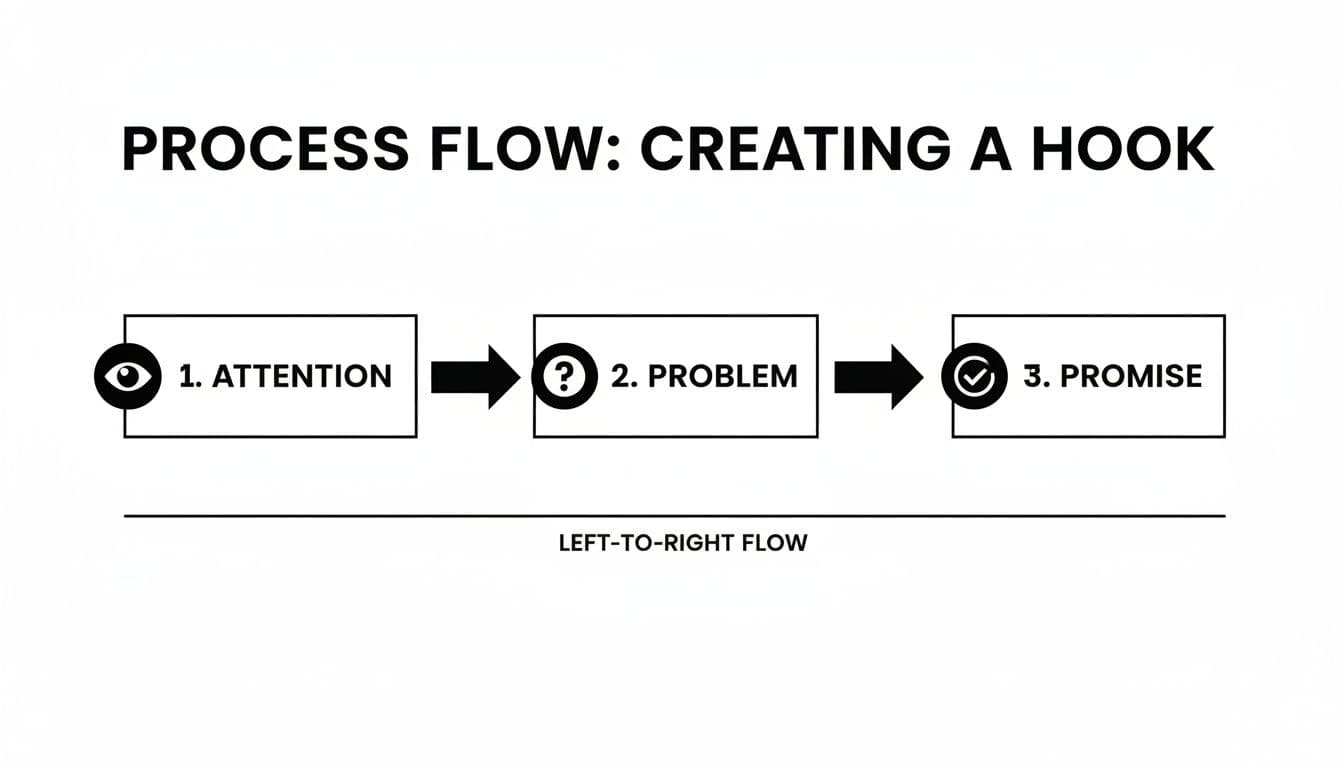
This simple journey is what turns a passive viewer into an interested prospect in just a handful of seconds.
Choosing Your Storytelling Framework
Two of the most battle-tested frameworks in advertising are Problem-Agitate-Solve (PAS) and Attention-Interest-Desire-Action (AIDA). They both work, but they shine in different situations.
The Problem-Agitate-Solve (PAS) Model
This framework is brutally effective, especially for products or services that solve a very specific, nagging problem. It's direct, it builds empathy, and it makes your product the hero of the story.
- Problem: Call out the exact pain point your audience deals with. Get specific.
- Agitate: Now, twist the knife a little. Don’t just mention the problem; describe the frustration, the wasted money, or the missed opportunities that come with it. Make it feel urgent.
- Solve: With the pain fresh in their mind, introduce your product as the clear, easy way out.
Imagine a script for a project management tool. It could start with the problem of messy spreadsheets, agitate with the chaos of missed deadlines, and then solve with a clean, all-in-one dashboard. It just works.
The Attention-Interest-Desire-Action (AIDA) Model
AIDA is your go-to when you're selling an aspiration or an emotional benefit. It's less about fixing a direct pain and more about creating a powerful want.
- Attention: Your hook. The surprising statistic or bold claim we talked about.
- Interest: You’ve got them listening. Now, keep them hooked with fascinating details or unique benefits.
- Desire: This is the pivot from "that's interesting" to "I need that." Show them the "after" state. Use testimonials and visuals to paint a picture of how their life will be better.
- Action: Tell them exactly what to do to get that feeling.
AIDA is perfect for lifestyle brands, new gadgets, or anything where the feeling is the real selling point. You're selling the destination, not just the vehicle.
Pacing Your Script for Different Ad Lengths
The framework you pick is only as good as its execution, and that means respecting the clock. A rambling 30-second story squeezed into a 6-second spot is a recipe for disaster. You have to be ruthless with your timing.
Getting the pacing right is crucial. Here’s a breakdown of how to map out your script for an advertisement across the most common ad lengths.
Ready to create video ads?
Turn your photos into scroll-stopping ads in minutes. No video editing skills required.
Try For FreeAd Script Pacing for Common Video Lengths
This table shows how to allocate your precious seconds to make sure your message lands, no matter the format.
| Timing (Seconds) | 6-Second Ad | 15-Second Ad | 30-Second Ad |
|---|---|---|---|
| 0-2s | Hook + Problem | Hook + Problem | Hook + Problem |
| 2-4s | Solution | Agitate + Solution Intro | Agitate Problem |
| 4-6s | CTA + Brand Logo | Main Benefit + CTA | Introduce Solution |
| 6-12s | N/A | Show Social Proof/Benefit | Explain 2-3 Key Benefits |
| 12-15s | N/A | Strong CTA + Brand | Build Desire (Show Results) |
| 15-25s | N/A | N/A | Social Proof/Testimonial |
| 25-30s | N/A | N/A | Final CTA + Brand Logo |
For a 6-second ad, there's no time for a slow burn. The problem and solution have to hit almost at the same time. Think: "Tired of endless invoicing? Get paid in minutes. Try PayUp." It’s a one-two punch.
A 15-second ad gives you a bit more breathing room. You can spend a couple of seconds making the problem feel real before you swoop in with the solution and its biggest benefit, right before the call to action.
With a 30-second ad, you can tell a more complete story. You have the luxury of agitating the problem properly, demonstrating a few key benefits, and even dropping in a quick customer quote to build trust before a strong final CTA.
Mastering this rhythm is what separates ads that get skipped from ads that get clicked.
A great hook and story arc will grab attention, but it’s the voice and tone that actually build a connection. The best ad scripts feel real, like they come from a brand that just gets its audience. Nail this, and your ad won’t just be seen—it will be felt.
This is where we move beyond what you’re saying to how you’re saying it. A script for a luxury car brand can't sound like one for a fast-food chain. That difference comes down to two things that work together but aren't the same: your voice and your tone.
Uncovering Your Brand’s Core Voice
Think of your brand voice as its permanent personality. It’s the consistent character that shows up everywhere, from your ads to your emails. Is your brand a knowledgeable expert? A witty friend? A caring mentor? A rebellious innovator?
Your voice shouldn't change from ad to ad; it’s the foundation. If you haven't defined it, your ads will feel scattered and confusing.
Here's a quick exercise I use with clients to pin this down. Try describing your brand using only three to five adjectives.
- Are you bold, playful, and energetic?
- Or maybe you’re calm, reassuring, and authoritative?
- Perhaps you're innovative, sleek, and aspirational?
Jot them down. This little list becomes your north star for every word you write, making sure every script sounds like it comes from the same brand.
Adapting Your Tone for Audience and Platform
If voice is your personality, then tone is your mood in a specific situation. You only have one personality, but your mood changes all the time. You wouldn't use the same tone at a funeral that you use at a birthday party, and the same logic applies to your ads.
Your tone has to shift based on the platform you're on and what your audience is feeling in that moment.
An ad’s tone has to match its environment. A stuffy, corporate script on TikTok feels just as jarring as a meme-filled, casual script on LinkedIn. The goal is to blend in just enough to stand out for the right reasons.
Think about the culture of each platform:
- TikTok/Instagram Reels: The vibe here is usually casual, fast, funny, or trend-driven. Your script needs to feel like it belongs there, almost like something a user would post themselves.
- LinkedIn/B2B Ads: Here, the tone gets more professional, authoritative, and data-focused. The script needs to project expertise and build trust in seconds.
- YouTube/Facebook: These platforms give you more room for storytelling. Your tone can be more emotional, inspirational, or educational, depending on what you’re trying to achieve.
For instance, a skincare brand’s voice might be "scientific and trustworthy." On Instagram, their tone could be "light and helpful" for a quick tutorial. On their website, it might shift to "in-depth and clinical" to explain the science. Same voice, different tones.
Making Your Dialogue Sound Human
Okay, you've got your voice and you've picked your tone. The last piece is writing dialogue that doesn't sound like it was written by a robot. Stiff, overly formal language is an instant killer.
Here are a few tricks I swear by to keep scripts sounding natural:
- Read It Out Loud: This is the most important test. Seriously. If it feels weird or clunky coming out of your mouth, it's going to sound even worse to an audience.
- Use Contractions: Real people say "don't," "can't," and "it's." Sprinkling these into your script instantly makes it more conversational.
- Break Grammar Rules (A Little): Starting a sentence with "And" or "But"? Totally fine in a script. Write like people talk, not like you're turning in a term paper.
This is also where modern tech can be a huge help. Using an AI voiceover tool, you can instantly test-drive different tones and inflections. Generate a voice that's energetic and upbeat or one that's calm and reassuring. This lets you match the audio perfectly to the script’s emotional arc, ensuring the final ad feels right from start to finish.
Writing a Call to Action That Actually Works

You’ve grabbed their attention with a killer hook and told a story that connects. So far, so good. But now comes the moment of truth in any ad script: asking for the click. Your Call to Action (CTA) is the pivot point where a passive viewer becomes an active customer.
Get this wrong, and everything you did before it was for nothing. A weak, vague, or high-effort CTA creates just enough hesitation to lose the sale. Your job is to make the next step feel like the most natural, obvious, and easiest choice they can possibly make.
It’s time to move beyond lazy phrases like "Click Here" and start thinking about the psychology of what makes someone act. A great CTA isn’t just a command; it's a clear, compelling promise of what they get by clicking.
From Vague Commands to Specific Promises
The single biggest mistake I see in ad scripts is an unclear CTA. Your audience needs to know exactly what will happen when they click that button. Ambiguity is the absolute enemy of conversion.
Instead of a generic prompt, you need to deliver clarity and value. The best CTAs instantly answer two questions bubbling up in the viewer's mind: "What's in it for me?" and "What do I have to do?"
- Vague: "Learn More"
- Specific: "Download Your Free Guide"
The second one is infinitely more powerful. Why? Because it offers a tangible outcome. You aren't just learning; you're getting something valuable. This simple shift from a passive verb to an active, benefit-focused one can have a massive impact on your ad's performance.
The Three Types of High-Converting CTAs
Most of the truly effective CTAs I've tested fall into one of three psychological buckets. Picking the right one all comes down to your campaign goal and where your viewer is, emotionally, at the end of your ad.
1. The Direct Command
This is your no-nonsense, straight-to-the-point approach. It’s clear, concise, and works best when the viewer's intent is already high and the offer is simple. Think e-commerce and direct-response campaigns where the goal is immediate action.
- Shop Now
- Get a Quote
- Book Your Spot
- Subscribe Today
The power here is in its simplicity. There’s zero guesswork. This is the CTA you use when you want to close the deal, right now.
2. The Benefit-Driven Prompt
This CTA flips the script, focusing on the value the user will receive. It’s less about telling them what to do and more about reminding them of the awesome thing they're about to get. It’s a perfect fit for lead generation, free trials, or anything where you need to reinforce the value proposition one last time.
- Start Your Free Trial
- Get Instant Access
- Claim Your 20% Discount
- Unlock Exclusive Content
See how each one leads with the prize? You're not just "signing up"—you're starting something valuable for free.
3. The Urgency Trigger
This one taps directly into the fear of missing out (FOMO). By introducing scarcity—either through a limited time or limited quantity—you push people to act now instead of putting it off for "later."
- Shop the Flash Sale
- Offer Ends Tonight
- Get It Before It's Gone
- Claim Your Spot (Only 3 Left)
This tactic is incredibly effective, but you have to use it honestly. Faking scarcity is a quick way to kill brand trust if people catch on.
Your CTA is the final instruction. It must be so clear and compelling that it feels like the only logical conclusion to the story you’ve just told. Don't leave any room for interpretation.
Struggling to nail the perfect phrase? A powerful CTA generator can be a great brainstorming partner, helping you explore different angles—from direct commands to benefit-driven prompts—to find the one that fits your ad perfectly.
Ultimately, crafting a winning CTA for your advertisement script is all about removing friction. It needs to be clear, specific, and perfectly aligned with what motivated your viewer in the first place. Make it easy for them to say "yes," and your conversion rates will thank you for it.
How to Use AI for Faster Scriptwriting
That blinking cursor on a blank page can feel like the biggest hurdle in making a great script for an advertisement. The good news? You don't have to start from a dead stop anymore. The right AI tools can be an incredible creative partner, helping you brainstorm, draft, and sharpen your ideas in a fraction of the time.
Think of it less as outsourcing your creativity and more as jump-starting it. Instead of wrestling with writer's block, you can fire off a simple prompt and get back dozens of hooks, story angles, and calls to action. It's about rapidly exploring angles you might have missed on your own.
Prompting AI for Script Ideas
The secret to getting genuinely useful ideas from an AI is to give it a solid, specific brief. If you just ask it to "write an ad script," you're going to get something bland and generic. A strong prompt, on the other hand, is packed with the core elements of your strategy.
When you're working with an AI scriptwriter, make sure to feed it these details:
- Your Target Audience: Who, specifically, are you talking to? (e.g., "busy working moms," "B2B tech managers").
- The Main Pain Point: What problem are you solving for them? (e.g., "it takes too long to cook dinner," "manual data entry is a nightmare").
- Your Key Benefit: What's the number one positive outcome they'll get? (e.g., "cook healthy meals in just 15 minutes," "put your workflow on autopilot").
- Desired Tone: How should the ad feel? (e.g., "upbeat and energetic," "professional and trustworthy").
Giving the AI this strategic foundation is like handing it a compass. It ensures the script variations it generates are already aligned with your campaign goals right out of the gate.
If you want to go deeper into how this works, it's worth understanding what AI copywriting entails.
From Script to Screen with AI Tools
This is where things get really efficient. Platforms like Proom AI build these scriptwriting capabilities directly into their video creation workflow, closing the gap between the written word and the final video.
As you can see, Proom AI’s interface lets you take your images and a freshly generated script and turn them into a polished video ad without ever leaving the platform. This combination of AI scriptwriting and automated video creation means you can produce a complete ad in minutes. You can learn more about how to make AI videos that truly resonate.
This kind of integrated approach shatters the old technical barriers, letting you test more creative concepts faster than ever before.
Got Questions? We've Got Answers.
When you're deep in the weeds of scripting a new ad, a few common questions always seem to pop up. Knowing the right ad length, the biggest pitfalls to sidestep, and how to approach different platforms can be the difference between a flop and a runaway success.
Let's clear up some of the most frequent queries we hear from fellow marketers and creators.
How Long Should a Script for a Social Media Video Ad Be?
For the blink-and-you'll-miss-it world of TikTok, Instagram Reels, and YouTube Shorts, you need to think short and sharp. Aim for a script that clocks in between 15 and 30 seconds. In terms of word count, that's roughly 40 to 75 words spoken at a comfortable, natural pace.
The most important part? You have to land your hook and introduce the core problem-solution in the first 3-5 seconds. There's absolutely no time for a slow, cinematic buildup here. Get straight to the point, or you’ll get scrolled.
What Is the Biggest Mistake to Avoid in an Ad Script?
Hands down, the most common mistake is getting lost in product features instead of shouting about customer benefits. Your audience doesn't really care what your product is; they care about what it can do for them.
Always build your script around the outcome. Are you solving a nagging problem? Fulfilling a deep desire? Making their life even a little bit easier? A script that leads with the benefit makes an emotional connection. A script that lists features just gets tuned out.
Sell the "after" state, not the "how."
Can I Use the Same Ad Script for Different Platforms?
While your core message can stay the same, you absolutely should not use the exact same script everywhere. A one-size-fits-all approach is a recipe for wasted ad spend because the audience mindset and platform culture are completely different.
Think of it this way:
- TikTok: The script needs to feel native and casual. It should lean into trending audio and use fast, energetic cuts.
- Facebook: You’ve got a little more breathing room here for a slightly longer, more story-driven script that can build a bit more connection.
- LinkedIn: The tone shifts completely. It needs to be professional, authoritative, and laser-focused on bottom-line business value.
The best move is to treat your main script as a blueprint, then create tailored variations that feel right for each platform's unique vibe.
Ready to turn your ideas into high-performing video ads in minutes? With Proom AI, you can generate compelling scripts and transform your photos into professional videos effortlessly. Stop waiting and start creating. Try Proom AI for free today!
Ready to create video ads?
Turn your photos into scroll-stopping ads in minutes. No video editing skills required.
Try For Free