Social Media For Architects: Build Your Brand (2026)
Social media for architects: Win 3X more projects in 90 days. Platform strategy, content templates & client-attraction workflow that works →
For architects, social media has moved far beyond being a "nice to have." It's now a core business development tool. Think of it as the engine that turns a static, passive portfolio into a living, breathing channel for attracting clients, building your brand, and even recruiting top talent. It’s where you get to tell the story behind your designs, connect with a real community, and build undeniable credibility in a very crowded market.
Why Social Media Is A Must-Have For Today's Architecture Firms
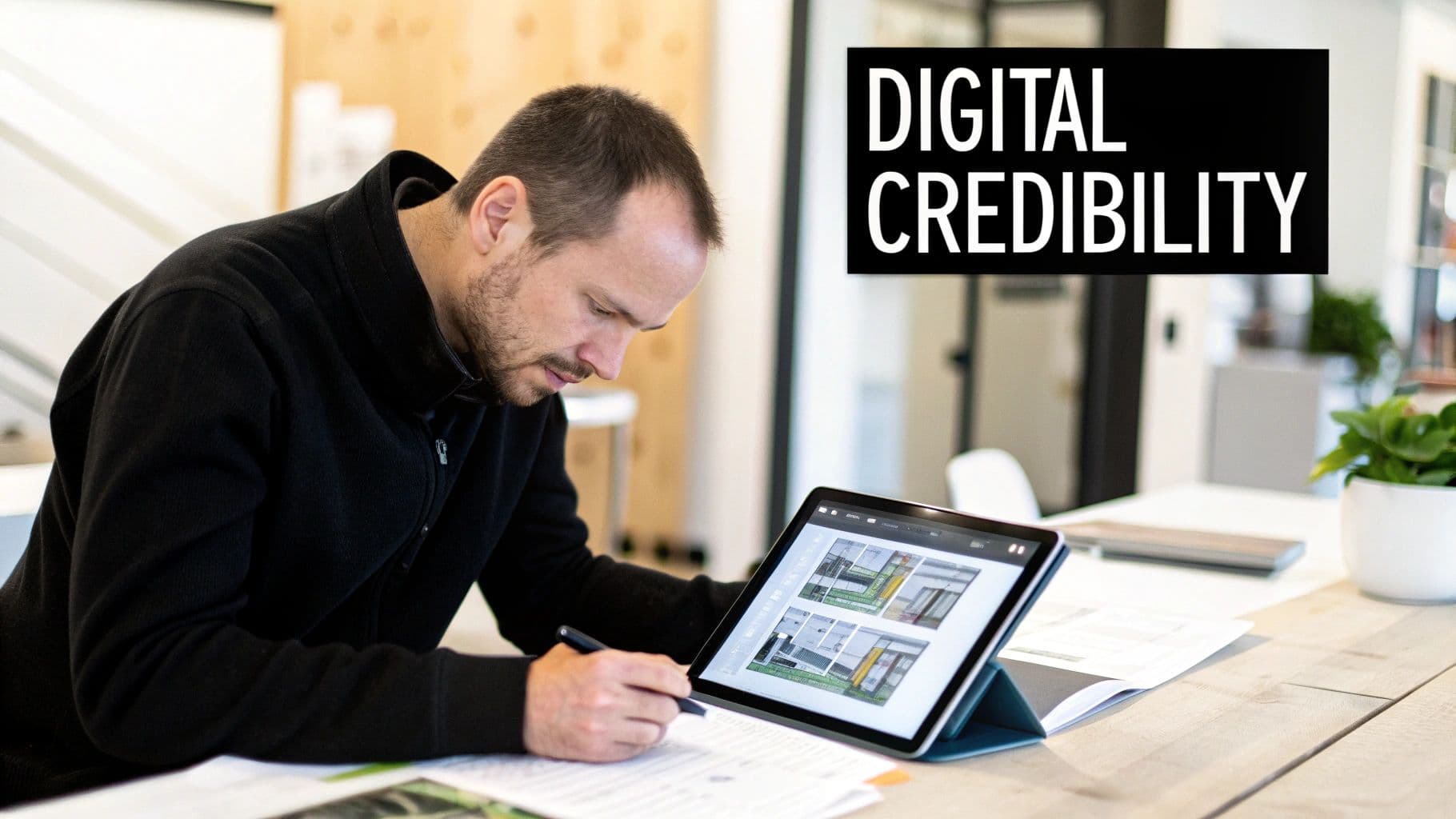
The days of relying purely on a slick website and word-of-mouth are over. Let's be honest, today's clients—whether they're homeowners planning their dream remodel or commercial developers scouting for their next big project—start their journey online. They aren't just looking for a gallery of finished projects. They're digging deeper, searching for proof of expertise, a clear design philosophy, and a firm they can actually connect with and trust.
This move toward digital validation means your online presence is no longer just a line item. It's the space where you transition from being just another name on a list to a recognized authority with a distinct voice and vision.
More Than Just a Digital Portfolio
A thoughtfully managed social media feed does so much more than just show off your finished work. It's your stage for telling the entire architectural story, from the very first napkin sketch to the final, breathtaking walkthrough. That storytelling is what transforms a passive portfolio into an active, lead-generating asset.
Think about the possibilities here:
- Showcase the Process: Give people a peek behind the curtain. Share quick clips of hand-drawn sketches, photos of material palettes, or time-lapses of 3D modeling. This builds excitement and shows off the immense skill that goes into your work.
- Build a Real Community: Don't just post—engage. Answer questions in the comments, connect with fellow designers, and share content from others in the industry. This builds a loyal audience that feels genuinely invested in your firm's journey.
- Attract the Best Talent: Let's face it, a vibrant, active social feed screams "forward-thinking firm." It instantly makes you a more attractive place to work for the next generation of architects and designers.
The numbers don't lie. The entire practice of architecture has hit a digital tipping point. A staggering 99% of architects now use the internet for their professional work. This isn't a trend; it's a fundamental shift in how professionals operate and how clients find them.
A Powerful New Way to Win Clients
At the end of the day, it's about growing the business. Social media gives you a direct line to do just that, creating a natural funnel that guides potential clients from initial discovery all the way to a formal inquiry.
By using compelling visuals—especially video—you can demonstrate your value long before you ever sit down for a first meeting. Our guide on video marketing for small businesses dives deeper into turning those visuals into tangible leads.
For architects, social media isn't just marketing; it's context. It's the place you prove not just what you build, but how and why you build it—creating a connection that a static image on a website simply can't match.
Choosing The Right Platforms For Your Architectural Practice

Let's get one thing straight: trying to be everywhere on social media is a surefire way to burn out. The goal isn't to plant a flag on every platform. It's to find the one or two places where your ideal clients hang out and where your work can really shine. A scattered approach just waters down your message and wastes time you should be spending on design.
It’s no longer a niche strategy, either. The industry has caught on, with around 66.7% of architectural firms now active on social media. They know that’s where clients are looking for—and vetting—professionals. With nearly a quarter of firms using these channels for direct business promotion, picking the right platform isn't just a marketing task; it's a critical business decision. If you want to dive deeper into the numbers, you can read the full industry analysis on beedier.com.
Aligning Platforms With Your Firm's Goals
Before you jump in, ask yourself: what’s the main objective here? Are you trying to land high-end residential clients? Connect with commercial developers? Or are you aiming to build a reputation as an industry thought leader? Your goal is your compass.
-
For a Residential Focus: Instagram and Pinterest are your best friends. They are visual discovery engines where homeowners go for inspiration. This makes them the perfect spot to showcase finished projects, material palettes, and jaw-dropping before-and-afters.
-
For Commercial and B2B: LinkedIn is the undisputed heavyweight champion. It's the digital boardroom where you connect with developers, contractors, and other industry players. Use it for sharing detailed case studies, insights on design innovation, and news about your firm's big moves.
-
For Brand Building and Storytelling: Instagram really shines here with its mix of Reels, Stories, and Carousels. It's where you can pull back the curtain and share behind-the-scenes looks at your process, introduce your team, and post mesmerizing project fly-throughs.
The best social media strategy for architects isn't about collecting the most followers across the most platforms. It’s about building a concentrated, engaged audience on the one or two channels that best reflect your work and attract your ideal client.
Social Media Platform Comparison For Architects
To help you make an informed decision, let's break down the top contenders from an architect’s point of view. Each platform has its own personality and purpose, and knowing the difference is what separates a frustrating social media effort from a successful one.
| Platform | Best For | Primary Audience | Key Content Formats | Strategic Goal |
|---|---|---|---|---|
| Visually-driven storytelling and portfolio showcases | Design enthusiasts, potential residential clients, and younger professionals | High-quality photos, short-form video (Reels), multi-image carousels, and Stories | Build brand awareness and attract residential leads. | |
| Inspiration and long-term project planning | Individuals actively planning projects (home builds, renovations) | Vertical images, infographics, and visual guides that link back to your website | Drive website traffic and capture leads in the planning phase. | |
| Professional networking and establishing industry authority | Commercial developers, corporate clients, potential employees, and industry peers | In-depth project case studies, articles, company updates, and professional insights | Generate B2B leads and establish credibility. | |
| Houzz | Direct lead generation for residential projects | Homeowners and renovators actively looking to hire professionals | Detailed project portfolios with tags, client reviews, and direct messaging features | Convert active project seekers into clients. |
The right mix is all about your firm's unique identity. A boutique practice focused on sustainable homes will find a natural home on Instagram and Pinterest. A larger firm chasing corporate work needs to make LinkedIn its priority. Don't be afraid to start small. Master one platform, build momentum, and then expand thoughtfully.
Crafting Content That Showcases Your Design Philosophy
Your social media feed is so much more than a gallery of finished projects. Think of it as the living story of your firm’s unique design philosophy. This is your chance to move beyond static portfolio shots and start telling a compelling narrative that pulls in your ideal clients. The right content doesn't just show what you build—it reveals how you think and why your approach is special.
Of course, getting that story heard means cutting through a lot of noise. The global social media user base rocketed past 4.9 billion people in 2023, and with the market projected to hit $300 billion by 2026, the digital space is more crowded than ever. To stand out, architects need to create content that genuinely connects. You can dive deeper into this growing digital environment at reelmind.ai.
Moving Beyond the Final Photo
Those stunning final project images are non-negotiable, but they only tell the last chapter of a long story. To truly hook an audience and build a narrative around your work, you need to pull back the curtain and show them the journey.
Here are a few content formats that nail this storytelling aspect:
- Project Carousels: Use Instagram’s carousel feature to walk followers through a project from concept to completion. Start with the final hero shot, then let them swipe through to see initial sketches, 3D renderings, material palettes, and even construction details. This format is brilliant for showing the immense thought and effort that goes into the finished product.
- Before-and-After Reveals: A timeless classic for a reason. This format is incredibly powerful for renovation or adaptive reuse projects. A simple side-by-side post or a quick video transition showing the transformation can easily become one of your most engaging pieces of content.
- Behind-the-Scenes Glimpses: People connect with people. Share photos of your team collaborating in the studio, a site visit in progress, or a close-up of a unique material you’re excited about. It humanizes your firm and builds a real connection with your audience.
Embracing the Power of Video
Let’s be clear: video is no longer optional. It’s a core component of a winning social media strategy for architects. It brings a dynamic, immersive quality to your work that a static image just can’t replicate.
Don't assume this requires a massive production budget. Simple, well-executed videos can have a huge impact. A short Reel showing a project fly-through created from a 3D model can stop scrollers dead in their tracks. A time-lapse of a complex construction detail coming together beautifully illustrates your firm's expertise.
Tools with pre-designed templates make this incredibly efficient. For instance, you can explore a variety of interior design video templates to see just how easy it is to turn your existing project photos into cinematic clips that feel high-end.
A well-crafted project video does more than just showcase a space; it allows a potential client to emotionally inhabit it. That’s a powerful tool for turning a follower into a lead.
Ready to create video ads?
Turn your photos into scroll-stopping ads in minutes. No video editing skills required.
Try For FreeWriting Captions and Using Hashtags Strategically
Your visuals grab the attention, but your captions and hashtags make sure your message lands with the right people. A great caption should add context and communicate your design intent. Don't just describe the photo; explain the "why" behind your design choices.
To maximize your reach, develop a tiered hashtag strategy that covers all your bases:
- Broad Industry Hashtags: These are high-volume tags that get your content into general feeds (e.g.,
#architecture,#design,#archilovers). Aim for 3-5 of these. - Niche-Specific Hashtags: Get more focused to attract a qualified audience (e.g.,
#sustainablearchitecture,#residentialdesign,#modernhousedesign). Use 5-7 of these. - Location-Based Hashtags: These are absolutely crucial for attracting local clients (e.g.,
#austinarchitects,#californiamodern,#newyorkdesign). Stick to 2-3. - Branded Hashtags: Create a unique tag for your firm or a specific project. This builds a searchable archive of your work (e.g.,
#YourFirmNameDesigns,#ProjectNameHouse).
By combining these content formats and strategic elements, you create a repeatable framework. This system ensures every single post reinforces your design philosophy, showcases your expertise, and works hard to attract the clients you actually want.
Building A Sustainable Social Media Workflow For Your Firm
A brilliant social media strategy means nothing if your team is too buried in project work to actually execute it. For a busy architecture practice, the biggest hurdle isn't a lack of incredible project content—it's the absence of a sustainable workflow. The real goal is to build a system that makes consistency feel natural, not like another deadline you’re chasing.
The key is to move from reactive, last-minute posting to a proactive, structured approach. This means no more scrambling for an image and a caption five minutes before you feel you should post. Instead, you can build a simple, repeatable process that plugs right into your firm’s existing operations, turning social media into a manageable task instead of a constant source of stress.
Batching Content And Scheduling Ahead
By far, the most effective way to maintain a steady presence is through content batching. It’s simple: you dedicate a single block of time—say, two or three hours every other week—to prepare a bunch of posts at once. In that one session, you can write all the captions, pick the visuals, and sort out the hashtags for a dozen posts, easily covering your content for the next two weeks.
Once everything is ready, you load it all into a scheduling tool. Platforms like Later, Buffer, or Hootsuite let you set the exact dates and times for your posts to go live automatically. This frees up your team's mental space to focus on what really matters—design work, client meetings, and project management—while your social media presence runs like clockwork in the background.
A sustainable workflow isn't about posting more; it's about making the process of posting smarter and more efficient. Batching transforms social media from a daily chore into a scheduled, strategic task.
This infographic breaks down the simple flow of turning your existing project assets into a pipeline of social media content.
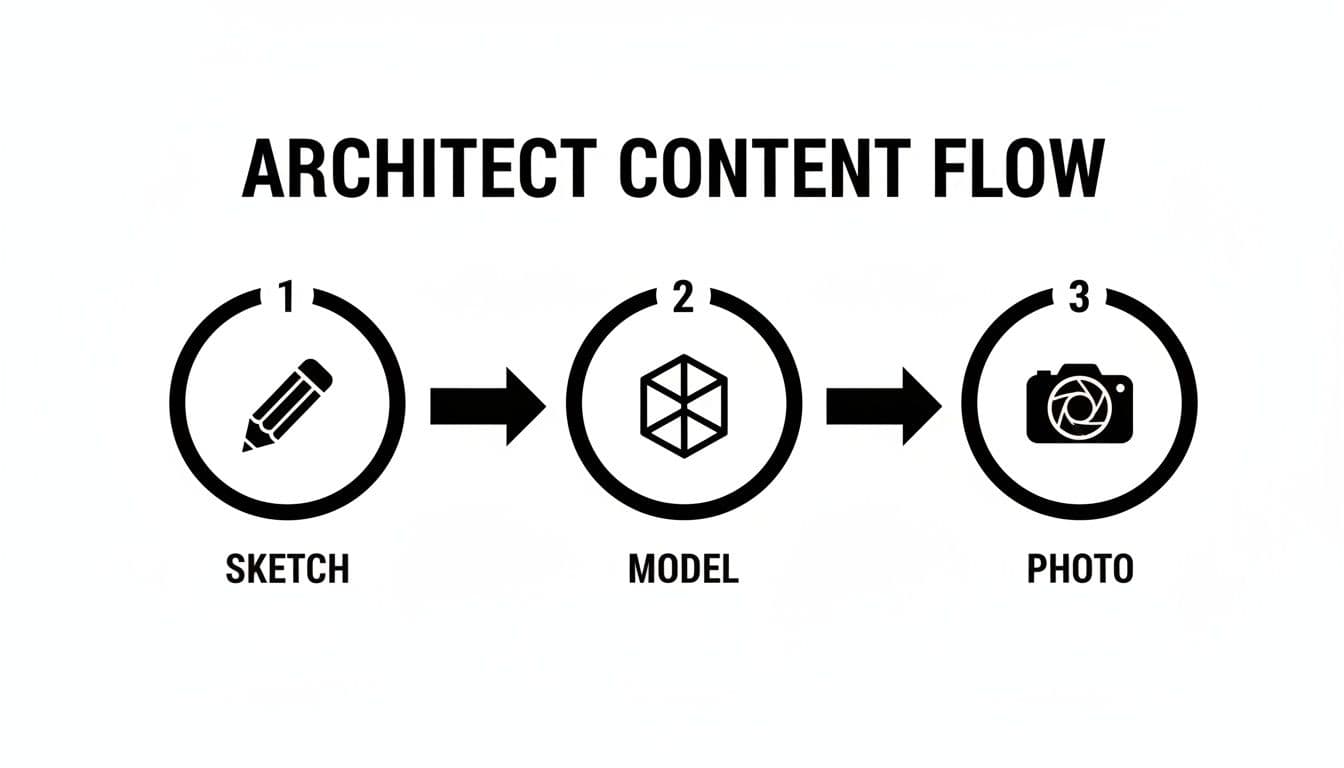
It’s a great reminder that every stage of your design process, from the first napkin sketch to 3D models and final photography, is a goldmine for creating engaging social media posts.
A Sample Posting Cadence For Architects
Remember, consistency beats frequency every time. A steady rhythm of high-quality posts is way more effective than a frantic, erratic burst of activity. For most architecture firms, aiming for 3-4 posts per week on your main platform is a powerful and, more importantly, achievable goal.
Here’s a simple weekly schedule to get you rolling:
- Monday: Project Spotlight. Showcase a finished project with a stunning hero shot or a carousel that walks through the design journey.
- Wednesday: Behind-the-Scenes. Give a glimpse into studio life, a site visit, a beautiful material palette, or a team member’s contribution. This is what humanizes your firm.
- Friday: Educational or Inspirational Post. Share a quick design tip, a video fly-through of a 3D model, or an architectural detail that inspires your team. Crafting a compelling opening line for these is crucial, and you can get quick ideas using an AI-powered hook generator tool for social media to grab attention right away.
This cadence gives you a healthy mix of portfolio-building content, brand storytelling, and value-driven posts. It keeps your audience engaged and shows off the depth of your firm’s expertise without demanding an overwhelming amount of new content creation each week.
How To Measure Your Social Media Success
Putting beautiful content out there is a huge part of the job, but it's really only half the battle. If you aren’t keeping an eye on performance, you’re basically designing without a blueprint—investing time and effort without knowing if the structure will stand.
The goal here is to get past the surface-level vanity metrics. Things like likes and follower counts feel good, but they don't tell you if your social media efforts are actually bringing in business. They're nice to have, but they don't pay the bills.
What you really need to track are the actions that signal genuine client interest. These are the numbers that prove your content is not just being seen, but is compelling potential clients to take that next, crucial step.
Focus on these key performance indicators (KPIs) to get a real sense of your impact:
- Website Clicks: How many people are leaving Instagram or LinkedIn to check out your firm’s website? This is a huge sign of high intent.
- Direct Messages (DMs): Are potential clients sliding into your DMs to ask about your services, process, or availability? This is a direct line to a new lead.
- Profile Visits: A jump in profile visits means your posts are intriguing enough to make people want to learn more about who you are.
- Saves and Shares: When someone saves or shares your work, they're bookmarking you for later or recommending you to their network. It positions your firm as a valuable, go-to resource.
Getting into the Data
Every major platform has its own built-in analytics dashboard—Instagram Insights, LinkedIn Analytics, you name it. These tools are your best friend for figuring out what’s actually working.
Don't just give them a quick glance. Dive in and look for the patterns. For instance, you might discover that your quick video fly-throughs are generating twice as many website clicks as your polished, static project photos. That’s an incredibly valuable piece of information.
This data shows you exactly which formats are driving meaningful engagement. If a post detailing your material selection process gets an unusual number of saves, that’s a loud and clear signal from your audience: "We want more of this!"
Measuring social media success isn't about chasing the biggest numbers. It's about figuring out which numbers directly connect to your business goals, like generating qualified leads and building real brand authority.
Your Monthly Check-In
You don't need a complicated system. Just set aside a little time once a month to do a simple review. Pull up your key metrics and ask yourself three simple questions:
- What Worked? Pinpoint your top-performing posts based on the KPIs that matter (clicks, DMs, saves). What do they have in common? Was it the project style, the format, the caption?
- What Didn’t? Which posts fell flat? Be honest about what didn't connect. Maybe the image was too abstract, or the caption didn't spark a conversation.
- What Will We Do Differently? Based on your answers, decide on one or two small, data-backed tweaks to your strategy for the next month.
This simple, iterative loop—measure, analyze, and refine—is what transforms a hopeful social media presence into a predictable, lead-generating machine for your architecture firm.
Got Questions? We’ve Got Answers.
Jumping into social media can feel like learning a new language, especially when you're used to the world of blueprints and client meetings. It’s natural to have questions. The good news is that the core principles you already live by—showcasing expertise and building relationships—are exactly what work here, too.
Let's tackle some of the most common hurdles and questions we hear from architecture firms just like yours.
"How Much Time Does This Actually Take For a Small Firm?"
Look, you don't have a dedicated marketing department. We get it. For a small firm, the goal is consistency, not volume. You can make a real impact with just 3-5 hours a week.
The trick is to be smart about it. Don't let social media be a constant distraction that pulls you away from billable work. Instead, block out a single 2-3 hour session once a week. Use that time to plan your posts, write your captions, and schedule everything. Then, all you need is 15-20 minutes a day to check in, reply to comments, and engage with others. That’s it. It’s a system that works without taking over your life.
"How Do I Show Our Process Without Giving Away a Project?"
This is a big one. You want to build trust by showing your work, but you can't just post final photos of a confidential project. The secret is to zoom in on the craft and the story, not the full reveal.
Focus on teasing compelling details that highlight your expertise and create a sense of anticipation. Think about sharing things like:
- A close-up shot of a beautiful hand sketch exploring a tricky design problem.
- A flat lay of a material palette you're developing for a new project.
- Short video clips of a 3D model fly-through, focusing on just one interesting moment or space.
- A time-lapse of a complex joint being assembled on site.
This approach frames you as a creative, thoughtful problem-solver. You’re sharing the journey and the thinking behind the design, which builds immense value without ever compromising client confidentiality or spoiling the big reveal.
Can social media really land high-value clients? Yes, but maybe not in the way you think. While you might get the occasional direct message, its real power is in building brand authority and staying on your ideal client's radar.
Think of it this way: high-value clients and developers absolutely use social media for due diligence. When they're vetting firms, a professional, insightful, and active presence validates your credibility long before they ever pick up the phone. It's the modern-day portfolio that proves you're the real deal, making that first call a much easier decision for them.
Ready to turn your project photos into videos that actually stop the scroll? With Proom AI, you can create cinematic fly-throughs, mood boards, and project showcases that tell your design story in minutes, not hours.
Ready to create video ads?
Turn your photos into scroll-stopping ads in minutes. No video editing skills required.
Try For Free