What Makes a Video Viral The Ultimate Marketer's Guide
What makes a video viral: Psychology + platform algorithms decoded. 7 patterns found in 1,000+ viral hits. Storytelling formulas you can copy →
Viral videos aren't just happy accidents; they're engineered. The real secret to what makes a video viral is a potent mix of strong emotional triggers, a hook that grabs you in the first three seconds, and content so relatable that hitting the share button feels like a reflex.
The Blueprint of a Viral Video
Going viral might feel like catching lightning in a bottle, but it’s far more science than luck. Forget the idea of a random lottery ticket. Think of it more like a recipe, where each ingredient is carefully chosen to create something people feel an undeniable urge to watch, engage with, and—most critically—share.
This guide pulls back the curtain on virality, turning it from a mysterious fluke into an achievable marketing goal. We're going to break down the core pillars of viral content, giving you a repeatable blueprint for success. This framework will help you understand the "why" behind every single share, like, and comment.
The Core Components of Virality
At its heart, a viral video connects with us on a human level. It's not about the flashiest editing or the biggest budget; it's about mastering the elements that make us tick. The most successful content consistently nails three key areas:
- Emotional Resonance: The video has to make the viewer feel something. It could be joy, surprise, awe, or even a bit of righteous anger. The emotion just has to be strong.
- An Unskippable Hook: In a world of infinite scrolling, those first three seconds are everything. A powerful hook snags attention immediately and gives people a compelling reason to stick around.
- Deep Relatability: The content needs to mirror a shared experience, a common thought, or a universal problem. It makes viewers think, "That's so me," creating an instant impulse to share it with friends who will get it, too.
This next diagram shows exactly how these three pillars work together to form the foundation of any viral hit.
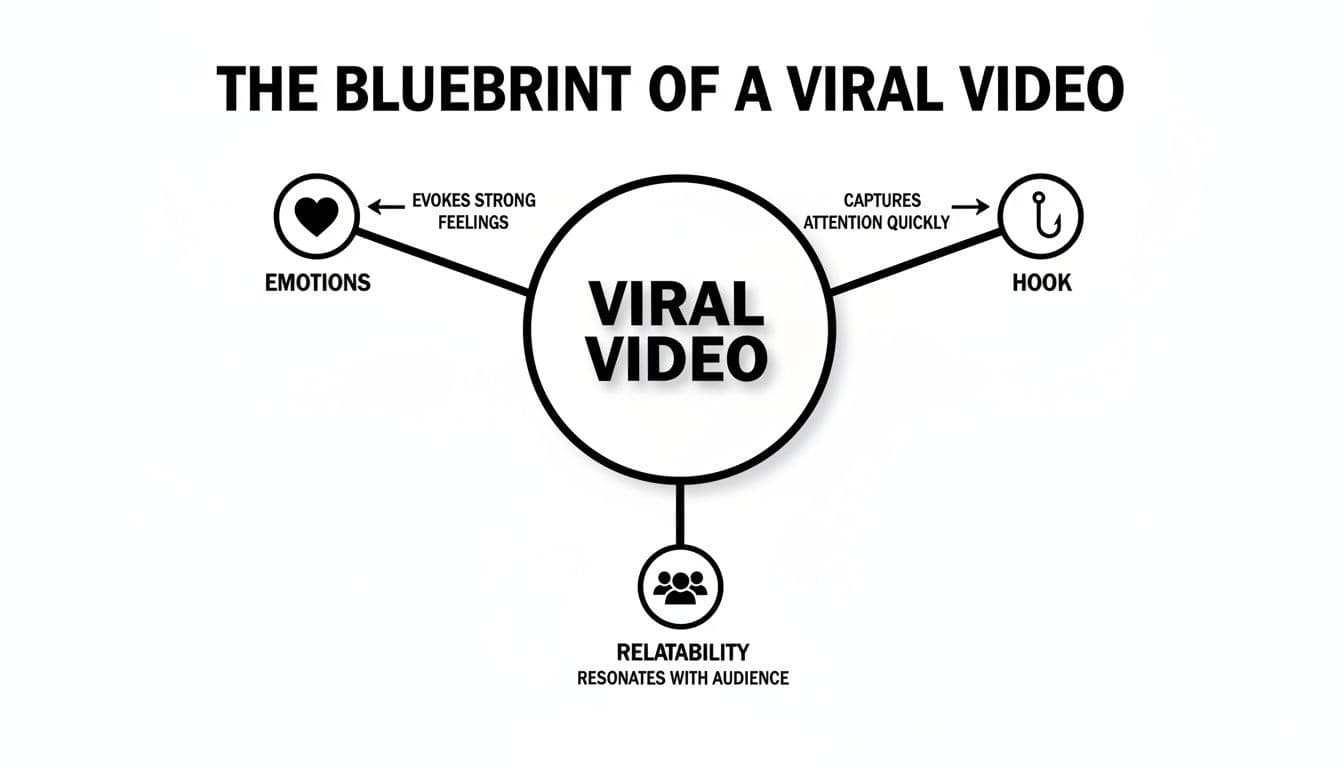
As you can see, virality isn’t about a single magic ingredient. It's born from the powerful intersection of emotion, a killer hook, and genuine relatability. Mastering this trio is your first big step. For a deeper dive into these principles, check out this excellent a creator's guide on what makes a YouTube video go viral.
A truly viral video isn't just watched; it gets adopted. Viewers see a piece of themselves in it and share it as a form of self-expression.
Knowing these concepts is one thing, but actually putting them into practice is what drives results. This is where tools like Proom AI can bridge the gap between theory and execution, helping you create emotionally resonant video ads that are primed for sharing. For instance, once you've crafted your video, you'll need a powerful prompt to drive action. Using an effective CTA generator can help you write compelling calls-to-action that encourage the likes, comments, and shares needed to fuel the viral engine.
The Psychology Behind Why We Share
Ever wondered what makes someone stop dead in their scroll, watch a video, and feel an immediate, almost physical urge to hit 'share'? It’s not just about liking what they see. The answer is rooted deep in human psychology, where sharing becomes less of a choice and more of a social instinct.
At its heart, sharing is about connection and identity. When we share a video, we’re using it as a shorthand to say something about ourselves. It’s a way to broadcast our sense of humor, signal our intelligence, or show solidarity with a cause, all without typing a single word. The video becomes a proxy for our own voice.
But to trigger that instinct, you need to tap into the right emotions. Not just any feeling will do.
The Power of High-Arousal Emotions
Think of emotions on a spectrum of energy. On one end, you have passive feelings like contentment. They’re pleasant, but they don’t exactly make you jump out of your chair. On the other end, you have high-arousal emotions—the kind that create a jolt of energy and demand an outlet.
These intense feelings are the rocket fuel for viral content. They include:
- Awe and Wonder: Videos that make us feel small in the face of something vast and beautiful—think stunning drone shots of a mountain range or a mind-bending display of human talent.
- Intense Joy and Hilarity: Laughter is contagious and deeply communal. Sharing a genuinely hilarious clip is like giving someone the gift of a good laugh, forging an instant positive bond.
- Surprise and Intrigue: Our brains are wired to pay attention to the unexpected. A video with a clever twist or a shocking reveal makes us want to see our friends react to it, too.
- Righteous Anger or Inspiration: Content that shines a light on injustice or tells a powerful comeback story creates a strong feeling of “we’re in this together.” Sharing becomes an act of solidarity.
Leaning into these emotions is non-negotiable. It’s why a surprising or funny video can explode overnight. Videos are already shared twice as often as other content types, but adding a peak emotional moment can drive 1200% more shares than text and images combined. You can dig into more video engagement stats to see just how critical emotion is.
To help you get tactical, here’s a breakdown of the key emotional triggers and how they work.
Key Emotional Triggers and Their Viral Potential
This table breaks down the most powerful emotions for video content and explains why they drive shares, providing a framework for strategic emotional targeting.
| Emotion | Psychological Driver | Why It Drives Shares | Example Application |
|---|---|---|---|
| Awe / Wonder | Self-transcendence; feeling part of something bigger. | People share to spread that feeling of amazement and wonder. It makes the sharer seem profound and in touch with beauty. | A time-lapse of a flower blooming, cinematic drone footage of a landmark, or a stunning architectural rendering. |
| Joy / Hilarity | Social bonding; the desire to share positive experiences. | Laughter is a universal connector. Sharing a funny video is a low-effort way to make someone's day and strengthen a social tie. | A clever prank, a relatable comedy sketch, or an animal doing something absurdly human-like. |
| Surprise / Intrigue | Novelty seeking; the brain's reward for new information. | We want others to experience the same "Aha!" or "WTF?" moment we did. It makes the sharer seem like they're in-the-know. | A magic trick with an unexpected reveal, a product demo with a surprising feature, or a shocking plot twist in a short story. |
| Inspiration / Hope | Self-improvement; seeing the potential for good. | These stories activate our desire for a better world. Sharing is a way to spread positivity and align with uplifting values. | An underdog success story, someone overcoming a disability, or a community coming together to solve a problem. |
| Anger / Outrage | Injustice sensitivity; the drive to correct wrongs. | Sharing becomes a call to action or a way to signal group identity. It validates the sharer's moral compass and recruits allies. | Exposing a scam, highlighting an unfair policy, or a video showing a clear social injustice. |
By strategically choosing which emotion to target, you can create a video that doesn't just entertain but also provides a powerful psychological reason for viewers to pass it on.
Earning Social Currency Through Sharing
Beyond raw emotion, there's another powerful driver at play: social currency.
Think of it as a way to boost your reputation. When we share something online, we’re subconsciously asking, "What does this say about me?" We share things that make us look good.
Sharing a clever, funny, or insightful video positions us as someone who is smart, has great taste, or is connected to the zeitgeist. The video is a tool we use to build our personal brand within our social circles.
This plays out in a few ways:
- Being First: Discovering and sharing something cool before it goes mainstream makes the sharer look like a trendsetter.
- Insider Knowledge: Sharing a niche meme or an inside joke strengthens bonds within a specific community, signaling "I'm one of you."
- Appearing Smart or Funny: Forwarding a hilarious sketch is like saying, "This is my sense of humor." Sharing a fascinating explainer says, "I'm interested in smart things."
Key Takeaway: People don't just share content; they share what the content says about them. Your video has to give them a way to express their identity, intelligence, or humor to their friends.
For marketers, this insight is gold. When you're creating a video ad, the crucial question isn't just "Will people like this?" but "Why would someone stake their reputation on this?" Will sharing it make them look smart, funny, or compassionate?
With a tool like Proom AI, you can bake these emotional triggers right into your video from the start. You can amplify joy with an energetic music track, build awe with a cinematic template and a dramatic voiceover, or create intrigue with a well-paced reveal. By focusing on the why behind the share, you can create something that people don’t just watch—they feel compelled to own it by passing it on.
Mastering The Irresistible Three-Second Hook
In the world of infinite scrolling, your video doesn’t get minutes to make an impression—it has seconds. The battle for a viewer's attention is won or lost right at the start. A powerful three-second hook is the single biggest factor that separates a video that gets swiped away from one that captivates an audience and has a real shot at going viral.
Think of your hook as a pattern interrupt. The average person's thumb is in constant motion, trained to flick past anything that doesn't immediately demand attention. Your job is to shatter that hypnotic rhythm. You need an opening so compelling it physically forces them to pause. This isn't just about being loud or flashy; it's a strategic move that creates an immediate "information gap" the viewer feels a psychological itch to close.
Proven Hook Formulas That Stop The Scroll
Crafting a killer hook isn't about reinventing the wheel. Decades of advertising and storytelling have given us several formulas that just plain work. If you understand these frameworks, you can systematically build openings that grab people by the collar.
Here are three of the most effective hook strategies out there:
- The Provocative Question: Kick things off by asking something that challenges a common belief or just makes people intensely curious. A video that opens with, "You're probably cleaning your kitchen all wrong," makes viewers instantly second-guess their own habits and stick around to see the right way.
- The Dramatic Transformation: This is the classic "before-and-after," but on steroids. Show the stunning final result first—the perfectly organized closet, the gorgeous renovated room, the incredible fitness transformation. This move immediately proves the video's value and makes people desperate to learn how you did it.
- The Pattern Interrupt: This hook uses something completely unexpected—a weird sound, a jarring visual cut, or a strange statement—to jolt the viewer out of their scrolling stupor. It could be an unusual noise, a clip that starts mid-sentence, or a visual that makes zero sense without context, forcing the brain to stop and figure it out.
A great hook makes a promise to the viewer: "If you give me a few more seconds of your time, I'll show you something surprising, valuable, or entertaining."
That initial promise is everything for audience retention. Once you've earned that split second of attention, you can smoothly transition into your core message. But without that initial buy-in, even the best content in the world will go completely unseen.
Deconstructing Viral Hooks: A Case Study
Let's break down a real-world example. Imagine a video ad for a cleaning product. A weak, predictable hook would be a slow pan over a dirty kitchen while a voiceover drones, "Is your kitchen a mess?" We've all seen it. We all ignore it.
Now, a viral-ready hook starts with a close-up shot of someone squeezing a perfect spiral of cleaning gel onto a grimy stovetop, complete with a satisfying sizzling sound. The text on screen is bold and direct: "This is the only way you should be cleaning burnt-on grease."
This opening works on so many levels. It’s visually appealing, the sound is satisfying (hello, ASMR), and it makes an authoritative claim that creates instant intrigue. The viewer immediately wants to see if the claim holds up and if the final result is as satisfying as the setup.
Ready to create video ads?
Turn your photos into scroll-stopping ads in minutes. No video editing skills required.
Try For FreeBuilding Your Hook with Proom AI
Coming up with these powerful openings used to be a draining creative exercise, but AI tools can now put that process on hyperdrive. The game today is about generating multiple compelling options fast so you can test what actually connects with your audience.
Proom AI is built for this. Its AI scriptwriter can help you brainstorm and sharpen your opening lines. For example, you can use the powerful AI video hook generator to spit out dozens of scroll-stopping questions or bold statements tailored directly to your product.
Better yet, its video templates are often structured around these proven formulas from the get-go. You can pick a "Dramatic Reveal" template to instantly create a high-impact transformation sequence. Just upload your "before" and "after" shots, and the platform handles the pacing and visual flair needed to make the hook land hard. It turns a complex creative task into a simple, repeatable workflow.
Crafting Stories That Feel Real and Relatable
Let's be honest: facts and figures are boring. They might inform someone, but they rarely get anyone to smash the share button. Stories, on the other hand, are magnetic. They build an instant connection.
When a viewer sees their own struggles, hopes, or weird little habits reflected in a video, sharing it becomes a way of saying, "This is me." That’s the real secret to virality—it has to feel relatable. We share things that say something about us, and a good story is the fastest way to forge that bond. Even a 30-second ad can turn a passive scroller into someone who feels truly seen.

The Classic Story Arc for Short-Form Video
You don't need a Hollywood-sized budget to tell a story that sticks. The oldest and most effective narrative structure can be squeezed into even the shortest videos. It’s a simple three-act arc that our brains are practically hardwired to love.
-
The Setup: This is the "before." You introduce a character and the problem they're facing. For an ad, this could be anything from a disastrously messy room to a frustrating daily annoyance.
-
The Conflict: Here’s where the struggle happens. The character tries to solve the problem. In a product video, this is the perfect moment to introduce your product as the hero that helps them tackle the challenge.
-
The Resolution: And finally, the satisfying "after." The problem is solved, and life is better. The room is spotless, the task is a breeze, and you deliver that sweet emotional payoff.
This simple formula transforms a boring product demo into a miniature adventure. It creates a feeling of progress and satisfaction that makes the video feel whole—and worth sharing.
A relatable video doesn't just show a product; it tells the story of a problem being solved. The product becomes the hero of a very short, very satisfying tale.
Why Raw and Authentic Wins
In a world saturated with glossy, overproduced ads, something interesting has happened: raw, unpolished, user-generated content (UGC) often blows them out of the water. But why?
Because it feels real.
When a video looks like it was shot on a phone by an actual person, it slips right past our internal "ad detector." It builds instant trust. This authentic vibe tells us the story is genuine, not some marketing gimmick. In fact, viewers are 58% more likely to find UGC more authentic than slick branded content, which leads directly to more trust and more shares.
Imagine a small business that makes custom furniture. A professionally shot video of the finished table is nice, but it screams "advertisement." Now, picture a time-lapse shot on a phone showing the entire messy process—the sanding, the assembly, the final coat of finish. That tells a story of craftsmanship and transformation. It feels authentic, and it's far more compelling.
Turning Images into Shareable Mini-Narratives
Here's the good news: you don't even need live-action footage to tell a fantastic story. A well-structured sequence of images can be incredibly powerful. A tool like Proom AI is specifically built to weave static photos into these kinds of compelling mini-stories.
Let's say you're a real estate agent. Instead of a boring slideshow of a renovated house, you can use Proom AI to build a narrative:
- Setup: Start with the "before" photos—the sad, run-down kitchen and dated bathroom.
- Conflict: Show images of the renovation in progress, with walls torn down and new fixtures being installed.
- Resolution: End with a cinematic reveal of the gorgeous, finished home.
By using an AI scriptwriter to nail the hook and craft a satisfying ending, you're no longer just showing a property. You're telling a transformation story. That narrative hook makes the content far more engaging, turning a simple tour into a journey viewers will actually want to share.
Choosing The Right Playground for Your Video
A brilliant video on the wrong platform is like telling a killer joke in a library. The content might be gold, but the context is all wrong.
Crafting a video with viral potential is only half the battle. Placing it in the right digital environment is what actually unlocks its reach. Think of each social media platform as its own unique playground with different rules, different audiences, and completely different expectations for what's "good."
A sprawling, cinematic video belongs on YouTube, just like a quick, punchy skit thrives on a comedy club stage. That same in-depth YouTube video will almost certainly bomb as a 30-second vertical clip on TikTok. Success comes from making your content feel native—like it was born and raised on the platform where it lives.
This means you have to adapt everything: your style, your video's length, and even its physical orientation to match what people expect to see in their feed. What goes viral on one app might get completely ignored on another.

Decoding Platform Algorithms and Expectations
Every platform's algorithm is a gatekeeper, and each one has a very distinct personality. If you want to get past the gate, you need to understand what that algorithm values most. A one-size-fits-all strategy is just a recipe for wasted effort and crickets.
Here's a quick look at what the major players are looking for:
- TikTok’s Algorithm Craves Watch Time: This platform is obsessed with keeping you scrolling. Its algorithm heavily favors videos that people watch all the way through—or even better, multiple times. Strong hooks and seamless loops are absolute magic here.
- Instagram’s Algorithm Values Engagement: Watch time is important, but Instagram’s algorithm gives huge weight to interactions like shares, saves, and comments. Content that makes someone DM it to a friend or save it for later gets a massive boost.
- YouTube’s Algorithm Rewards Session Time: YouTube wants to be a destination, not a drive-by. It prioritizes videos that not only hold your attention but also lead you to watch another video right after, keeping you on the platform for as long as possible.
Mastering the platform means learning to speak the algorithm's language. Give it the signals it's looking for—whether that's raw watch time, a flurry of shares, or a long viewing session—and it will reward you with the organic reach you're after.
Tailoring Your Content for Maximum Impact
Understanding the algorithms is step one. Step two is adapting your entire creative approach to fit the culture of each platform. This goes way beyond just changing the video dimensions; it gets into the very DNA of your content.
To give your video the best shot at going viral, you need to know the playground and have some fresh social media content ideas to drive engagement that feel completely at home there.
Here’s how to adapt your content to fit the vibe:
| Platform | Optimal Length | Orientation | Content Style and Vibe |
|---|---|---|---|
| TikTok | 7-15 seconds | Vertical (9:16) | Fast-paced, trend-driven, and authentic. Use trending sounds, jump on challenges, and keep the energy high. |
| Instagram Reels | 15-60 seconds | Vertical (9:16) | Visually polished and aesthetic. Focus on high-quality visuals, inspirational content, quick tutorials, and satisfying transformations. |
| YouTube Shorts | Under 60 seconds | Vertical (9:16) | Value-driven and educational. Use Shorts for quick tips, teasers for your long-form videos, or fascinating facts that leave viewers wanting more. |
| YouTube (Long-Form) | 8-15+ minutes | Horizontal (16:9) | In-depth, narrative-driven, and authoritative. This is the place for deep dives, comprehensive tutorials, and well-researched storytelling. |
When you respect these unwritten rules, your video feels less like an intrusive ad and more like a welcome part of the user's feed. That alignment is a huge piece of the virality puzzle.
How Proom AI Simplifies Platform Adaptation
Okay, so you need different versions of your video for every platform. Manually re-editing everything is a time-consuming nightmare. This is exactly where AI tools come in, letting you create platform-specific versions in a fraction of the time.
With a tool like Proom AI, this process becomes unbelievably efficient. You can just upload your core assets—your images and key message—and let the platform do the heavy lifting. Proom AI can instantly generate different cuts of your video tailored for each channel.
This means it can handle things like:
- Automatically formatting your video to the correct vertical or horizontal aspect ratio.
- Generating platform-specific captions and text overlays that match the tone.
- Suggesting hooks and scripts that align with the rapid-fire nature of TikTok or the storytelling style of YouTube.
This allows you to keep your brand message consistent while making sure your content feels perfectly native wherever you post it. It dramatically increases the odds of your video being picked up by the algorithm and shared by your audience.
Create Your Own Viral-Ready Video with Proom AI
Knowing what makes a video go viral is one thing. Actually making one is another beast entirely. This is where the theory hits the road. An intuitive tool like Proom AI is built to take all those complex strategies—the emotional triggers, the powerful hooks, the relatable stories—and bake them into a simple, repeatable workflow.
Let's walk through how you can build a shareable video ad from scratch in just a few minutes. We'll turn your raw ideas into a polished, emotionally resonant video that's primed to connect with an audience.
Step 1: Select a Template Built for Emotion
First things first, you need to pick a template. Think of these not as cookie-cutter designs, but as pre-built emotional blueprints. Instead of staring at a blank screen, you're choosing a structure that's already engineered to deliver a specific feeling, like surprise, awe, or satisfaction.
For example, to tap into surprise—a massive viral trigger—you could choose a template called ‘Dramatic Reveal.’ This is perfect for a real estate agent showing off a stunning home renovation or an e-commerce brand launching a hyped-up new product. The pacing and visual flow are already optimized to build that crucial anticipation and deliver a satisfying payoff.
The interface is clean and simple, letting you browse through templates designed for different industries. You can quickly find a style that matches your brand's vibe and the emotional tone you're aiming for.
Step 2: Upload Your Assets and Generate a Script
Once your template is locked in, it's time to upload your images. This is where your story really starts to take shape. Got some killer "before-and-after" photos? Great. Have a folder of beautiful product shots or lifestyle images? Perfect. Upload them.
This is also where the AI scriptwriter jumps in. It helps you nail that all-important three-second hook we talked about earlier. The tool can generate compelling opening lines and a tight narrative that weaves your images into a cohesive story. No need to be a pro copywriter—you get a strong foundation that you can tweak to make your own.
Step 3: Customize Your Video for Maximum Impact
The final step is all about the finishing touches. Customization is where you fine-tune the video to perfectly match your brand’s voice and dial in the mood. A video’s viral potential often comes down to getting these details right.
You can adjust several key elements:
- Music: Choose a track that cranks up the core emotion. An upbeat, punchy score can make a video feel joyful and exciting, while a dramatic, swelling track can build a powerful sense of awe.
- Text and Captions: Edit the AI-generated script, switch up the fonts, and adjust the colors to stay on-brand and make your message impossible to miss.
- AI Presenter: Want to add a human touch? You can add an AI presenter, selecting from different voices and languages to deliver your message with the perfect tone.
By following this straightforward, three-step process, you can consistently pump out high-quality videos that are strategically built to be shared. If you want a more detailed walkthrough, check out our guide on how to make AI videos with Proom AI. It's all about removing the technical headaches so you can focus on the creative and emotional stuff that actually makes a video connect.
Frequently Asked Questions About Viral Videos
Figuring out the "rules" of viral video marketing can feel like trying to catch lightning in a bottle. Let's clear up a few of the most common questions marketers have when trying to create videos that people can't stop sharing.
How Many Views Make a Video Viral
There’s no magic number. Virality isn't a threshold; it's a behavior. It’s all about the speed and scale of sharing relative to your normal audience size.
A video from a brand new channel could absolutely be considered viral with 100,000 views in 24 hours. But for a massive brand like Nike, that would just be another Tuesday. They might need several million views to see the same kind of explosive, out-of-control growth.
What you're really looking for are these three signals:
- Rapid View Velocity: A sudden, almost vertical spike in views over a very short time.
- Audience Expansion: The analytics show most views are coming from outside your existing followers or subscribers.
- High Engagement Rate: An explosion of likes, comments, and—most importantly—shares across different platforms.
A video has truly gone viral when it stops being your content and becomes part of the public conversation. It’s spreading on its own, far beyond the reach of any paid ads.
How Long Should a Viral Video Be
This one's tricky because the ideal length is dictated entirely by the platform you're on. There’s no universal sweet spot, but each app has its own rhythm and user expectations.
The rule of thumb is simple: be as long as necessary to tell the story, but as short as possible to maintain attention. Unnecessary length is the enemy of retention.
For platforms like TikTok and Instagram Reels, the prime territory is between 7 and 15 seconds. These feeds reward quick, punchy content that delivers its payload almost instantly.
YouTube gives you more breathing room. Shorts under 60 seconds can definitely take off, but longer videos (8-15 minutes) also go viral if they deliver incredible value or tell a gripping story. On YouTube, you just have to earn every second of that runtime.
Ready to create your own viral-ready video ads without the complexity? Proom AI turns your photos into professional, emotionally resonant videos in minutes. Choose a template, upload your assets, and let our AI handle the rest. Start your free trial at Proom AI and make your first shareable video today!
Ready to create video ads?
Turn your photos into scroll-stopping ads in minutes. No video editing skills required.
Try For Free