How to Create Commercials That Captivate and Convert
Learn how to create commercials that get results. This guide covers scripting, AI-powered production, distribution, and optimization for modern marketers.
Making a commercial that actually works involves way more than just a cool idea. It's a process: you start by nailing down your strategy, then write a killer script, pull together your assets, produce the video, and finally, get it in front of the right eyeballs.
It really breaks down into defining goals, understanding your viewers, and crafting a core message—all before a single frame is shot.
Building Your Commercial's Strategic Foundation
Before you even think about cameras, scripts, or talent, the most important work needs to happen. A great commercial is built on a rock-solid strategic foundation. Without this groundwork, you're just making an expensive piece of content that might look pretty but won't move the needle on your business goals.
This planning phase is all about connecting your creative vision to real, measurable outcomes. It starts with asking a few basic but crucial questions. Rushing this is like building a house without a blueprint—it’s a recipe for disaster.
Define Your Target Audience
You can't make an effective commercial if you don't know who you're talking to. And I mean really know them, beyond just basic demographics like age and location. You need to get into their heads and understand their values, what keeps them up at night, and what truly motivates them.
- What problems are they dealing with that your product can solve? Your message has to be framed around their needs, not just a list of your features.
- Where do they hang out online? This is key. It'll tell you whether you should be on TikTok, YouTube, LinkedIn, or somewhere else entirely.
- What content are they already watching and loving? Pay attention to the tone, style, and formats that already grab their attention.
Figuring this out is how you craft a message that feels personal and relevant, which dramatically boosts your chances of making a real connection.
Set Clear and Measurable Goals
What, exactly, do you want this commercial to do? And please, don't say "go viral"—that's a hope, not a business goal. You need specific, measurable objectives to know if your campaign was a success or a flop.
A commercial without a clear goal is just an expensive piece of art. Your objective dictates the entire creative direction, from the call-to-action to the emotional tone of the ad.
Are you trying to:
- Increase direct sales for a particular product?
- Boost brand awareness in a market where nobody knows you?
- Drive lead generation by sending people to a landing page?
- Educate customers on a powerful new feature?
Your goal directly impacts your core message and your call-to-action (CTA). A brand awareness ad might end on a clever tagline, while a sales ad needs a hard-to-miss "Shop Now" button. For a deeper dive into this initial planning, you can learn more about what a creative strategy is and how it shapes your entire campaign.
This simple flow chart really nails the foundational steps, starting with your audience and moving through goals and budget.
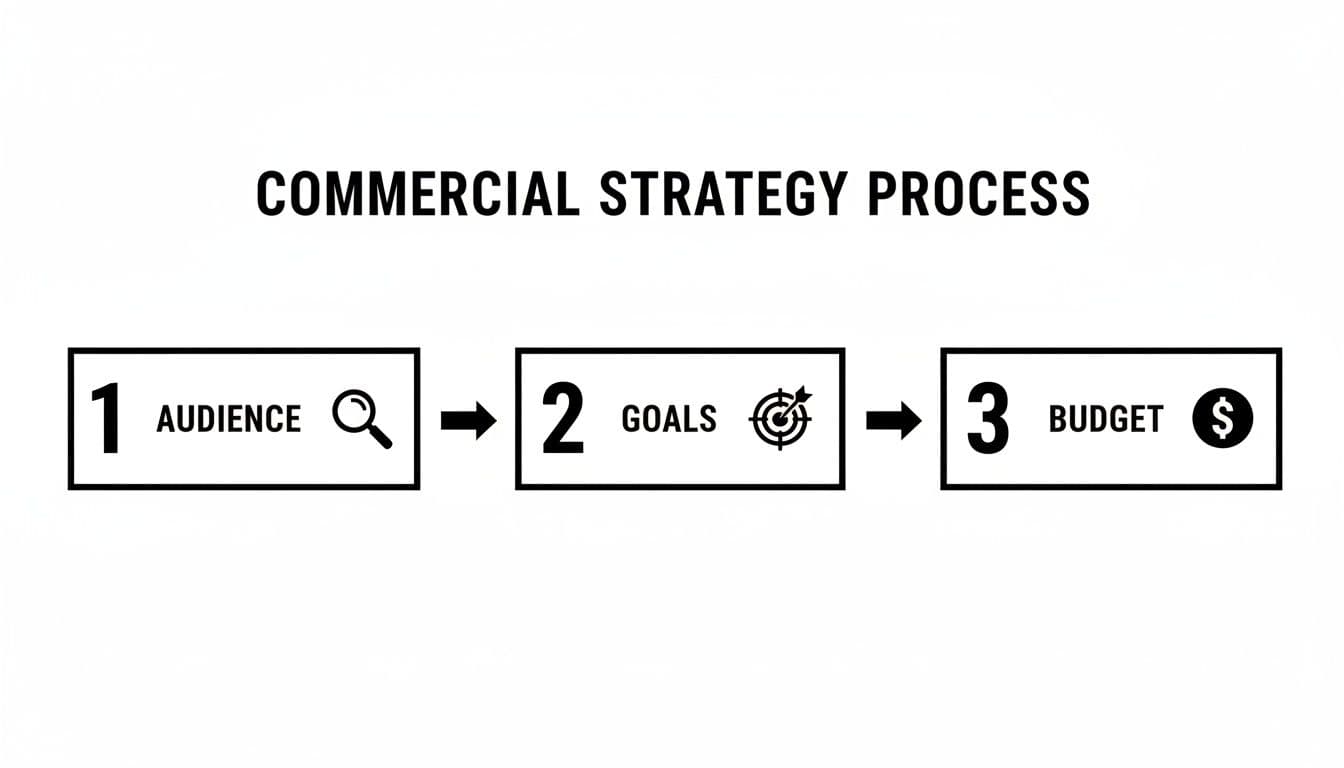
Think of it this way: each stage builds on the last, making sure your money is spent wisely to reach the right people with a message designed to get the job done.
Scripting a Story That Grabs Attention Fast
With your strategy locked in, it's time to shift from the 'what' and 'who' to the 'how'—how are you actually going to tell this story? The script is the absolute soul of your commercial. I’ve seen countless projects with stunning visuals fall completely flat because the script was weak. In a world where attention is measured in milliseconds, you can't afford a flimsy narrative.
The real goal here is to build an emotional bridge to your audience while delivering your core message with crystal clarity. This isn't about rattling off features; it's about making your product a meaningful part of a viewer's life.

Nail the First Three Seconds
You have a tiny, brutal window to stop the scroll. Those first three seconds are everything. They must contain a powerful hook—something that sparks curiosity, hits on a relatable problem, or is just visually arresting. Forget the slow build-up or the gentle brand reveal. You have to get straight to it.
That initial moment really sets the tone for the entire ad. Think of it as a promise to the viewer: "Stick around, this is worth your time."
Choosing Your Storytelling Framework
Staring at a blank page is intimidating. That's why leaning on a proven storytelling framework is a smart move. These are narrative structures that audiences already understand, giving your ad a logical flow that guides the viewer from the hook right to your call to action.
Here are a few of my go-to frameworks:
- Problem-Solution: This one is a classic for a reason. You start by showing a common pain point your audience feels deeply. Then, you swoop in with your product as the obvious, elegant solution.
- Before-and-After: Nothing beats a dramatic transformation. Show the frustrating "before" state and contrast it with the amazing "after" that your product makes possible. It's incredibly powerful for visual products, like fitness programs or home renovation services.
- Testimonial / Social Proof: Why not let a happy customer do the talking? A genuine, authentic testimonial builds trust in a way that slick marketing copy never can.
The right framework really depends on your product and your audience. A B2B software company might crush it with a problem-solution story, while a new gadget could get more mileage from a before-and-after demo. If you need some inspiration, we've put together a guide with more commercial script examples you can adapt.
From Script to Visual Blueprint
Once you've got a script you're happy with, the next job is translating those words into a visual plan. This is where a storyboard and a shot list become your best friends. They're the tools that get everyone on the same page and ensure you capture every single scene you need on production day.
A storyboard is basically a comic-strip version of your ad. It’s a sequence of simple drawings or images that map out each key moment. It doesn't have to be a work of art—stick figures are perfectly fine. The point is to visualize the flow, the pacing, and the camera angles before you start shooting.
Think of the storyboard as the comic book version of your ad. It forces you to visualize the pacing and ensures the story makes sense visually before you spend a dime on production.
The shot list is the nitty-gritty, tactical document. It’s a detailed checklist for your production day, breaking down every single shot you need to get. Each item on the list should include details like:
- Scene Number: To keep things in order.
- Shot Description: A quick note on what’s happening in the frame.
- Camera Angle: Is it a wide shot? A close-up on the product?
- Action/Dialogue: What are the actors doing or saying?
This kind of prep work saves you from making expensive mistakes or, even worse, realizing you missed a critical shot when you get to the edit. It’s the blueprint that turns a good script into a great final product. After all, with digital advertising dominating the landscape, a compelling video is non-negotiable. Video ads can boost purchase intent by a staggering 97% over static images, and ads under 15 seconds often see the best engagement.
Let AI Do the Heavy Lifting: A Smarter Way to Produce Commercials
Forget the idea that you need a Hollywood budget, a full camera crew, and weeks of planning to create a compelling commercial. Those days are gone. With the incredible rise of AI video generation platforms, anyone—from a solo entrepreneur to a marketing team—can produce high-quality ads.
This shift is huge. It means you can funnel your budget into what really matters: getting eyeballs on your ad. Instead of sinking thousands into production, you can invest in distribution and actually reach your audience.
Modern tools are all about speed and efficiency. You don't need to scout locations or hire actors anymore. Instead, you can build a stunning, professional-looking commercial using assets you probably already have, like product photos or short video clips. What used to take weeks now takes minutes.
From Still Photos to a Finished Ad in Minutes
Using a platform like Proom AI is surprisingly simple and built for getting things done fast. It’s designed to take your raw materials and, with a little AI magic, turn them into a polished video that’s ready for any social platform.
The secret sauce is starting with a template built for your specific industry. A real estate agent's ad needs a different vibe than an e-commerce brand's, and these templates give you a proven structure—the right pacing, the perfect effects—that already works for your niche.
Here’s what that looks like in practice:
- Pick an Industry-Specific Template: This is your foundation. Platforms like Proom AI have templates for everything from interior design portfolios to new product launches, so the style is already aligned with your goals.
- Upload Your Assets: Grab your best high-res product shots, photos of your work, or even short video snippets. These are the building blocks the AI will use.
- Let the AI Work Its Magic: Once your assets are in, the AI takes over. It analyzes your images and the template's structure to animate your photos, add slick transitions, and create a video that feels dynamic and alive.
This is what a modern, AI-powered creation platform is all about—it's intuitive, fast, and removes the technical headaches.
You’re immediately presented with clear, industry-focused options. No guesswork, just straight to creating.
Ready to create video ads?
Turn your photos into scroll-stopping ads in minutes. No video editing skills required.
Try For FreeMaking the Ad Your Own
Once the AI generates the initial video, the real fun begins. This is where you inject your brand's personality and make the ad uniquely yours. And don't think for a second that using AI means you lose creative control—these tools offer a ton of flexibility.
Start by tweaking the text overlays and captions. This is your chance to drive home your message, call out key features, or drop in a catchy tagline. The best platforms will even suggest effective copy, helping you nail the hooks and calls-to-action that fit perfectly with the video's timing.
AI isn't just about automation; it's about augmentation. It handles the heavy technical lifting so you can focus on the strategy and creative touches that make your brand memorable.
This level of control empowers small teams to produce a whole suite of high-quality ads without needing a video editing guru on staff. If you want to dive deeper into this, our guide on ads creative AI has plenty more strategies.
Go Global and Get Accessible With a Click
AI doesn't just make production easier; it opens up powerful new ways to connect with a wider audience. Features that used to be incredibly complex and expensive are now built right in.
- AI Presenters and Voiceovers: Want to add a human touch? You can select an AI presenter to appear in your ad. Even better, you can generate a professional voiceover in dozens of languages, letting you create localized ads for different markets without the hassle of hiring voice actors.
- Automated Captions: Let's be real: most social media videos are watched on mute. Captions are essential. AI can automatically generate and sync them to your video, ensuring your message lands whether the sound is on or off.
- Transcription for More Than Just Words: Beyond captions, AI can help with the entire content lifecycle. It can brainstorm script ideas or even help you transcribe video to text to repurpose your ad for blog posts and other content.
These tools are game-changers in today's media landscape. The creator economy advertising market is exploding, hitting $29.5 billion in 2024 and projected to climb to $37 billion by 2025. This space is growing four times faster than the rest of the media industry, which means brands need to produce high-quality content at scale. By embracing AI, you’re not just keeping up; you’re giving your team the power to compete and win.
Editing and Polishing Your Final Commercial
This is where the magic really happens. You've got your footage, your AI-generated clips, or a mix of both. Now it’s time to step into the editing suite—whether that’s a professional software or a user-friendly tool—and assemble those pieces into a story that actually sells.
Post-production isn’t just about trimming clips. It’s where you shape the rhythm, inject emotion, and make your message crystal clear. A great edit can elevate good footage into an unforgettable ad, while a clumsy one can make even the most beautiful shots feel flat and boring.
Mastering the Art of Pacing and Flow
Pacing is the heartbeat of your ad. It controls the energy and decides whether someone keeps watching or scrolls right past. Fast-paced, snappy cuts can build excitement for a product launch, while slower, more deliberate edits can create an emotional connection or a sense of luxury.
Think about the feeling you want to evoke. Is it urgency? Trust? Awe? Your editing style should mirror that. Don't be afraid to play around. Sometimes the rhythm you initially imagined doesn't quite work, and experimenting is the only way to find what truly clicks for your brand.
The goal of a great edit isn't just to look cool—it's to control the viewer's emotional journey from the first frame to the last. Every cut, transition, and pause should serve the story.
To keep things moving and visually interesting, here are a few classic techniques:
- Cut on Action: When you transition from one shot to another while the subject is in motion, the cut feels almost invisible. It’s a simple trick that makes the flow incredibly smooth.
- Use B-Roll: You can't just show a talking head for 30 seconds. Weave in supplemental footage—close-ups of the product, shots of happy customers, or clips that add context—to make the ad far more dynamic.
- Vary Your Shot Angles: No one wants to look at the same static shot for too long. Mix wide, medium, and close-up shots to hold the viewer's attention and emphasize what’s important.
Enhancing Your Commercial with Audio and Graphics
Honestly, visuals are only half the battle. Sound is what truly brings a video to life, turning a silent movie into an immersive experience. The right audio choices can completely transform the mood of your ad.
First up, background music. This is your emotional shortcut. An upbeat track makes your product feel fun and exciting, while a subtle, cinematic score can lend an air of sophistication. The key is to find music that complements the visuals without drowning out your message.
Next, let's talk about the voiceover. A confident, clear voiceover guides the viewer, explains what they’re seeing, and lands your call-to-action with authority. You can hire a professional voice actor or use a high-quality AI voiceover tool, but either way, make sure the tone of voice aligns perfectly with your brand’s personality.
Finally, you need to layer in some essential graphics. These are the workhorses that provide clarity and push for the conversion.
- Text Overlays: Use these to pop key benefits, pricing, or a special offer on screen. Keep the text short, sweet, and easy to read.
- Your Logo: Don't forget to brand your work! A small logo in the corner is usually all you need to reinforce who the ad is from.
- A Clear Call-to-Action (CTA): This is non-negotiable. Your ad needs to end with a direct command. "Shop Now," "Learn More," or "Download the App"—tell people exactly what you want them to do next.
Exporting for Every Platform
You’ve done it. The ad is polished and ready to go. But wait—the final step is arguably one of the most critical: exporting it correctly for each platform. It’s a rookie mistake to export a single video file and use it everywhere. A video that looks perfect on your desktop can end up pixelated or awkwardly cropped on a phone.
Forgetting this step is like running a marathon and stopping one foot from the finish line. You have to format your ad for the environment where it will be seen.
Here are the three aspect ratios you absolutely need to know:
- 9:16 (Vertical): This is the king of mobile. Think TikTok, Instagram Reels, and YouTube Shorts. It’s designed to fill the entire phone screen.
- 1:1 (Square): Perfect for the main feeds on Instagram and Facebook. A square video simply takes up more screen real estate on a feed than a horizontal one, making it harder to ignore.
- 16:9 (Horizontal): The classic widescreen format. This is what you’ll use for standard YouTube videos and for embedding on your website.
When you export, always go for the highest quality you can (1080p at a minimum, 4K if possible) and stick with the MP4 file format. It gives you the best blend of quality and manageable file size. By creating a version for each key aspect ratio, you ensure your ad looks professional and is fully optimized to grab attention, no matter where your audience finds it.
Getting Your Commercial Seen by the Right People
You've done the hard work and created a fantastic commercial. That’s a huge win, but it's only half the job. A masterpiece is useless if it never reaches the people it was made for. Now comes the final, crucial phase: smart distribution. This is all about getting your ad in front of the right eyeballs and then fine-tuning its performance to squeeze every drop of value from your budget.
This is where all that foundational strategy really pays off. The work you did earlier to define your audience will now guide every decision you make about where to place your ad for maximum impact. You're not just throwing your commercial into the digital void; you're delivering it with laser-like precision.
Picking the Right Playground: Where to Run Your Ad
Not all platforms are created equal, and where you choose to run your commercial matters immensely. Each one has a unique audience and a completely different ad environment. The real trick is to match the platform's vibe and user base to your target demographic and campaign goals.
- Meta (Facebook & Instagram): This is an absolute powerhouse for granular targeting. You can zero in on users based on their interests, recent life events, online behaviors, and detailed demographics. It’s perfect for e-commerce brands, local businesses, and anyone aiming for direct sales or leads.
- TikTok: If you're trying to reach a younger audience and want to ride the wave of current trends, TikTok is where you need to be. The platform rewards authentic, entertaining, and fast-paced content that feels like it belongs in the feed, not like a traditional, polished ad.
- YouTube: As the world’s second-largest search engine, YouTube is ideal for capturing user intent. You can target people based on what they're actively searching for or the kinds of videos they love to watch. This makes it a goldmine for educational content, product demos, and in-depth tutorials.
Once you have your final video, it's worth diving into channel-specific strategies. For instance, learning how to properly use YouTube video ads to drive conversions can make a massive difference in your ROI on that platform.
Choosing the right platform is the first step to making sure your ad budget works as hard as you do. To help you decide, here’s a quick breakdown of the major players.
Choosing the Right Ad Platform for Your Commercial
| Platform | Primary Audience | Best For | Ad Formats |
|---|---|---|---|
| Meta (Facebook/Instagram) | Broad (Millennials & Gen X) | E-commerce, Lead Gen, Brand Awareness | In-feed video, Stories, Reels |
| TikTok | Gen Z & Younger Millennials | Viral Marketing, Trend-based Content | In-feed ads, Branded Hashtags |
| YouTube | Wide Demographic (Intent-based) | Product Demos, How-to Content, Brand Storytelling | Skippable/Non-skippable in-stream, Bumper ads |
| B2B Professionals | B2B Lead Gen, Professional Services | In-feed video, Sponsored Content |
Ultimately, the best platform is where your customers spend their time. Don't be afraid to test a couple of different channels to see where you get the most traction.
Kicking Off Your First Ad Campaign
Launching a campaign might sound intimidating, but it’s actually quite logical. Inside your chosen ad platform, you’ll start by defining your campaign objective—are you trying to drive website traffic, generate new leads, or get direct sales? This tells the platform's algorithm what a "win" looks like for you.
Next up is the most important part: audience targeting. This is where you bring your customer persona to life in the ad manager. You can layer different targeting options to get incredibly specific. For example, a real estate agent could target users who have recently shown interest in mortgage calculators, live within a 15-mile radius of a specific zip code, and are between the ages of 30-45.
Finally, you’ll set your budget. You can choose a daily spending limit or set a total budget for the entire campaign. Most platforms run on an auction system, so a competitive budget is crucial to ensure your ad gets shown to your carefully selected audience.
The Power of A/B Testing
Here’s a pro tip: never assume your first attempt is the best one. A/B testing, also known as split testing, is simply the process of running two slightly different versions of your ad to see which one performs better. This is how you stop guessing and start making data-driven decisions.
You can test almost any element of your commercial:
- The Hook: Try out two different opening scenes or lines of text.
- The Call-to-Action: Pit "Shop Now" against "Learn More."
- The Visuals: Use a different hero image or a key video clip.
- The Audience: Show the exact same ad to two different audience segments.
By changing only one variable at a time, you can clearly identify what's working and what's not. This cycle of testing and refining is what turns a good campaign into a truly great one.
Your audience will always tell you what they want to see—you just have to listen to the data. A/B testing is how you tune in to that feedback and stop wasting money on creative that doesn't connect.
The global advertising market is projected to hit an astounding $1.1 trillion in 2025, with digital ads claiming about 75% of that spend. This massive investment underscores the need for scalable and efficient commercial production, allowing brands to test more creative and maximize their return in a fiercely competitive space.
By focusing on smart distribution and relentless optimization, you ensure your commercial doesn't just get made—it gets results.
Got Questions About Making a Commercial?
Even with a solid plan, you're bound to have some questions pop up. It's totally normal. Tackling these common hurdles head-on will save you a ton of headaches down the road. Let's dig into a few of the questions I hear all the time.
What's This Going to Cost Me?
Ah, the million-dollar question—sometimes literally. The honest answer is that the cost can be all over the map. A traditional, full-scale commercial shoot can easily run into the tens of thousands, once you factor in the crew, actors, location fees, and all the post-production work. For a lot of businesses, that kind of price tag is a non-starter.
But things have changed. The rise of AI video tools has completely upended the old budget models. Instead of a huge upfront investment, you can now create a genuinely polished commercial for the price of a monthly subscription. This is a huge shift. It means you can take the photos you already have and spin them into compelling video ads, saving your real budget for distribution, which is where the magic really happens.
How Long Should My Ad Be for Social Media?
On social media, speed is everything. You have to get your point across before the viewer's thumb keeps on scrolling.
- TikTok & Instagram Reels: Keep it under 15 seconds. These platforms are all about quick, punchy content. You have to land your hook, message, and call-to-action almost instantly.
- YouTube & Facebook Feed: You get a little more time to play with here, but 15-30 seconds is still the gold standard. For those YouTube pre-roll ads, the first 3-5 seconds are make-or-break. That’s your only window to stop someone from hitting "Skip Ad."
The golden rule is to be as concise as you can without losing your message. Every extra second is a risk. A short, memorable ad will beat a long, meandering one on social media every single time.
What Are the Absolute Must-Haves for Any Commercial?
It doesn't matter if your ad is 10 seconds or 60, for TV or TikTok. Every single effective commercial is built on four core elements. Think of this as your pre-launch checklist. If you miss one, your ad just won't work.
- A Killer Hook: You need to grab their attention in the first three seconds. This could be a surprising question, a jaw-dropping visual, or a problem they know all too well.
- One Clear Message: What’s the single most important thing you want people to walk away with? It needs to be a simple, clear statement about what you offer and why it’s great.
- Unmistakable Branding: People have to know the ad is from you. Your logo, colors, and overall vibe should be front and center so they connect the message back to your business.
- A Strong Call-to-Action (CTA): This is non-negotiable. You have to tell them exactly what to do next. "Shop Now," "Learn More," "Download the App"—be direct and make it easy.
Can I Seriously Make a Good Ad Just From Photos?
Yes, one hundred percent. In fact, it's one of the smartest and most efficient ways to create amazing video content right now. AI video platforms are built to do exactly this: take your static images and breathe life into them, turning a folder of photos into a cinematic ad.
This approach is a godsend for anyone in a visual business—think e-commerce, real estate, or design. You can just upload your best product shots or portfolio pieces, and the AI handles the rest, adding dynamic motion, slick transitions, and text to tell a story. It lets you create something beautiful without ever picking up a camera.
Ready to see it in action? Proom AI was designed to turn your photos into professional commercials in just a few minutes, with smart templates and a simple three-step process. Generate your first video ad for free and see just how easy it is to create content that gets results.
Ready to create video ads?
Turn your photos into scroll-stopping ads in minutes. No video editing skills required.
Try For Free