What is creative strategy: A Practical Guide to Winning Campaigns
Discover what is creative strategy and how it drives brand impact. A concise guide to essential components and winning campaign frameworks.
Creative strategy is the plan that connects what your data tells you with the big ideas that will actually get your audience to listen. It’s the essential bridge between the numbers on a spreadsheet and the story you tell in an ad, making sure every single piece of content has a clear, unified purpose.
Understanding Creative Strategy
Think of your creative strategy as the recipe for a signature dish. All your market research and customer data are the ingredients—they tell you exactly what flavors, textures, and combinations your diners (your audience) absolutely love. The creative execution is how you expertly combine those ingredients, adding your unique flair to create a memorable meal (your campaign) that people will crave again and again.
If you don't have that recipe, you're just tossing random ingredients in a pan and hoping for the best. With a solid strategy, every choice is intentional, building toward a final product that works.
The Bridge Between Data and Art
At its core, creative strategy marries two worlds that seem like total opposites: the analytical and the artistic. It’s where spreadsheets meet storyboards. For a long time, marketing teams kept these functions completely separate. One team would crunch performance data while another brainstormed wild, imaginative ideas. This almost always created a disconnect, leading to beautiful ads that didn't sell or data-packed campaigns that didn't inspire anyone.
A strong creative strategy forces these two sides to collaborate. It ensures that the "big idea" isn't just clever but is actually grounded in real audience behavior and concrete business goals.
A great creative strategy doesn’t just make your ads look better; it makes them work harder. It’s about transforming raw data into compelling narratives that drive action and build brand loyalty.
This kind of integration isn't just a nice-to-have anymore; it's essential in a marketplace saturated with noise. People see thousands of ads every day. The only way to cut through is with a message that’s both emotionally powerful and strategically sound.
Why It’s Crucial for Growth
A cohesive creative strategy is your brand's North Star. It guides every single decision, ensuring you show up consistently and make an impact everywhere your customers see you. It's the antidote to the random, fragmented marketing efforts that confuse audiences and burn through budgets. Instead of chasing one-off viral moments, it helps you build a sustained, meaningful conversation with your audience.
Here’s why it’s so critical for any business that wants to grow:
- It ensures consistency. When your strategy is clear, your brand’s voice, visuals, and message are the same everywhere. That consistency builds trust and makes you instantly recognizable.
- It boosts efficiency. A clear framework eliminates the guesswork. Your team knows the playbook, which lets them produce effective content much faster.
- It drives better results. Campaigns that come from strategic insights are far more likely to resonate with the right people, leading to higher engagement, more conversions, and a better return on your investment.
How Video Became Central to Modern Strategy
Creative strategy has gone through a massive shake-up. What used to be a balanced diet of text, images, and video has now tilted almost entirely toward a video-first world. This isn’t just a passing fad—it's a fundamental change in how people consume information and decide which brands to trust.
Video just has a special kind of magic. It blends sight, sound, and motion to tell a story that grabs you in seconds. It can break down a complicated idea, show you exactly how a product works, and stir up emotions in a way a static image or a wall of text simply can't. That’s why the winning campaigns today are built on a solid video foundation; it's the main engine driving the entire creative strategy forward.
The New Audience Expectation
Let's be honest, platforms like TikTok, Instagram Reels, and YouTube Shorts have completely rewired our brains. We're now conditioned to expect a never-ending stream of short, snappy, and authentic video content. This has created a massive appetite for video that brands have to feed if they want to stay on the radar.
The numbers here are just wild. Video is on track to make up 82% of all internet traffic, and a staggering 92% of users around the globe watch online videos every month. Even more telling, social video gets 1200% more shares than text and images combined. As these video marketing statistics show, if you're not putting video at the core of your creative strategy, you're already falling behind.
This infographic really nails the flow of a great creative strategy, from digging up insights to building that crucial audience connection.
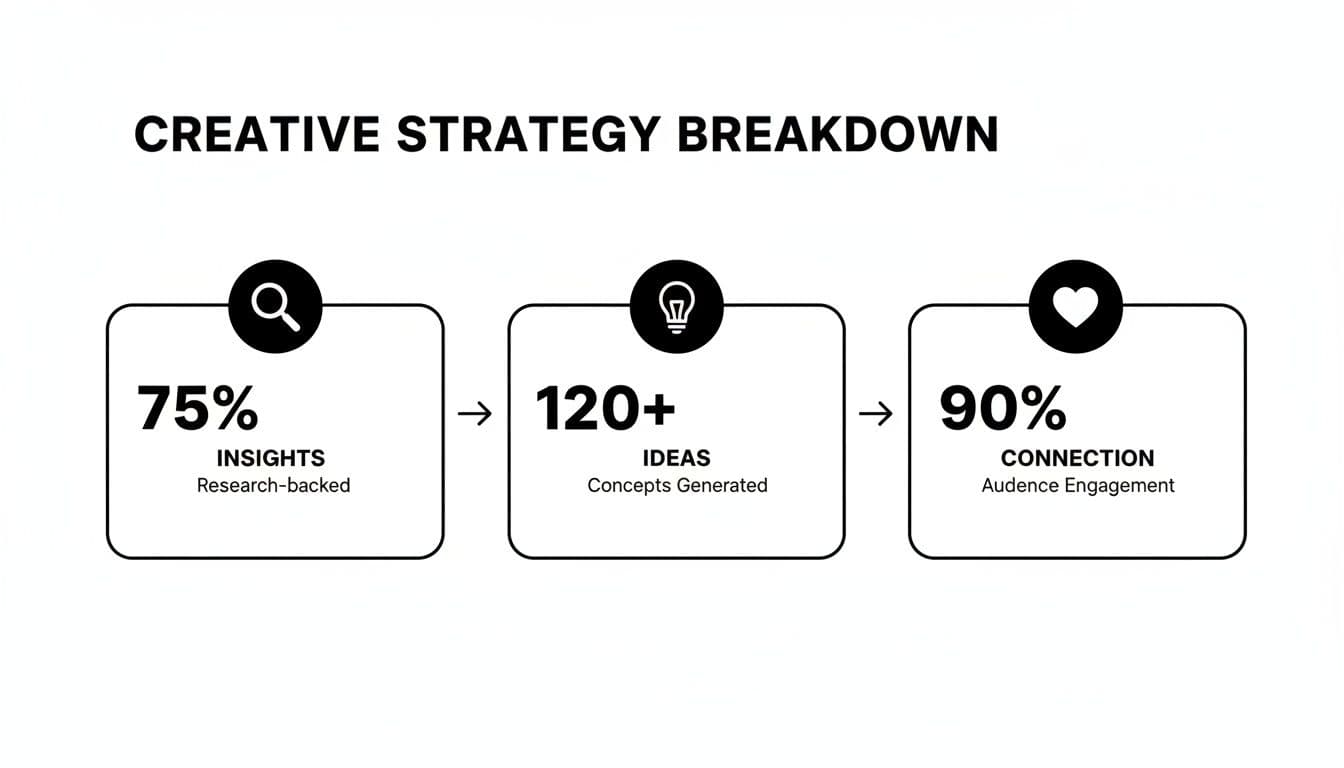
As you can see, it’s a clear path: start with data, move to creative execution, and end with an emotional bond that turns a viewer into a customer.
The Production Challenge for Marketers
Of course, this video-centric world creates some pretty big headaches. The constant demand for a high volume of quality content puts a ton of pressure on marketing teams, especially smaller ones trying to do more with less.
The game has changed. It's no longer about sinking your entire budget into one perfect, polished video. It's about consistently churning out a variety of engaging videos at speed and scale to keep up with both your audience and the algorithms.
This is where the production bottleneck kicks in. Great ideas get stuck in the pipeline because of tight deadlines, limited budgets, or a lack of technical skills. Marketers are caught in a tough spot—they know they need more video, but they just don't have the bandwidth to produce it all. And that's exactly where new technology is stepping in to bridge that gap between the strategic vision and the day-to-day reality of getting it all done.
The 4 Pillars of a Winning Creative Strategy
A great creative strategy isn't just a vague idea; it's a practical blueprint built on four non-negotiable pillars. Getting these right is the difference between making ads that get ignored and building a brand that people actually care about.
Think of it like building a house. If one of the foundational pillars is weak, the whole structure gets wobbly. Let's break down each one.

Pillar 1: Defining Your Audience Persona
First thing's first: who are you really talking to? This goes way beyond surface-level demographics like age and city. A proper audience persona is a semi-fictional character you build from real data and market research. It’s about understanding their goals, what drives them, and—most critically—what keeps them up at night.
For example, instead of just targeting "women aged 25-34," a sustainable fashion brand might create a persona for "Eco-Conscious Chloe." She's a 29-year-old graphic designer who’s deeply worried about fast fashion's environmental toll. She wants to look good, but not at the expense of her values. See how much clearer that is? That level of detail is what makes your message land.
Pillar 2: Crafting Your Core Message
Once you know your "who," you can figure out your "what." Your core message is the single most important idea you want your audience to remember. It’s not just a clever tagline; it’s the emotional and logical anchor for everything you do. It's the "aha!" moment.
Your core message is the promise you make to your audience, distilled into one powerful statement. It guides every single ad, post, and video you create.
For our fashion brand targeting Chloe, the core message isn't "buy our clothes." It's something like: "Style that aligns with your values." For a B2B software company selling to overworked project managers, it could be: "Finally, a tool that gives you back your time." Simple, direct, and powerful.
Pillar 3: Establishing Your Brand's Tone of Voice
If the core message is what you say, your tone of voice is how you say it. This is your brand's personality. Are you an authoritative expert? A witty, playful friend? Or a warm, empathetic guide? Whatever it is, it has to be consistent across every single touchpoint. Consistency builds trust.
That B2B software brand talking to project managers on LinkedIn will probably have a professional, data-driven tone. But our sustainable fashion brand on Instagram? They’ll likely use an inspirational, community-focused voice. The tone has to match the brand, the audience, and the platform.
Pillar 4: Selecting Your Distribution Channels
Finally, a brilliant message is completely useless if it never reaches the right people. Distribution channels are simply the platforms and places you choose to deliver your message. This decision shouldn't be about what's trendy; it should be driven entirely by where your audience persona actually hangs out online.
- Where is Eco-Conscious Chloe? She's on visually-driven platforms like Instagram, TikTok, and Pinterest, looking for style inspiration.
- Where is the overworked B2B Project Manager? He's on professional networks like LinkedIn and reading industry-specific blogs, searching for credible solutions.
Choosing the right channels is what turns all that strategic planning into real, measurable results. It ensures your carefully crafted message doesn't just shout into the void—it lands with maximum impact.
How to Execute Your Creative Strategy with AI
Having a brilliant creative strategy on paper is one thing. Actually bringing it to life? That's a completely different challenge.
For most teams, especially smaller businesses and startups, the execution phase is where things get messy. Traditional video production comes with a mountain of hurdles: sky-high costs, painfully long timelines, and the need for highly specialized technical skills. It's often the biggest barrier between a great idea and a finished ad.
This is exactly where AI tools have stepped in to change the game.
AI-powered platforms act as the bridge between your strategic vision and the tangible videos you need to launch. They effectively level the playing field, giving marketers the power to create a high volume of quality content—something that was once only possible for big agencies with even bigger budgets.
Instead of getting bogged down in complicated editing software, your team can finally focus on what really matters: nailing the strategic message and the core creative idea.
Ready to create video ads?
Turn your photos into scroll-stopping ads in minutes. No video editing skills required.
Try For FreeAmplifying Creativity, Not Replacing It
There’s a common myth that AI is here to replace human creativity. The reality is far more exciting. AI doesn't replace you; it amplifies you.
Think of it as the ultimate creative assistant—one that handles all the repetitive, time-sucking tasks, freeing you up to think bigger and experiment more.
Here’s how AI tools can supercharge your workflow at every stage:
- Idea Generation: Stuck on a hook? AI can help brainstorm initial script ideas, angles, and opening lines based on your core message and audience profile.
- Rapid Prototyping: Instead of spending a week on one video concept, you can instantly generate multiple visual variations to see which one actually lands with your audience.
- Personalization at Scale: Need to tweak an ad for different audience segments? AI lets you create tailored versions without having to start from scratch every single time.
This isn’t just a minor improvement. It’s a fundamental shift, turning the old, slow, linear creative process into a dynamic cycle of rapid, data-informed experimentation.
The New Standard in Content Production
The impact of AI on video creation isn't some far-off trend; it's happening right now and completely reshaping the industry.
The global AI video generator market is projected to explode from $534.4 million to $2,562.9 million by 2032. This isn't just about market size—it's about how quickly everyone is jumping on board.
A stunning 41% of businesses are now using AI to create videos, which is a 128% increase from just a few years ago. Even more telling, 50% of small businesses have adopted these tools, finally giving them the firepower to compete. In fact, nearly 57% of online ads now feature AI-generated video, making it the new normal for executing a modern creative strategy. You can find more surprising video marketing stats here.
This rapid adoption drives home a critical point: AI tools are no longer optional. They are essential for staying competitive. They give you the speed and scale required to execute your creative strategy and win in today's fast-paced digital world.
To learn more about how brands are putting this technology to work, you can explore our deep dive into the expanding role of AI in advertising.
Bringing Your Strategy to Life with Video Ads
Okay, the creative strategy is your blueprint. Now it's time to actually build something with it. This is the fun part—where your big ideas about your audience, message, and tone of voice stop being abstract concepts and become a real, tangible video ad that people will actually see. The kind that stops the scroll and gets results.
And the best part? Modern tools have completely changed the game, making this process faster and way more accessible than you'd think.
Let's walk through a real-world example. We'll use an AI-powered platform like Proom AI to show you how a plan on paper becomes a finished video ad in just a few minutes.
Step 1: Set a Clear Campaign Objective
Every single great ad starts with one crystal-clear goal. What do you really want the viewer to do after watching?
Vague goals like "boost brand awareness" are the enemy of good creative. They lead to fuzzy, ineffective ads. Get specific. For instance, a sharp objective might be: "Drive initial sales for our new eco-friendly sneaker collection by showcasing its unique recycled materials."
See how that works? This one sentence immediately gives you a filter for every single creative choice you're about to make, from the opening hook right down to the final call-to-action.
Step 2: Choose a Template That Aligns with Your Message
Your ad's visual vibe has to match your brand's personality and the campaign's goal. It's not just about looking good; it's about being coherent. If your brand is all about sleek, modern design, a playful, chaotic, fast-cut template is going to feel jarring and off-brand.
Platforms like Proom AI are built for this, offering industry-specific templates designed for different strategic needs.
For our sustainable sneaker launch, we wouldn't just pick any template. We'd look for one that feels clean, earthy, and maybe a little aspirational. This isn't just an aesthetic choice—it's a strategic move to visually hammer home our core message of eco-conscious style.
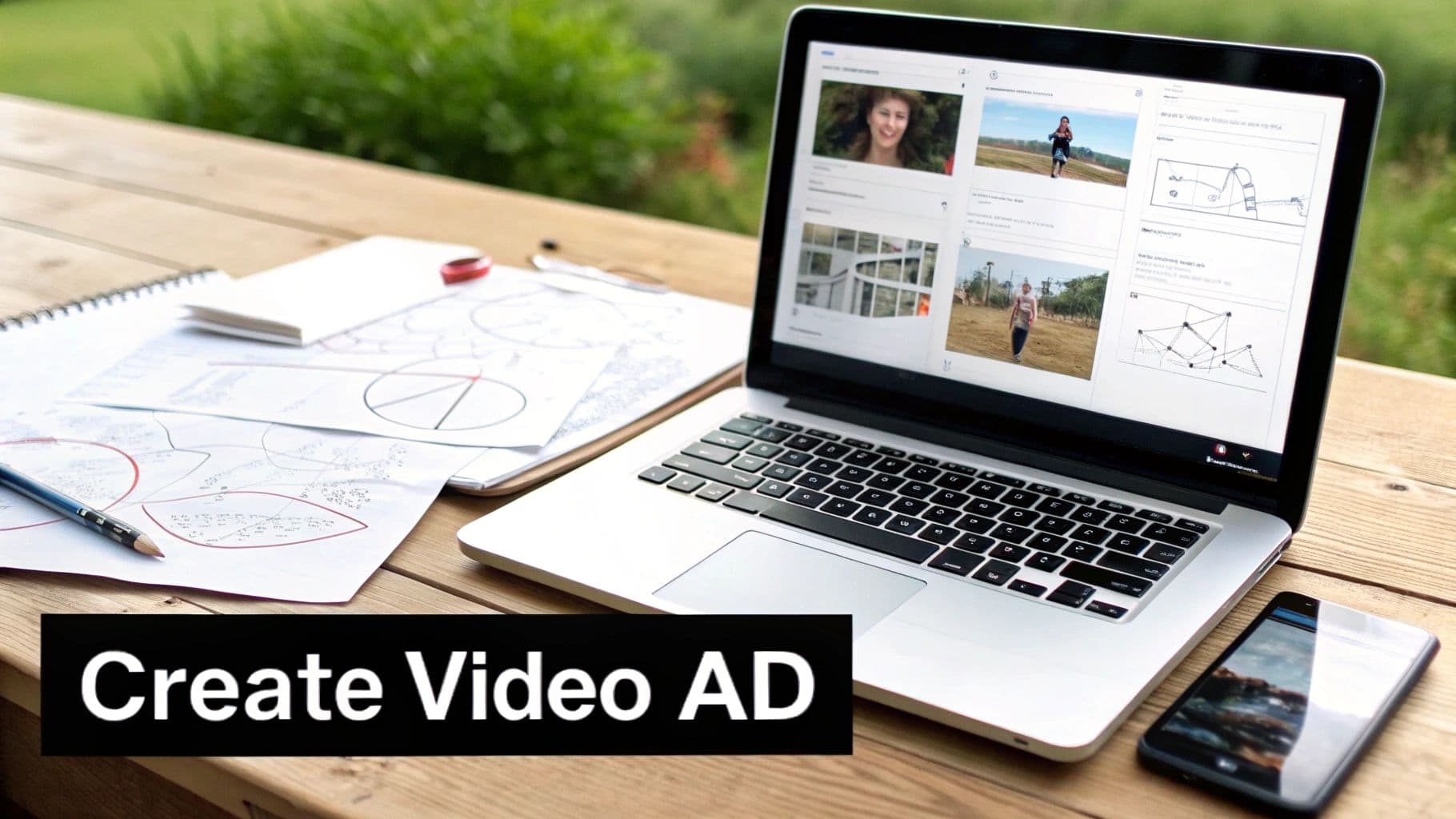
This is exactly that first, critical step—where you pick the visual foundation that turns your strategy into a finished ad.
Step 3: Write Compelling, AI-Assisted Copy
With your objective set and your template locked in, it’s time for words. This is where a lot of marketers get bogged down, but AI scriptwriting tools can be a massive shortcut to powerful options. The two most critical pieces of copy? The hook and the call-to-action (CTA).
- The Hook: You have about three seconds. That's it. An AI tool can spit out dozens of ideas in seconds, like: "The world's most comfortable sneaker is made from trash." or "Tired of choosing between style and sustainability?"
- The CTA: Tell people exactly what you want them to do. No ambiguity. "Shop the collection now." or "Be the first to wear the future."
These tools are brilliant for translating your core message into punchy language that grabs attention right out of the gate.
A creative strategy lives or dies in the execution. The ability to rapidly generate and test different hooks, visuals, and calls-to-action is what separates campaigns that succeed from those that stagnate.
Step 4: Customize Visuals and Generate Variations
Time to make it real. You'll upload your own assets—in our case, some killer photos of the new sneakers. The platform takes those static images and automatically animates them into an engaging video, all based on the template you chose. To get the most out of this, it helps to understand the nuances of the platform you're targeting; for example, knowing the best practices for how to create Instagram Reels can give you a huge advantage.
But don't just make one version and call it a day. This is 2024. A huge part of modern creative strategy is testing.
With a single click, you can generate multiple variations of your ad. Try a different hook. Swap in a new CTA. Tweak the visuals slightly. This lets you A/B test your creative and let actual data tell you what your audience responds to. This simple step turns your strategy from a one-time plan into a continuously optimized engine for growth.
To see more examples of this process in action, you can check out our detailed guide on how to create video ads that actually convert.
Measuring Performance and Optimizing Your Strategy
A brilliant creative strategy is completely useless if you can't prove it works. To make smarter decisions and actually justify your budget, you need to measure the real-world impact of your creative—and that means shifting your focus away from vanity metrics like views.
It’s all about prioritizing the business-critical Key Performance Indicators (KPIs) that tell you a clear story about what’s working and what isn’t. Tracking the right data is the first step toward turning your strategy from a static plan into a dynamic engine for growth.
From Views to Value: The KPIs That Really Matter
A million views feels great, but it doesn't pay the bills. The true test of your creative is how effectively it drives profitable action.
You need to get obsessed with the numbers that connect directly to your bottom line. Here’s a quick overview of some of the most important metrics to watch.
To help you get started, this table breaks down the most critical KPIs for evaluating your creative strategy and what each one really tells you about your ad performance.
| Metric (KPI) | What It Measures | Why It Matters for Creative Strategy |
|---|---|---|
| Click-Through Rate (CTR) | The percentage of people who see your ad and click on it. | This is your first real test. A high CTR means your visual, hook, and headline successfully stopped the scroll and grabbed attention. It tells you your creative is compelling. |
| Conversion Rate (CVR) | The percentage of clickers who complete a desired action (e.g., purchase, sign-up). | This is the ultimate proof. A high CVR shows that your ad not only got the click but also delivered on its promise and persuaded the user to act. |
| Return on Ad Spend (ROAS) | The total revenue generated for every dollar spent on advertising. | This is the bottom line. ROAS directly connects your creative efforts to revenue, answering the most important question: "Is this ad making us money?" |
| Cost Per Acquisition (CPA) | The average cost to acquire one new customer through your campaign. | A low CPA indicates your creative is efficiently converting viewers into customers. It helps you understand the profitability and sustainability of your campaigns. |
| Thumb Stop Rate | The percentage of impressions where a user watches at least 3 seconds of your video. | This is a crucial early indicator for video ads. It tells you if your first few seconds are strong enough to hook a viewer in a fast-scrolling feed. |
Ultimately, tracking these KPIs helps you build a clear picture of what’s resonating with your audience and what isn’t, allowing you to make informed, data-driven decisions instead of just guessing.
A great creative strategy isn't just about making ads people like; it's about making ads that make a tangible difference to the business. The goal is to create a repeatable process for generating high-performing creative.
To see how these metrics come to life in a real campaign setup, our guide on how to run Facebook ads offers a detailed look at campaign measurement and optimization.
The Creative Feedback Loop: Launch, Measure, Learn, Iterate
Your first ad is almost never your best one. The secret to long-term success comes from a simple but powerful cycle: the creative feedback loop. This framework turns every campaign you launch into a learning opportunity, ensuring your ads get more effective over time.
It’s an iterative process where you systematically A/B test different creative elements—from headlines and hooks to visuals and calls-to-action—to find winning combinations. A huge part of this is knowing when an ad is losing steam and how to fix dead ads before they drain your budget.
This approach transforms your strategy from a one-time guess into a data-driven process that consistently evolves and improves.
Frequently Asked Questions About Creative Strategy
Even with the best roadmap, you're bound to hit a few questions when the rubber meets the road. Let's tackle some of the most common ones that pop up when putting a creative strategy into action.
Creative Strategy vs. Marketing Plan: What's the Difference?
It’s easy to get these two mixed up, but they play very different roles. Think of it like building a house: the marketing plan is the blueprint, and the creative strategy is the interior design.
A marketing plan is your high-level roadmap. It’s the "what" and "where"—which products you're pushing, which channels you'll use (like TikTok or Google Ads), and how much you're spending. It's all about logistics.
The creative strategy, on the other hand, is the soul of that plan. It’s the "how" and "why." It defines how you'll say what you need to say in a way that makes people stop scrolling and why they should care enough to listen. This is where your brand’s voice, visuals, and story come to life.
How Often Should I Update My Creative Strategy?
Your core strategy—the big pillars like your target audience, core message, and brand personality—should be pretty solid. Think of it as your brand's constitution. It’s smart to give it a formal review every quarter or year just to make sure it still lines up with your business goals and what's happening in the market.
However, the day-to-day execution of that strategy needs to be constantly in motion.
Your strategy is a living document, not a stone tablet. While the core principles stay put, the tactics—the specific ad hooks, visuals, and CTAs—should be tweaked constantly based on what the performance data is telling you.
This means you’re always testing and optimizing. The strategy gives you the guardrails, but your campaign data tells you how to drive between them.
Can a Small Business Have a Creative Strategy?
Absolutely. In fact, for a small business, a killer creative strategy is even more important. It’s the ultimate equalizer.
Many people think "strategy" means "big budget." Not true. A creative strategy is about being smart, not spending big. It's about knowing your audience so intimately that you can craft a message that hits home, even with a shoestring budget.
- Focus on Insight: A small business can often get way closer to its customers, uncovering unique pain points that bigger, slower competitors completely miss.
- Embrace Agility: Small teams can test an idea on Monday and have a better version running by Wednesday. That speed is a massive advantage.
- Leverage Technology: Tools like AI video generators make it possible to produce high-quality, on-strategy ads for a tiny fraction of what it used to cost.
At the end of the day, a strong creative strategy makes sure every single dollar you spend is working as hard as it possibly can to connect with the right people in a way they’ll actually remember.
Ready to bring your creative strategy to life without the production bottlenecks? With Proom AI, you can turn your product photos and strategic ideas into high-performing video ads in minutes. Choose a template, upload your assets, and let AI generate compelling visuals and copy that will stop the scroll and drive results.
Start your free trial today and create your first video ad with Proom AI!
Ready to create video ads?
Turn your photos into scroll-stopping ads in minutes. No video editing skills required.
Try For Free