AI in Ads A Guide to Transforming Your Marketing Strategy
Discover how AI in ads is revolutionizing marketing. This guide explains how to use AI for ad creative, targeting, and optimization to boost ROI.
Imagine trying to craft the perfect, personalized message for thousands of individual customers. By hand. That's the old way of doing advertising. Now, picture an intelligent system that does it for you in an instant—that’s what AI in ads brings to the table.
The New Era of Advertising Is Powered by AI
Artificial intelligence isn't some far-off concept anymore; it's a real, workhorse tool for marketers on the ground today. It directly attacks the biggest headaches in the industry: the constant demand for more speed, deeper personalization, and performance you can actually measure at scale.
Think of it as the difference between a single artisan painstakingly carving a sculpture and a fully automated, intelligent factory floor churning out flawless work for your campaigns.
This isn't just a fleeting trend. It’s a seismic shift in how brands talk to people. And the money is following. In 2024, private investment in AI in the United States alone hit a mind-boggling $109.1 billion. That number absolutely dwarfs what other countries are spending, showing just how aggressively U.S. tech is building the tools that are remaking the ad world. You can dig into more insights about this massive AI investment on sopro.io.
Why AI Is Reshaping the Ad Industry
At its core, AI gives marketers superpowers. Instead of just guessing which ad creative will land, AI can predict which one will win. Instead of manually tweaking campaign bids, AI optimizes them on the fly for the best possible return.
The advantages of weaving AI into your advertising workflow are immediate and obvious:
- Blazing Speed: Go from a simple idea to a dozen different video ad variations ready to launch in minutes, not weeks.
- Real Personalization: Talk to people based on their actual behaviors and interests, not just clunky demographic buckets.
- Smarter Performance: Let predictive analytics automatically funnel your budget toward the channels and creatives that actually work.
- Endless Creativity: Beat creative fatigue by generating a constant flow of fresh ad concepts to keep your audience from tuning out.
AI finally solves the advertiser's dilemma of having to choose between quality, speed, and cost. Now, you can have all three at once, breaking the old trade-offs and opening up brand new ways to grow.
Ultimately, the best way to think about AI in advertising is as a powerful collaborator. It handles the repetitive, soul-crushing tasks, uncovers audience insights you'd never find on your own, and lets you scale creative production like never before. That frees you—the human marketer—to focus on the big picture: strategy, storytelling, and building a brand people genuinely connect with.
Whether you're running a small business or working at a growing agency, getting a handle on these tools is no longer optional. It's essential for staying in the game and getting real results. This guide will show you how.
Understanding the Core AI Technologies in Advertising
To really get what makes AI in ads tick, we need to pop the hood and look at the engines driving this shift. Forget the dense technical jargon. Let's break down the three core technologies that are the real foundation of modern AI advertising, using some simple analogies.
Think of them as a specialist team, where each member brings a unique and powerful skill to the table. They work together to make your advertising faster, more personal, and ultimately, far more effective.
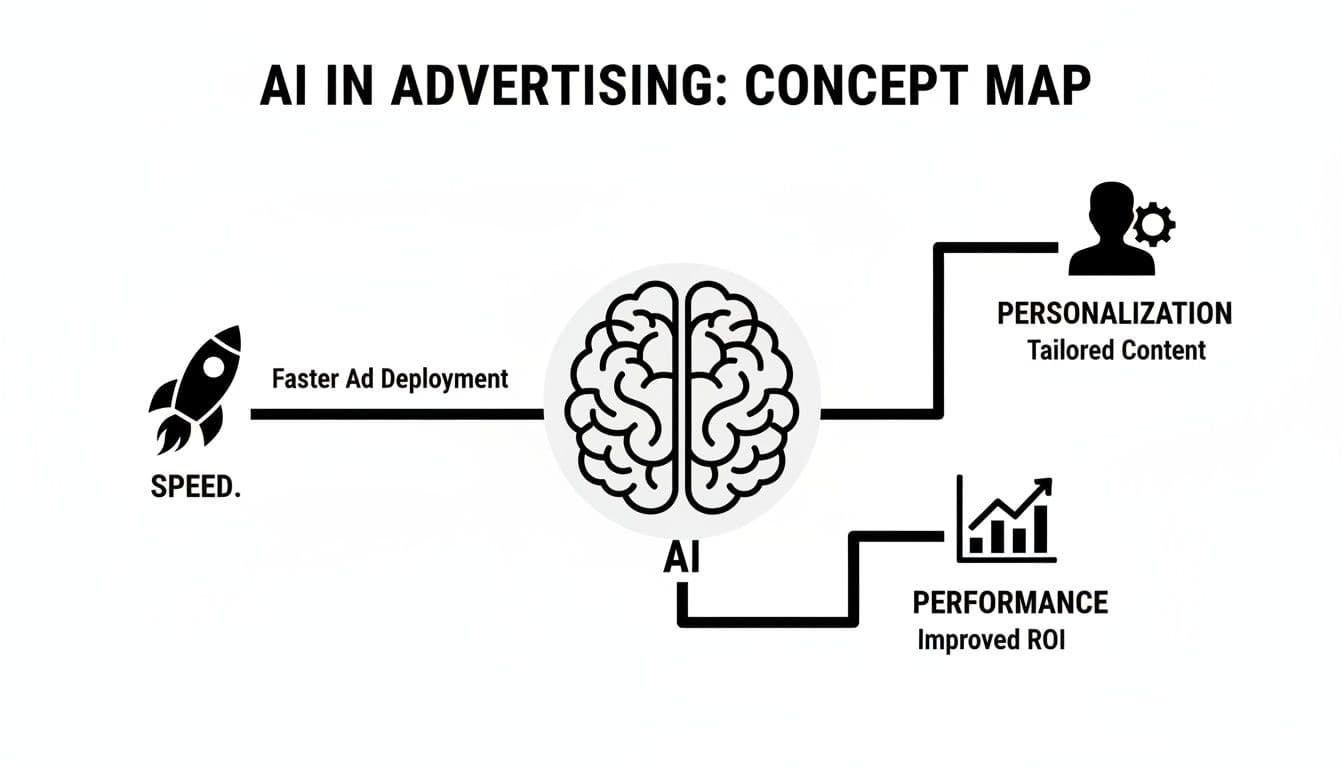
This image nails it: a central AI hub powers these three critical outcomes for marketers. It’s this synergy that lets brands ditch slow, manual processes for an automated, intelligent system that scales both creative production and campaign results.
Generative AI: The Creative Apprentice
First up is Generative AI, the one grabbing all the headlines. The best way to think of it is as a tireless creative apprentice. This apprentice has studied millions of successful ads—images, videos, lines of copy—and has learned the patterns of what works.
You can give this apprentice a simple prompt, like "create a video ad for a new line of sustainable sneakers," and it will instantly draft scripts, mock up visuals, and even suggest different taglines. It doesn't replace the creative director; it gives them an army of assistants to handle the grunt work of initial production. This means you can test dozens of creative ideas in the time it used to take to build just one.
Machine Learning: The Digital Detective
Next on the team is Machine Learning (ML). Picture ML as a digital detective, meticulously sifting through mountains of data to find hidden clues about your audience. It analyzes thousands of behavioral signals—what people click, what they watch, what they buy—to spot patterns that are completely invisible to the human eye.
This is the magic behind hyper-specific audience targeting. Instead of just aiming for "women aged 25-34 interested in fitness," an ML model can identify a micro-audience of "women who recently searched for yoga mats, follow three specific fitness influencers, and bought organic products last month."
Machine Learning turns messy, complex user data into clear, actionable audience segments, ensuring your message reaches the people most likely to convert.
And the detective work doesn't stop once a campaign is live. ML algorithms are constantly learning and adjusting, optimizing ad delivery in real time to squeeze every last drop of performance out of your budget.
Predictive Analytics: The Campaign Fortune Teller
Finally, we have Predictive Analytics. This technology acts as your campaign's personal fortune teller. By analyzing historical data from past campaigns and current market trends, it can forecast which ad concepts, audience segments, and channels are most likely to deliver the best results.
For instance, a predictive model might look at your creative assets and forecast that a video featuring user-generated content will pull in a 25% higher click-through rate with your target demographic than a polished studio ad. This lets you allocate your budget with much greater confidence, putting your money behind the strategies with the highest probability of success before you even spend a dime.
Let's quickly recap how these technologies work together to create smarter, more effective advertising campaigns.
Core AI Technologies Driving Modern Ads
| AI Technology | Primary Function in Ads | Key Benefit for Marketers |
|---|---|---|
| Generative AI | Creates new content (text, images, video) based on prompts. | Dramatically speeds up creative production and allows for massive-scale testing. |
| Machine Learning | Analyzes vast datasets to identify patterns and make decisions. | Enables hyper-precise audience targeting and real-time campaign optimization. |
| Predictive Analytics | Uses historical data to forecast future outcomes and trends. | Reduces wasted ad spend by identifying high-potential strategies before launch. |
In short, they form a powerful trio:
- Generative AI builds the creative assets at scale.
- Machine Learning finds the perfect audience for those assets.
- Predictive Analytics tells you which combination of creative and audience will perform best.
These three technologies are the pillars of AI in advertising. Once you understand how they function, you can see beyond the buzzwords and appreciate the real, tangible value they bring to your marketing. For those looking to dive deeper, our guide to the best AI tools for content creators is a great next step.
How AI Is Revolutionizing Ad Creative Production
The real, tangible impact of AI in ads snaps into sharp focus when you look at creative production. For decades, creating a high-quality ad was a slow, expensive ordeal involving writers, designers, and video editors. AI completely flips that model on its head, turning a production bottleneck into a high-speed, scalable operation.
Imagine needing fresh ad copy for a new campaign. Instead of waiting days for a copywriter to draft five options, an AI tool can spit out fifty distinct variations in under a minute. This isn't just a small speed bump; it allows for immediate A/B testing at a scale that was previously unthinkable, helping you find the winning message faster.
This principle extends far beyond just text. AI can now take a simple URL from a product page and generate a polished video script, complete with scene descriptions and calls-to-action. The real magic happens with sophisticated tools, and some of the most effective are powerful AI video editing tools that automate tasks that once took hours.
From Manual Labor to Automated Creation
Let's look at a common scenario: an e-commerce brand launching a new product line. Traditionally, creating a suite of social media video ads would demand a week-long video shoot, a painful editing process, and a serious budget.
With AI, the entire workflow changes. That same brand can now upload their existing product photos, pick a style template, and generate ten different high-quality video variations in less than an hour. Platforms like Proom AI are a perfect example of this shift, making it possible to produce cinematic video ads through a simple, repeatable process.
This change delivers three core benefits that directly impact your bottom line:
- Massive Speed Gains: Reduce production timelines from weeks down to mere minutes.
- Drastic Cost Reduction: Cut out the high costs tied to traditional video shoots and design agencies.
- Unprecedented Testing Ability: Create and test a huge volume of creative variants to find what truly resonates with your audience.
AI isn't just making the old process faster; it's creating an entirely new one. It shifts the focus from the labor of production to the strategy of performance, empowering marketers to be more agile and data-driven.
Ready to create video ads?
Turn your photos into scroll-stopping ads in minutes. No video editing skills required.
Try For FreeThe Power of Iteration at Scale
The true competitive advantage of using AI in creative production is the power of iteration. When you can generate dozens of ad variations without breaking a sweat, you can test every single element to squeeze more performance out of your campaigns.
For example, you could test:
- Different Hooks: Generate five unique opening lines to see which one grabs the most attention in the first three seconds.
- Varied Visuals: Use AI to create ads with different background styles or color palettes to discover which aesthetic drives more clicks.
- Audience-Specific Messaging: Quickly produce ads with copy tailored to different customer segments, like new buyers versus loyal customers.
This rapid, low-cost testing cycle creates a powerful feedback loop. You learn faster, adapt quicker, and ultimately drive much better results from your ad spend. This agility is fast becoming the new standard in the industry.
The Industry Is All In on AI Creative
This isn't just some niche trend; it's a full-blown mainstream movement. The advertising industry is rapidly adopting AI for creative tasks because they see its immense potential to drive efficiency and, more importantly, performance.
The numbers don't lie. By 2026, a remarkable 83% of ad executives report their companies have deployed AI in the creative process, a sharp jump from 60% in 2024. This signals AI's deep integration into video ad production and beyond. The shift aligns perfectly with 86% of buyers using or planning to use generative AI for their video ad creatives.
This rapid adoption just makes sense. Tools that allow you to generate compelling content from simple inputs are no longer a luxury—they're a necessity for staying competitive. For anyone curious about the practical steps, our guide on how to make AI videos offers a great starting point for leveraging these new capabilities.
Smarter Targeting and Optimization with AI
Creating a killer ad is a huge win, but it’s only half the battle. The other half—the part that really makes or breaks your campaign—is getting that ad in front of the right eyeballs at the perfect moment. This is where AI in ads completely changes the game, leaving the clumsy demographic targeting of the past in the dust.
Forget about just relying on basic age, gender, or location data. Modern AI algorithms chew through thousands of digital signals in real-time, painting a rich, detailed picture of individual users. This allows you to build hyper-specific audiences that were once pure fantasy.
Moving Beyond Demographics to Intent
Let’s get practical. The old way was to target "males aged 30-45 interested in technology." Yawn. An AI-powered approach finds "people who have read three articles about new graphics cards this week, watched a GPU review on YouTube, and visited two different sites selling PC components." See the difference?
This leap from broad categories to specific, demonstrated intent is everything. It means your ad spend isn't wasted on people who just fit a profile. Instead, it's laser-focused on those actively signaling they're ready to buy. AI does the heavy lifting, sifting through mountains of data to find your ideal customers with uncanny precision.
This deeper understanding gets real results. We're already seeing ads delivered through AI-driven conversational experiences drive 73% higher click-through rates than old-school search ads.
Real-Time Campaign Optimization
Once your hyper-targeted audience is locked in, the AI's job isn't over. Not by a long shot. It now becomes a tireless campaign manager, constantly fine-tuning every part of your ad delivery to squeeze out the maximum return.
Think of AI optimization as a smart thermostat for your ad campaigns. It’s always making tiny, real-time adjustments to your bids, budgets, and placements to keep performance at the perfect temperature—all without you having to manually fiddle with the controls.
This automated process runs 24/7, reacting to market shifts and user behavior in milliseconds. It’s all about making sure your budget is always flowing to the most effective channels and creatives.
Here’s a look at how AI keeps your campaigns humming:
- Automated Bidding: For every single ad impression, AI algorithms calculate the probability of a conversion and adjust the bid in real-time. You end up paying the right price for every click, maximizing your ROI.
- Budget Allocation: The system can automatically pull budget from underperforming ad sets and push it toward the winners, making sure no dollar goes to waste.
- Placement Tuning: AI figures out the best spots to show your ads—whether it’s a specific website, social feed, or app—based on where your audience is most likely to click and convert.
The Impact on Efficiency and ROI
This cycle of continuous, automated optimization creates a powerful flywheel. The more data the AI collects from your campaigns, the smarter its decisions get. It learns which ad creative resonates with which audience segment and immediately doubles down on those winning combos.
This is the kind of efficiency that lets marketers find winners in minutes, not weeks. You can rapidly identify and scale high-performing campaigns without the endless manual analysis we all used to dread.
At the end of the day, smarter targeting isn't just about reaching more people. It’s about reaching the right people with a message that clicks, at a cost that makes sense. By putting AI in ads to work, you ensure every single dollar you spend is working as hard as it possibly can to drive real results for your business.
Implementing AI in Your Ad Strategy
So, you're ready to move from theory to action? Great. But before you jump in, let's be clear: adopting AI isn't about a massive, overnight overhaul of your entire workflow. The smartest way to start is to think small, prove the concept, and then scale what works. This is your playbook for getting started without the chaos.
First things first, you need to pinpoint your single biggest bottleneck. Where does the machine constantly jam? Is your team struggling to churn out fresh ad creatives at the insane pace social media demands? Or is your real problem that ads are hitting the wrong eyeballs, torching your budget? Be brutally honest about your primary pain point.
Once you know the problem, you can pick the right tool for that specific job. If creative production is the constant headache, an AI ad video generator is a no-brainer. If targeting is off, then it's time to look at platforms with smarter machine learning baked in.
Start with a Single Use Case
Seriously, don't try to boil the ocean. The secret to getting AI adoption right is picking one high-impact area and absolutely nailing it. For most businesses, especially in e-commerce, the fastest and most tangible ROI comes from automating creative production.
This is the perfect place to start because the results are so easy to see. You can run a direct, apples-to-apples comparison of the time and money it takes to make video ads with an AI tool versus your old, manual grind.
Here’s a simple framework for your first test run:
- Define a Clear Goal: Aim to create five new video ad variations for your top-selling product in less than an hour.
- Choose the Right Tool: Pick a platform built for exactly this, like an AI ad video generator that handles the entire process.
- Measure the Impact: Track the hard numbers. How long did it take? What was the cost per video? And most importantly, how did these new ads perform on click-through rate (CTR) and conversions?
- Prove the Concept: Use that data to build an undeniable business case for expanding AI into other parts of your ad strategy.
This focused approach delivers a clear win and builds momentum. It demystifies the tech and shows its real-world value to your team and anyone watching the budget.
Best Practices for Ethical AI Use
As you start weaving AI into your strategy, it's absolutely critical that you build and maintain trust with your audience. Using AI responsibly isn't just about compliance; it's a core part of building a brand that people actually respect.
The industry is already sprinting in this direction. Projections show generative AI is expected to power at least 50% of Super Bowl spots by 2026. This explosive growth is exactly why you need an ethical framework from day one. You can read more about these marketing predictions and the future of AI on Marketing Dive.
AI gives you incredible power to personalize and persuade. But with that power comes the responsibility to be transparent, fair, and respectful of user privacy. Your brand's reputation depends on it.
To keep your strategy on the right side of the line, focus on these three pillars:
- Data Privacy and Consent: Be upfront about how you collect and use customer data for ad targeting. Make sure any tool you use is compliant with rules like GDPR and gives people clear control over their info.
- Transparency in Content: Don't use AI to create deceptive or misleading ads. Authenticity is everything. While AI can create amazing visuals, be honest about its use where it matters to avoid eroding customer trust.
- Mitigating Bias: AI models are trained on data, and sometimes that data reflects existing societal biases. Always review AI-generated audience segments and creatives to make sure they align with your brand's commitment to fairness and inclusivity.
By starting with a focused project and sticking to ethical best practices, you can bring AI into your ad strategy the right way. This measured approach gets you immediate value while building a sustainable, trustworthy foundation for the future.
Common Questions About AI in Ads
Jumping into any new technology kicks up a lot of questions and a healthy dose of skepticism. When it comes to something with as much impact as AI in ads, it’s best to tackle the big concerns head-on. My goal here is to give you clear, straight-shot answers that cut through the noise so you can move forward with confidence.
Let’s get into a few of the most common questions marketers have when they’re thinking about bringing AI into their day-to-day.
Will AI Replace Human Creativity in Advertising?
This is almost always the first question, and it’s a big one. But the reality is much more about collaboration than competition. Don't think of AI as a replacement for human creativity—think of it as a powerful amplifier. It’s brilliant at tasks that demand incredible scale and speed, things humans just aren't built for.
AI can spit out hundreds of ad variations in minutes, draft initial concepts from a single prompt, or whip up a whole suite of video ads from just a few static images. This frees up human marketers from the soul-crushing, repetitive parts of the job.
The real role of AI in advertising is to be a tireless creative partner. It handles the heavy lifting of production, while humans bring the high-level strategy, the brand story, and the emotional intelligence that makes an ad actually connect with people. The future is a partnership, not a replacement.
By taking over the grunt work, AI hands you back your most valuable asset: time. You can spend that time fine-tuning the creative vision, digging deeper into campaign strategy, and focusing on those uniquely human touches that a machine simply can't fake.
How Can a Small Business Start Using AI in Ads?
The idea that AI is only for massive corporations with bottomless budgets is a total myth. The tools for AI in ads are more accessible and affordable than ever, putting incredible power within reach for businesses of all sizes.
The trick is to start small and focus on your single biggest pain point. For a lot of small businesses, that’s the constant grind of creating high-quality, engaging ad content without going broke.
Here’s a simple way to get started:
- Find Your Bottleneck: Is it creating enough video for social media? Writing ad copy that converts? Pinpoint the one area where you’re spending the most time for the least reward.
- Find a Niche Tool: Look for a platform built to solve that specific problem. Instead of hiring a pricey video agency, you can use an AI tool to turn your existing product photos into slick video ads for Instagram or Facebook.
- Start with a Free Trial: Nearly every modern AI platform offers a free trial or a flexible pay-as-you-go model. This lets you test the tech and see the value for yourself without a huge upfront commitment.
- Measure the Impact: Pick one marketing channel and track the performance of your AI-generated ads. The ROI from even a small, targeted investment in AI creative tools can be massive, giving you the fuel to scale up as your business grows.
What Are the Key Ethical Considerations for AI in Advertising?
Using AI responsibly isn't just a box to check—it’s fundamental to building and keeping customer trust. As you bring these tools into your workflow, keeping ethics front and center will protect your brand's reputation and create a better experience for your audience.
Focus on these three areas to make sure your AI use is both effective and ethical:
- Data Privacy: Only use AI tools that are compliant with privacy laws like GDPR. Be upfront with customers about how their data informs targeting and give them clear control over their information.
- Transparency and Authenticity: Don't try to pass off AI-generated elements as something they're not. Authenticity is everything. While AI can create amazing visuals, being honest about its role is vital for your brand’s long-term health.
- Monitoring for Bias: AI models learn from the data they’re trained on, and that data can reflect and even amplify human biases. Always review AI-generated creative and targeting suggestions to ensure they align with your brand’s commitment to fairness, diversity, and inclusion.
Responsible AI is a cornerstone of any strong, modern brand. By prioritizing these ethical practices from day one, you can tap into the power of AI while actually strengthening your connection with customers.
Ready to see just how fast and easy AI-powered ad creation can be? With Proom AI, you can turn your static images into stunning, professional video ads in just minutes. Stop wasting time on slow, expensive production and start creating high-performing creatives at scale. Try Proom AI for free and generate your first video ad today!
Ready to create video ads?
Turn your photos into scroll-stopping ads in minutes. No video editing skills required.
Try For Free