Ai-ads Mastery: How ai-ads Shape AI-Driven Marketing
Discover ai-ads and learn how AI-powered creative, targeting, and optimization can boost your campaigns and deliver measurable results.
At its core, an AI ad is just an ad campaign that uses artificial intelligence to automate and sharpen nearly every step of the process. Instead of marketers manually guessing which audiences to target or which creatives will land, AI algorithms do the heavy lifting. The goal is to deliver more relevant ads to the right people, at the perfect moment, driving higher engagement and better ROI.
What Are AI Ads and Why Do They Matter Now?
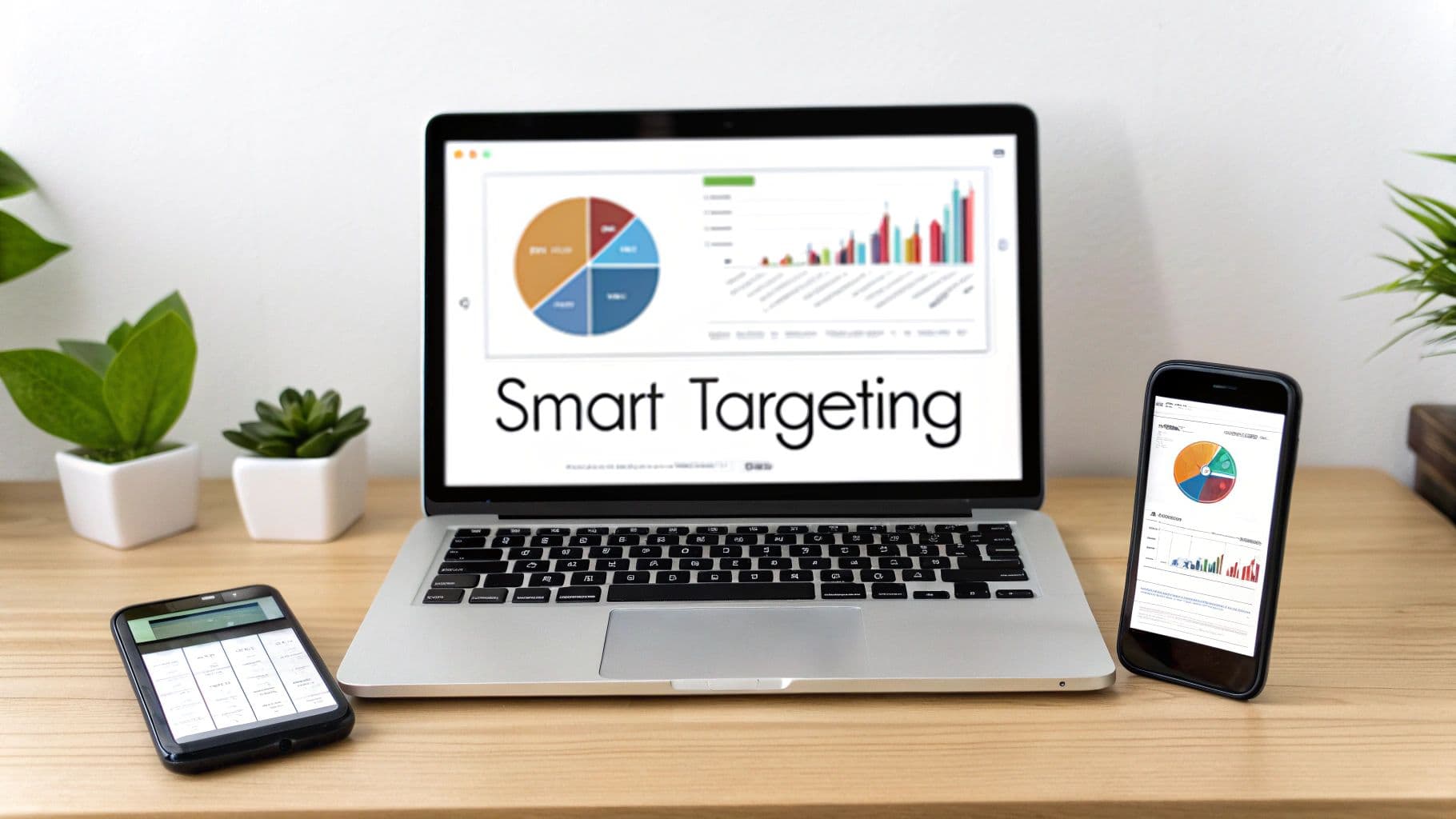
Think of old-school digital advertising like casting a huge, generic net into the ocean. Sure, you might catch some of the fish you want, but you’ll also snag a ton you don’t, wasting time, energy, and money.
AI ads are completely different. They’re more like a smart, sonar-guided fishing rod. It pinpoints the exact fish you’re after, understands its behavior, and drops the perfect, irresistible lure right when it's most likely to bite.
This smarter approach tackles some of the most stubborn headaches marketers have been dealing with for years. Advertising has long been a battle against inefficiency and guesswork. For a deeper dive into the foundational tools shaping this space, this resource on AI Ads offers some helpful context.
Solving Old Problems with New Technology
The whole point of AI in advertising is to swap out tedious manual work with data-driven automation. It's not just about doing things faster; it's about doing them smarter and solving the big problems that have held campaigns back for years.
Here are the key issues AI-driven advertising is finally fixing:
- Wasted Ad Spend: AI’s precision targeting means your budget goes toward audiences with a high probability of converting. This dramatically cuts down on money burned on uninterested eyeballs.
- Creative Burnout: Forget manually designing dozens of ad variations. Generative AI can spit out thousands of unique images, videos, and ad copy combos from just a few core assets, speeding up testing and keeping your content fresh.
- Lack of Personalization: AI analyzes user data to serve up hyper-relevant ad content at scale. We're moving beyond broad segments to individual-level personalization that actually connects with people.
This isn't just a game for massive corporations with bottomless budgets anymore. Today’s platforms are making AI-powered advertising accessible to businesses of all sizes, leveling the playing field and letting smaller teams compete with the big dogs.
The New Competitive Edge
So why does this all matter right now? Because consumer expectations have fundamentally changed. People demand relevant, non-intrusive experiences, and AI is the only way to deliver that at scale.
As old-school methods lose their punch in an incredibly crowded digital world, adopting AI is quickly becoming a non-negotiable for survival and growth. You can get more practical ideas for putting this into action by exploring these insights on AI in ads.
The Core Technologies Behind Smarter Advertising
To really get how AI ads pull off their magic, you have to look under the hood. It’s not some single, mysterious black box. It’s a mix of powerful technologies working in harmony, kind of like a skilled pit crew in a Formula 1 race, where every member has a specific job.
These core pieces handle everything from dreaming up the ad creative to analyzing who sees it, turning advertising from a game of guesswork into a science of precision. Let’s pop the hood and break down the engine that drives today's smarter ad campaigns.
Generative AI: The Tireless Creative
Picture this: you have a single product photo, a logo, and a short line of copy. In the old days, making just a handful of ad variations from those assets was a tedious, hours-long task.
Now, imagine a digital artist who never sleeps. This artist can take those exact same elements and instantly spin up thousands of unique ad variations—different layouts, backgrounds, headlines, and even entire videos.
That’s Generative AI in a nutshell. It’s your creative engine, churning out endless combinations of visuals and text for you to test. This frees you up to discover what actually connects with your audience, without the soul-crushing manual work. For any creator, getting familiar with the best AI tools for content creation is the perfect starting point to tap into this power.
Machine Learning: The Strategic Brain
If Generative AI is the artist, Machine Learning (ML) is the strategic brain running the whole operation. ML algorithms are designed to learn from data, spot patterns, and make smart predictions without being told exactly what to do in every situation.
It’s just like your favorite streaming service. It doesn’t just throw random shows at you. It analyzes what you’ve watched, what you’ve skipped, and what other people like you enjoy to recommend something you’ll probably love. In advertising, ML does the same thing with user behavior, sifting through clicks, conversions, and engagement data to zero in on the audiences most likely to buy.
Having a solid data foundation is everything here, especially as collecting and using your own first-party data becomes more critical.
By continuously learning from campaign performance, machine learning fine-tunes targeting in real-time. This ensures your ads are not just seen, but seen by the right people at the right moment.
Predictive Analytics: The Financial Forecaster
Predictive Analytics is the fortune-teller of the group. It uses statistical models and machine learning to forecast future outcomes based on what’s happened in the past. In the world of AI ads, this tech acts as a financial planner for your campaign budget.
It digs into past performance to answer the big questions:
- Which audience segment is most likely to give us the highest Return on Ad Spend (ROAS)?
- How much should we bid for a specific ad placement to get the most conversions?
- When is an ad creative going to hit "ad fatigue" and stop working?
This foresight allows ad platforms to shift your budget intelligently, automatically doubling down on what's working and pulling back from what's not. It’s a proactive approach that makes sure every single ad dollar is working as hard as it possibly can to hit your goals.
How AI Is Reinventing Ad Creative Generation

For decades, getting new ad creative has been a serious bottleneck for marketers. The old-school workflow—brainstorming, shooting, editing, then doing it all over again—is slow, expensive, and a nightmare to scale.
This painful process means teams can only test a handful of ad variations at a time. The result? Countless "what ifs" and potential winning ads that never even get a chance to run.
Now, AI ads are completely flipping that script. What was once a linear, manual grind has become a rapid, scalable workflow that can turn a few static assets into a library of high-performing video ads in minutes. For performance marketing and e-commerce teams who live and die by their ability to test and optimize, this is a massive shift.
From Static Images to Dynamic Videos
The real magic behind this reinvention is AI’s ability to generate professional-quality videos from the simplest inputs. Platforms can now take a handful of your product photos, a logo, and a line of text, and automatically spin up cinematic videos with slick motion, transitions, and music.
This capability shatters huge barriers to entry. Small teams no longer need a Hollywood-sized budget or video production expertise to create compelling ad content. They can just focus on getting strong images and let the AI handle the heavy lifting of video assembly.
If you want to see this in action, you can check out our practical guide on how to make AI videos.
Ready to create video ads?
Turn your photos into scroll-stopping ads in minutes. No video editing skills required.
Try For FreeAmplifying Creativity, Not Replacing It
There's a common fear floating around that AI is coming for creative jobs. The reality is far more interesting: these tools are creative amplifiers, not replacements.
AI takes over the repetitive, time-sucking parts of production. This frees up marketers to focus on what humans do best: big-picture strategy, authentic storytelling, and actually understanding what makes customers tick.
Think of it as gaining a whole new set of superpowers:
- AI Scriptwriting: Tools can instantly generate hooks, ad copy, and calls-to-action that are already dialed in for specific platforms and audience mindsets.
- Custom AI Presenters: Brands can create unique AI avatars that perfectly match their visual style. This gives you a consistent, recognizable face for campaigns without the hassle and cost of hiring actors for every single ad.
- Endless Variation Testing: AI makes it dead simple to test countless combinations of visuals, scripts, and presenters to find the exact formula that connects with your audience.
The industry is already taking notice. Generative AI is rapidly becoming a core part of the advertising toolkit. Nearly 40% of all video ads are expected to be touched by genAI by 2026—a huge jump from 22% in 2024. This detailed IAB report on the rise of genAI in video advertising shows just how quickly this technology is becoming central to modern campaigns.
By automating the grunt work of creative production, AI lets marketers graduate from being assemblers to being architects. The focus shifts from manual execution to high-level strategic direction, leading to smarter, faster campaign optimization. This fundamental change is unlocking a new level of performance that just wasn't possible before.
Using AI for Powerful Targeting and Optimization
A great ad is only half the battle. The real magic happens when you get that ad in front of the right people at the right time, and this is where AI ads completely change the game. It’s the difference between shouting into the void and having a quiet, convincing conversation with your ideal customer.
AI looks past the broad, often clumsy, strokes of demographic targeting. Instead, its machine learning algorithms dig into thousands of behavioral signals—from browsing habits and past purchases to the content someone actually engages with—to build incredibly specific audience segments.
Like a Wall Street Algorithm for Your Ad Spend
Think of it like an AI built for stock trading. That system doesn't just guess; it analyzes market data in milliseconds to predict movements and make lightning-fast trades. In the same way, an ad platform’s AI makes real-time bidding decisions for you.
It instantly calculates the value of showing your ad to a specific person and bids just the right amount to win the placements most likely to lead to a sale. This is how you stop overpaying for low-value clicks and start winning the attention of high-intent customers.
Automated Testing on a Massive Scale
One of the biggest bottlenecks for human marketers is A/B testing. We all know we should do more of it, but manually setting up, tracking, and making sense of tests across different creatives, headlines, and audiences is a soul-crushing amount of work.
AI automates this entire workflow at a scale no human team could ever manage. It can test thousands of creative variations against countless audience segments at the same time, quickly finding the winning combinations with statistical certainty.
This process, often called multivariate testing, creates a feedback loop where the system is always learning and adapting. The AI automatically shifts your budget away from the ads and channels that aren't working, pouring it back into what actually drives results.
AI is constantly refining your campaign to maximize Return on Ad Spend (ROAS). It learns from every single click and conversion, ensuring your money is always flowing to the most powerful mix of creative, audience, and placement.
Balancing Power with Responsibility
These targeting capabilities are incredibly powerful, but they also come with some serious ethical responsibilities. Using data the right way is absolutely essential for building and keeping the trust of your customers.
As advertisers, we have to stay grounded in a few key principles:
- Ethical Data Use: All data must be sourced and handled in line with privacy laws like GDPR and CCPA. Being transparent about what data you collect and how you use it isn't optional.
- Avoiding Algorithmic Bias: A machine learning model is only as good—and as unbiased—as the data it’s trained on. It's on us to monitor campaigns to make sure they aren’t reinforcing ugly stereotypes or unfairly excluding certain groups.
- Ad Relevance, Not Intrusion: The whole point is to deliver helpful, relevant ads, not to be creepy. AI should make someone's online experience better by showing them things they're genuinely interested in, not make them feel like their privacy has been violated.
A Practical Roadmap to Launching Your First AI-Ad Campaign
Getting started with AI-ads feels a lot more manageable when you think of it less like flipping a giant switch and more like a series of small, deliberate steps. The goal isn't a perfect, massive launch on day one. It's about learning, iterating, and building momentum.
Here’s a simple roadmap to get you from theory to your first real campaign.
Your journey doesn't start with a fancy tool or a complex algorithm. It starts with a simple question: What are we actually trying to achieve? Before you do anything else, you have to define clear, measurable campaign goals. Are you driving sales, hunting for qualified leads, or just getting your name out there?
Each objective demands a completely different playbook. An e-commerce brand, for example, might be laser-focused on hitting a 3x Return on Ad Spend (ROAS). A B2B company, on the other hand, might just want to cut its Customer Acquisition Cost (CAC) by 20%. Get specific. It’s the only way to know if this is actually working.
Choosing the Right Tools and Preparing Your Assets
With a clear goal locked in, now you can think about tools. The right platform should feel like a natural extension of your objective. A small business that needs to pump out video ads fast might gravitate toward a tool like Proom AI for its sheer speed. A huge enterprise, however, might need a sprawling, all-in-one suite to manage complexity.
Once you’ve picked your platform, it’s time to feed the machine. The AI needs raw materials to work with, and the quality of your inputs directly impacts the quality of its outputs.
- Gather your best visuals: Pull together your sharpest product photos, brand logos, and any lifestyle shots that tell your story.
- Compile your core messaging: Get your key value propositions, go-to headlines, and powerful calls-to-action all in one place.
- Define your brand's DNA: Have your brand colors, fonts, and general style guide ready. Think of it as teaching the AI how to speak your brand’s visual language.
The more organized you are here, the better the results will be. Garbage in, garbage out.
Launching, Learning, and Scaling Your Campaign
Ready to go live? Don't go all in. Start small. A pilot campaign is your secret weapon—a low-budget, low-risk test run designed for one thing: collecting data. You're not chasing massive profits just yet. You're mining for insights.
The whole optimization process is a feedback loop. You target, test what works, and then double down on the winners to improve your results. It's that simple.
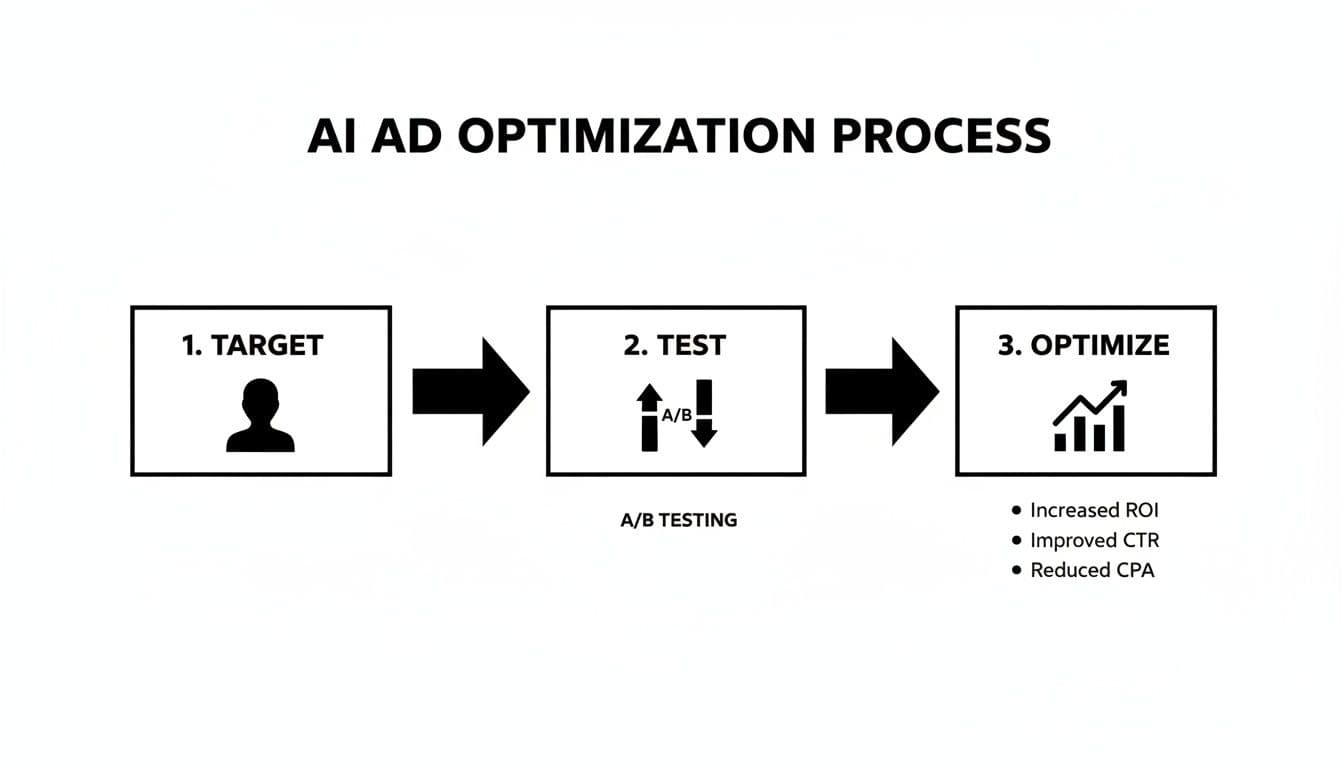
This cycle of targeting, testing, and optimizing is what makes AI so powerful. After you launch your pilot, let the AI do its thing. It will quickly tell you which ad variations, images, and audience segments are hitting the mark. Use those early wins to refine your strategy, and then you can confidently start scaling up the budget.
To give you a better idea of where to begin, we’ve put together a quick cheat sheet. It connects common business models with the AI-ad strategies that usually deliver the biggest impact right out of the gate.
AI-Ad Applications by Business Type
| Business Type | Primary Goal | Key AI-Ad Application | Example Tool/Feature |
|---|---|---|---|
| E-commerce Store | Increase Sales & ROAS | Dynamic Product Ads & Creative Variation Testing | Proom AI Video Generation |
| B2B SaaS | Generate Qualified Leads | Predictive Audience Targeting | Lookalike Audience Creation |
| Local Service | Drive In-Store Visits | Geo-Targeted Ad Delivery | Automated Bid Adjustments |
| Content Creator | Grow Audience | Personalized Content Promotion | AI-Generated Video Shorts |
Think of this table as a starting line, not a finish line. The best application for your business is the one that directly pushes you toward the specific goals you set in the very first step.
Measuring Success and Preparing for the Future of Advertising
Launching an AI-powered ad campaign is just the start. The real magic happens when you can draw a straight line from the AI’s capabilities to the business outcomes that actually move the needle. It's time to look past surface-level stats and zero in on the key performance indicators (KPIs) that prove your investment is working.
AI doesn’t just nudge these numbers in the right direction; it gives you a much deeper understanding of why certain ads are resonating. This granular insight lets you make smarter, faster decisions, turning your ad spend from a necessary cost into a reliable growth engine.
Key Metrics That Truly Matter
When you're looking at your AI campaign performance, a few core metrics tell most of the story. These KPIs give you a clear window into how efficiently you’re spending money and the real-world impact it’s having on your bottom line.
Here are the essentials to keep your eye on:
- Return on Ad Spend (ROAS): This is the ultimate measure of profitability. For every dollar you put in, how much revenue comes back out? AI directly boosts ROAS by getting your ads in front of the people most likely to buy.
- Customer Acquisition Cost (CAC): How much does it really cost to bring a new customer on board? AI slashes this number by cutting out wasted spend on uninterested audiences and shortening the path from first click to final purchase.
- Creative Fatigue Rate: This is the point where an ad just stops working because people are tired of seeing it. AI not only spots this decline faster but also generates fresh creative variations to keep your audience engaged before they even have a chance to tune out.
By focusing on these concrete outcomes, you get a clear, unfiltered view of your campaign’s health. AI-driven platforms provide dashboards that make this data easy to access, helping you prove the value of your efforts to stakeholders.
Looking Ahead: What's Next for AI Ads
The world of AI advertising is moving at a breakneck pace. What seems like a futuristic tool today will be standard practice tomorrow. If you want to stay ahead, you need to understand the trends that are shaping how brands will connect with people in the near future.
Video is a massive area of development. Marketers are jumping on AI for video creation, with 63% now using these tools—a huge leap from just 51% a year ago. The results speak for themselves: 93% of businesses say video directly boosts brand awareness, and 83% see it drive sales. You can dig into more of this data in the latest video marketing statistics from Wyzowl.
Looking forward, a few key trends are set to define the next chapter of ai-ads:
- True Hyper-Personalization: We're moving beyond simple audience segments toward creating true one-to-one advertising. Imagine ads where every single element—the image, the text, the offer—is dynamically generated for an individual's unique context and preferences.
- The Rise of Custom AI Influencers: Why borrow an influencer when you can build your own? Brands will increasingly create their own AI-powered brand ambassadors, giving them total control over messaging and style for a perfectly consistent and scalable way to build a community.
- Full Customer Journey Integration: AI won’t be siloed within your ad platform anymore. It will connect every single touchpoint, from the moment a person discovers your brand to their purchase and post-sale support, creating one seamless and intelligent experience.
Ready to stop guessing and start generating high-performance video ads in minutes? Proom AI gives you the power to turn your static photos into compelling, professional ad creatives that drive real results. Launch your first campaign and see the difference for yourself.
Ready to create video ads?
Turn your photos into scroll-stopping ads in minutes. No video editing skills required.
Try For Free