The Top 10 Types Facebook Ads To Master in 2026: A Complete Guide
Unlock higher conversions with our complete guide to the 10 essential types Facebook ads. Learn specs, best practices, and pro tips for 2026.
In the competitive world of social media advertising, relying on a single ad format is a surefire way to limit your reach and cap your return on investment. To truly succeed on Meta's powerful platform, you need a full toolkit. Understanding the nuances of all the different types of Facebook ads, from immersive Instant Experiences to high-converting Dynamic Product Ads, is the key to unlocking better engagement, higher ROI, and scalable growth for your brand. Simply boosting a post is no longer enough to cut through the noise and achieve meaningful business objectives.
This guide moves beyond the basics to provide a comprehensive roundup of the 10 essential ad formats every e-commerce and social marketer must master. We'll break down the technical specs, strategic use cases, creative best practices, and actionable performance tips for each format, giving you the blueprint to build more effective, targeted, and profitable campaigns. Whether you're aiming to drive sales with a dynamic product catalog or capture leads directly within the platform, choosing the right ad type is the first critical step.
By strategically aligning each format with specific campaign goals, you can create a more sophisticated and effective advertising funnel. To truly master all types of Facebook Ads, understanding the core Facebook Ads best practices is essential for maximizing your return on ad spend. Consider this your definitive resource for selecting, designing, and optimizing every ad in your arsenal, ensuring your message not only reaches the right audience but does so in the most impactful way possible.
1. Video Ads
Video ads are one of the most powerful and engaging types of Facebook ads, leveraging motion, sound, and storytelling to capture user attention in a crowded feed. These dynamic ads autoplay (often silently) as users scroll, making the first few seconds critical for hooking a viewer. They are exceptionally effective for demonstrating value that static images cannot convey, making them a cornerstone of modern social media marketing.
Primary Objectives and Use Cases
Video is the ideal format for illustrating transformation, demonstrating product functionality, or evoking emotion. It excels in campaigns with objectives like Brand Awareness, Engagement, and Conversions.
- E-commerce Retailers: Use videos to showcase a product in 360 degrees, demonstrate how a complex item works, or feature user-generated content of customers enjoying their purchase.
- Real Estate & Home Improvement: Before-and-after renovation videos or virtual property tours are incredibly effective. A real estate agent can use a short video to highlight the transformation of a staged home, generating interest and leads.
- SaaS & Tech Companies: A brief screen recording or animated explainer can quickly communicate a software's core benefits and user interface.
Creative and Performance Tips
To maximize performance, your video ad strategy needs to be mobile-first and optimized for short attention spans.
- Hook Within 3 Seconds: Start with your most compelling visual or message. Assume you only have a moment to stop the scroll.
- Design for Sound-Off Viewing: Approximately 85% of Facebook videos are watched without sound. Use bold text overlays, subtitles, or captions to ensure your message is understood.
- Optimize Aspect Ratios: Use a vertical (4:5 or 9:16) aspect ratio for Feeds and Stories. This maximizes screen real estate on mobile devices.
- Include a Clear CTA: End your video with a strong, clear call-to-action that tells viewers exactly what to do next, whether it’s "Shop Now" or "Learn More."
Pro Tip: Don't have video production resources? You can use AI-powered tools like Proom to instantly transform static product images into cinematic, engaging video ads, saving significant time and budget. For a deeper dive into campaign setup, explore this guide on how to run Facebook ads effectively.
2. Carousel Ads
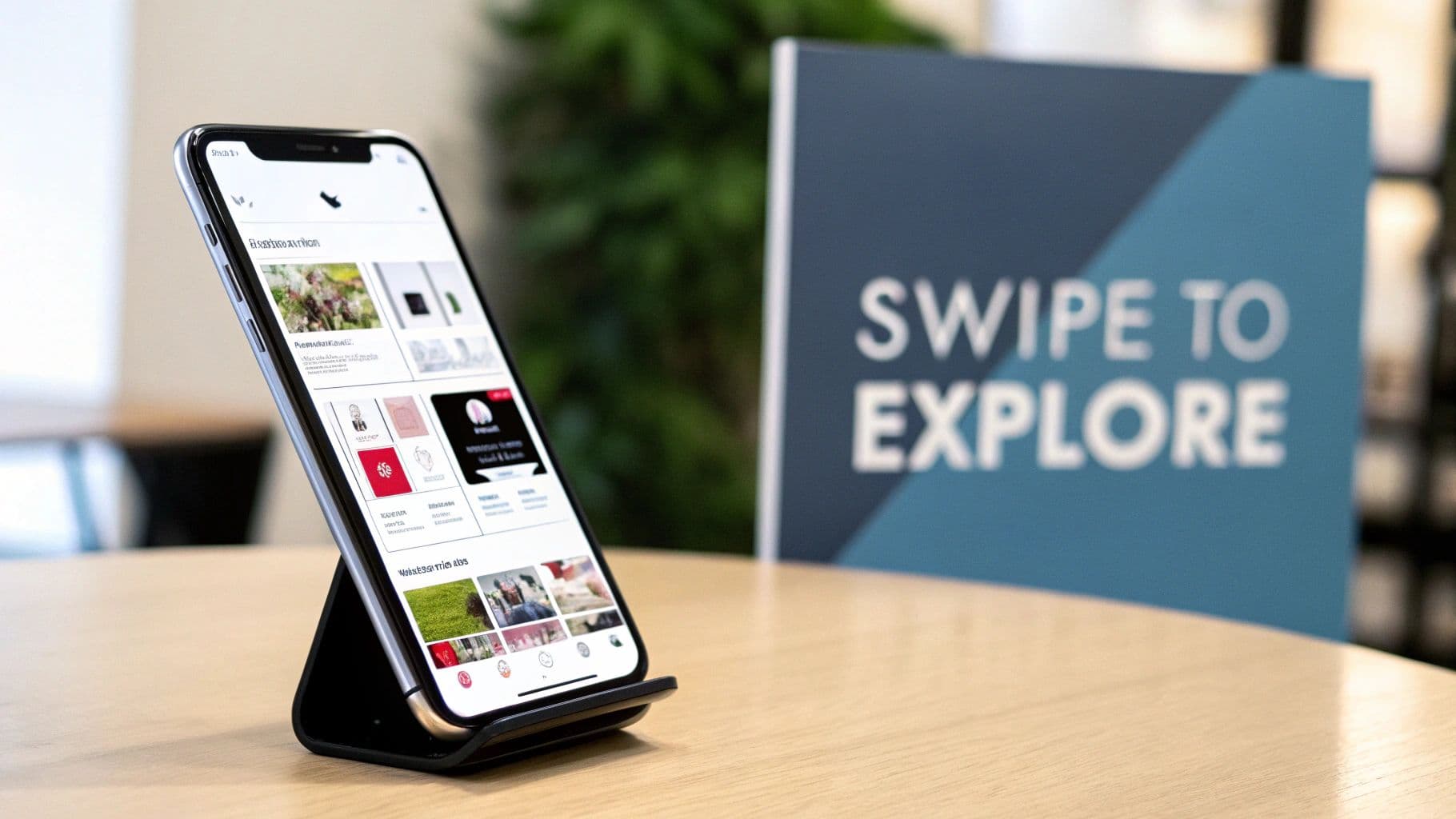
Carousel ads are a versatile and interactive type of Facebook ad that allows you to showcase up to 10 images or videos within a single ad unit. Each "card" in the carousel can have its own unique headline, description, link, and call-to-action, giving users a rich, swipeable experience. This format is incredibly effective for telling a story, highlighting multiple products, or detailing different features of a single offering.
Primary Objectives and Use Cases
Carousels are ideal for campaigns focused on Traffic, Conversions, and Catalog Sales, as they encourage direct engagement and exploration. They give you more creative real estate than a single image ad, allowing for deeper storytelling and product discovery.
- Fashion Retailers: Display a full outfit piece-by-piece or showcase multiple items from a new collection, with each card linking directly to the product page.
- Real Estate Agents: Feature multiple photos of a single property, taking users on a virtual room-by-room tour.
- Interior Designers & DIY Brands: Create a compelling before-and-after narrative, with each card revealing a different stage of a room's transformation.
Creative and Performance Tips
To make your carousel ads effective, you need to create a cohesive and compelling swiping experience that guides the user from the first card to the last.
- Lead with Your Strongest Visual: The first card is your hook. Use your most eye-catching product image or video to stop the scroll and encourage the first swipe.
- Create a Narrative Flow: Connect your cards visually or thematically to tell a story. A panoramic image split across multiple cards can create a powerful, continuous experience.
- Use Consistent Branding: Maintain a consistent visual style, color palette, and tone across all cards to create a professional and unified ad experience.
- Highlight Key Benefits: Use the headline and description space on each card to call out specific features or benefits, giving users a reason to click through.
Pro Tip: Mix static images with dynamic video cards to make your carousels more engaging. You can even feature user-generated content (UGC) on a card to build social proof. To get started with sourcing authentic customer content, learn more about how to make UGC a core part of your strategy.
3. Collection Ads
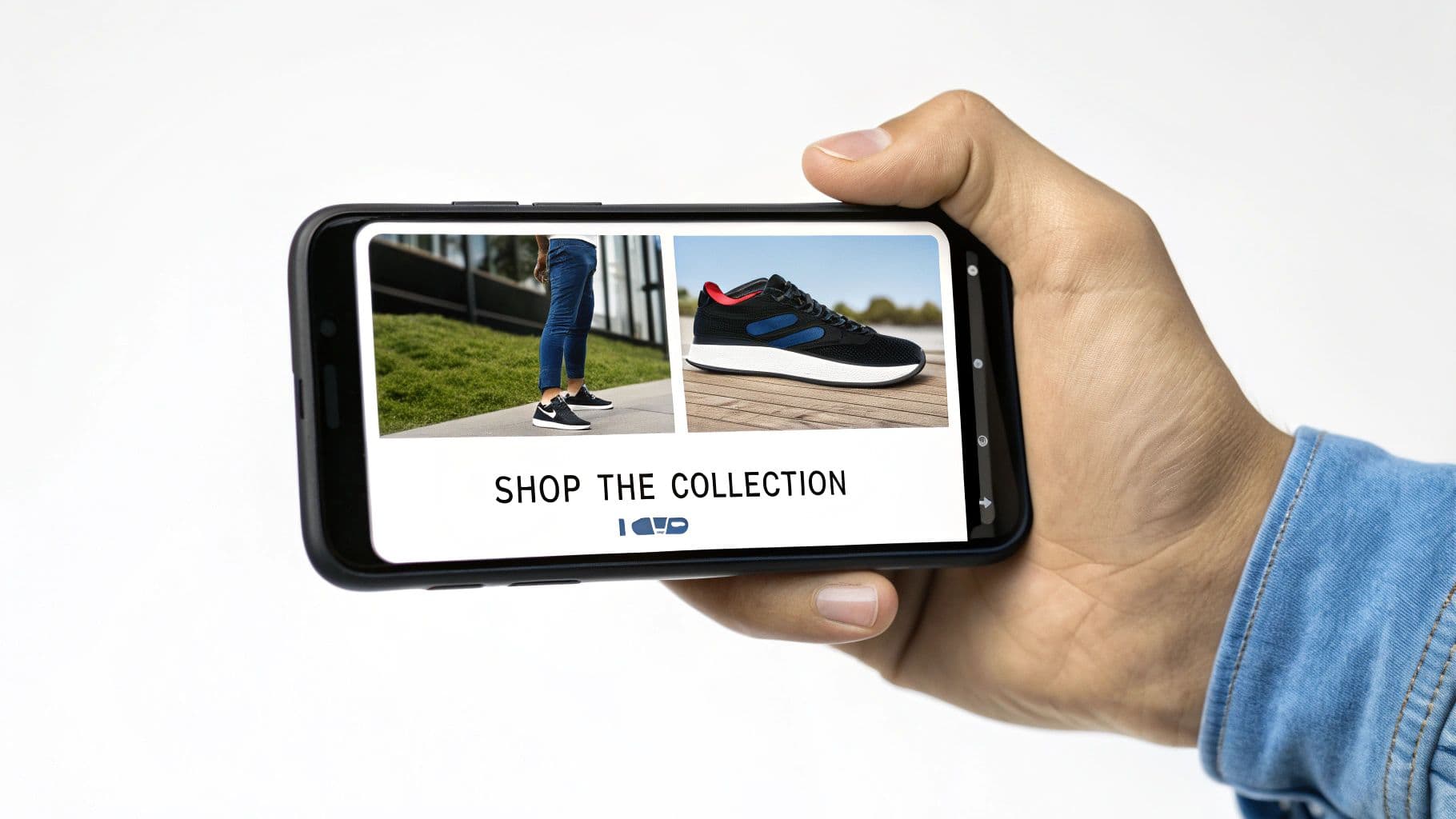
Collection ads offer a powerful, mobile-optimized storefront experience, making them one of the most effective types of Facebook ads for direct-to-consumer brands. This format pairs a primary "hero" video or image with a grid of four related product images below it. When a user taps on the ad, it opens into an Instant Experience, a full-screen, fast-loading catalog where they can browse and shop multiple products without ever leaving the Facebook app.
Primary Objectives and Use Cases
The primary goal of a Collection ad is to drive product discovery and sales by reducing friction in the mobile shopping journey. It excels in campaigns with objectives like Conversions, Catalog Sales, and Store Traffic.
- Fashion & Apparel Retailers: Use a lifestyle video to showcase a new seasonal collection, with the product grid featuring individual items like dresses, shoes, and accessories from the look.
- Home Goods & Décor Brands: A primary image of a styled room (e.g., a living room) can be paired with a product grid displaying the exact furniture, lamps, and art used in the shot.
- E-commerce Stores: Feature a "Best-Sellers" or "New Arrivals" collection, using a dynamic video to capture attention and the grid to highlight top-performing SKUs.
Creative and Performance Tips
Success with Collection ads hinges on creating a seamless and visually appealing mini-storefront experience.
- Lead with an Engaging Hero Asset: Your primary video or image must be compelling enough to make users stop scrolling and want to explore the collection. A dynamic video often outperforms a static image here.
- Curate a Cohesive Product Set: The products in your grid should be logically related to the main creative and to each other. Avoid a random assortment of items.
- Optimize Your Product Catalog: Ensure your product catalog has high-resolution images, clear and concise titles, and accurate pricing. This data directly populates your ad.
- Arrange Products Strategically: Place your most popular or highest-margin item in the first slot of the product grid, as it's the most prominent.
Pro Tip: Use the "Dynamic Video" creation tool in Ads Manager to automatically generate a video from your catalog items. This is a quick way to create an engaging hero asset that showcases multiple products without needing a dedicated video shoot.
4. Image Ads
Image ads are the original and most fundamental type of Facebook ad. Featuring a single, compelling static visual accompanied by a headline, primary text, and a call-to-action button, they are the backbone of many advertising strategies. While seemingly simple compared to dynamic formats, their strength lies in their clarity, speed of creation, and universal compatibility across placements, making them an essential tool for any marketer.
Primary Objectives and Use Cases
Single-image ads are incredibly versatile and can support nearly any marketing objective, from Brand Awareness to Conversions. They are particularly effective when you have one powerful visual that can communicate your entire message at a glance.
- E-commerce Brands: Use a high-quality "hero shot" to feature a single best-selling product, announce a new arrival, or promote a limited-time sale with a clean, direct visual.
- Real Estate Agents: Showcase a property's best feature, like a stunning kitchen or a beautiful exterior, in a single, high-resolution photo to capture immediate interest for a listing.
- Design Agencies & Creatives: Highlight a standout piece from a design portfolio or showcase a finished interior design project to attract new clients with a strong visual proof of work.
Creative and Performance Tips
To make a static image stand out, it must be visually arresting and strategically designed to stop the scroll and communicate value instantly.
- Use High-Contrast Visuals: Choose bright, bold, and eye-catching images that pop against the Facebook feed's neutral background. Avoid cluttered or low-resolution photos.
- Incorporate Text Overlays: Add a concise headline or key benefit directly onto the image to grab attention, but keep text minimal to comply with Facebook's guidelines.
- Test Multiple Variations: A/B test different images for the same offer. Small changes in color, angle, or composition can lead to significant differences in performance.
- Optimize for Placements: Use a square (1:1) aspect ratio for the Feed and a vertical (9:16) ratio for Stories and Reels to maximize screen space on mobile devices.
Pro Tip: Once you identify a high-performing static image ad, use it as a creative benchmark. You can leverage an AI tool like Proom to instantly convert that proven visual into a dynamic video ad, scaling your success and improving engagement without needing a full video production workflow.
5. Stories Ads
Stories ads are a full-screen, immersive type of Facebook ad that appears between organic Stories on Facebook, Instagram, and Messenger. Leveraging a vertical 9:16 aspect ratio, these ads are designed for the mobile-first user, capturing attention with ephemeral content that feels native to the Stories experience. They are highly effective for reaching younger demographics and users who engage more with Stories than the traditional news feed.
Primary Objectives and Use Cases
The temporary and engaging nature of Stories makes them perfect for creating urgency and driving immediate action. They excel in campaigns with objectives like Traffic, Brand Awareness, and Conversions, especially for visually driven products.
- Fashion & Apparel Brands: Tease a new collection with a rapid-fire sequence of images or a short video, encouraging users to "Swipe Up" to see the full line.
- E-commerce Retailers: Run limited-time promotions or flash sales using bold text overlays and countdown stickers to create a sense of urgency and drive quick purchases.
- Real Estate Agents: Create quick, engaging vertical video tours of a property, highlighting key features and ending with a clear call-to-action to schedule a viewing.
Ready to create video ads?
Turn your photos into scroll-stopping ads in minutes. No video editing skills required.
Try For FreeCreative and Performance Tips
To succeed with Stories ads, you must embrace the platform's fast-paced, vertical format and create content that feels authentic and stops the tap-through.
- Grab Attention Instantly: Use your most compelling visual or motion in the very first frame. Users decide whether to watch or skip in a fraction of a second.
- Keep It Simple and Clear: Avoid cluttering the screen. Use minimal, easy-to-read text and ensure your core message is understood quickly.
- Use High-Quality Vertical Video: Always shoot or design your creative for a 1080x1920 pixel resolution to fill the entire screen and provide a premium viewing experience.
- Include a Strong CTA: Make your call-to-action impossible to miss. Use a final frame that explicitly says "Swipe Up to Shop" or leverage interactive poll and quiz stickers to boost engagement.
Pro Tip: Need to create high-impact vertical videos fast? You can use AI tools like Proom that offer specialized vertical video templates, allowing you to generate Stories-optimized ad creative from static images in seconds. To learn more about setting up your campaigns, explore this guide on how to run Facebook ads effectively.
6. Reels Ads
Reels ads are short-form, vertical video ads designed to integrate seamlessly within the Facebook and Instagram Reels feeds. As Meta's direct answer to the TikTok format, these are among the most engaging types of Facebook ads available today. They tap into user behavior that favors fast-paced, entertaining, and trend-driven content, making them a powerful tool for brands looking to connect with a highly active audience in a native, non-disruptive way.
Primary Objectives and Use Cases
Reels ads are perfectly suited for campaigns focused on Brand Awareness, Engagement, and Traffic, as their primary function is to capture attention and build a community feel. The format excels at creative storytelling and showing a brand's personality.
- Design & Creative Agencies: Can use Reels to showcase a rapid-fire portfolio of recent work, a time-lapse of a creative process, or quick design tips that demonstrate expertise.
- Real Estate Agents: Property reveal videos, quick "before-and-after" clips of a staged room, or neighborhood highlight tours are highly effective for generating local interest and leads.
- Lifestyle & Fashion Brands: Can leverage Reels to share user-generated content, showcase customer transformation stories, or create "style with me" videos that feature their products organically.
- Tech & AI Brands: Can use animated clips or AI influencer-driven content to explain complex concepts in a simple, visually appealing way, driving brand awareness and curiosity.
Creative and Performance Tips
To succeed with Reels ads, your creative must feel authentic to the platform and prioritize entertainment over a hard sell.
- Hook in the First 2 Seconds: Use a strong visual opening, a surprising transition, or an intriguing question to immediately stop the scroll.
- Leverage Trending Audio: Incorporate trending sounds and music to increase relevance and potential reach, but ensure it aligns with your brand identity.
- Tell a Story: Focus on a simple narrative. Whether it’s a quick makeover or a behind-the-scenes look, a beginning-middle-end structure works best.
- Optimize for Sound-On: Unlike Feed ads, many users watch Reels with sound. Use audio to your advantage, but still include captions for accessibility and clarity.
- Subtle CTA: Integrate your call-to-action naturally. A text overlay suggesting "Link in Bio" or a simple "Follow for More" can perform better than an aggressive "Shop Now" button.
Pro Tip: Creating native-looking Reels content doesn't require a full production team. Use AI tools like Proom to instantly turn static image sequences or existing product shots into dynamic, cinematic videos. For more tips on production, check out this guide on how to create video ads for social media.
7. Instant Experience Ads (Canvas)
Instant Experience ads, formerly known as Canvas ads, are full-screen, mobile-optimized destinations that load instantly within the Facebook or Instagram app. This immersive format functions like a mini-landing page, allowing users to watch videos, swipe through carousels, and explore product galleries without ever leaving the platform. These ads are one of the most versatile types of Facebook ads for creating rich, narrative-driven brand stories.
Primary Objectives and Use Cases
The primary strength of an Instant Experience is its ability to hold user attention and provide a deep, interactive dive into a brand or product line. It excels in campaigns focused on Brand Awareness, Engagement, and Consideration, as it provides more space for storytelling than a standard ad.
- Luxury & Lifestyle Brands: Create an immersive digital lookbook or brand story, using a combination of high-quality video and lifestyle imagery to convey a premium feel.
- Real Estate & Home Improvement: Showcase a complete property tour with videos, before-and-after carousels, and tagged products for fixtures and furnishings, all within one seamless experience.
- Design Agencies & Creative Portfolios: Present detailed case studies by walking a user through a project from concept to completion, combining text, video testimonials, and final project images.
Creative and Performance Tips
Success with Instant Experience ads hinges on creating a compelling, intuitive, and visually engaging journey for the user.
- Design a Narrative Flow: Structure your content to tell a story that encourages scrolling. Start with a captivating hero image or video and guide the user logically through your message.
- Hook with the First Component: Your first piece of media is the "cover" of your experience. Use a dynamic video or a striking image to immediately capture attention and entice users to open the full-screen ad.
- Leverage Component Variety: Mix and match videos, carousels, single images, and text blocks to keep the experience dynamic and prevent user drop-off.
- Place Multiple CTAs: Don't wait until the end. Place call-to-action buttons at strategic points throughout the experience, such as after showcasing a specific product collection or a compelling video.
Pro Tip: Use an AI-generated video from a tool like Proom as the centerpiece of your Instant Experience. A cinematic product video can serve as a powerful hook at the top or as a detailed demonstration in the middle of the flow, significantly boosting engagement.
8. Slideshow Ads
Slideshow ads are a lightweight, video-like type of Facebook ad that uses a sequence of 3 to 10 static images, text, and sound to create a looping animation. They offer the motion and engagement of a video but with a much smaller file size, making them ideal for reaching audiences with slower internet connections. This format is perfect for businesses that have a strong library of images but lack the resources for full-scale video production.
Primary Objectives and Use Cases
Slideshows are incredibly versatile and excel in campaigns focused on Traffic, Conversions, and Catalog Sales. They are particularly effective for telling a simple story or showcasing multiple products or features in a single, digestible ad unit.
- E-commerce Brands: A home décor brand can display a single product in multiple colors or settings. Similarly, a fashion retailer can showcase different pieces from a new collection, creating a lookbook-style ad.
- Real Estate Agents: An agent can create a quick, compelling tour of a property by rotating through high-quality photos of different rooms, from the kitchen to the backyard.
- Service-Based Businesses: An interior designer can show the progression of a room makeover, using a sequence of photos to highlight the transformation from "before" to "after."
Creative and Performance Tips
To create a slideshow ad that stops the scroll and drives action, focus on visual flow and a clear narrative.
- Start with Your Strongest Image: Just like a video, the first frame is your hook. Use your most eye-catching or compelling product shot to capture immediate attention.
- Create a Logical Narrative: Arrange your images to tell a story or guide the viewer through a process. Show a product from different angles, highlight key features sequentially, or demonstrate a transformation.
- Set the Right Pace: Adjust the transition speed to match your message. A duration of 2-3 seconds per image is often recommended, giving viewers enough time to absorb the visual without losing interest.
- Maintain Brand Consistency: Use a consistent color palette, font, and overall aesthetic across all images to create a cohesive and professional-looking ad.
Pro Tip: Elevate your slideshows by turning them into more dynamic assets. AI tools like Proom can help you A/B test different image sequences and even generate compelling voiceovers to add an extra layer of engagement, turning a simple slideshow into a powerful video ad.
9. Lead Generation Ads
Lead generation ads are one of the most efficient types of Facebook ads for capturing user information directly within the platform. Instead of sending users to an external landing page, this format presents an instant, pre-populated form when a user clicks the call-to-action. By automatically filling in details like name and email from a user’s profile, it dramatically reduces friction and simplifies the lead capture process.
Primary Objectives and Use Cases
This ad format is purpose-built for the Lead Generation objective and is invaluable for businesses that rely on a pipeline of prospects. It's designed to collect contact information for follow-up rather than drive immediate sales.
- Service-Based Businesses: An interior design agency can use a lead form to collect project inquiries, or a marketing agency can offer a free consultation to generate qualified leads.
- Real Estate Agents: This is the perfect format for capturing contact details from potential home buyers or sellers interested in a property valuation.
- High-Ticket E-commerce: Brands selling expensive or customized products can use lead forms to schedule demos, consultations, or pre-order sign-ups.
Creative and Performance Tips
The success of a lead ad depends on a compelling offer and a frictionless form experience. The creative must clearly communicate the value of submitting information.
- Keep Forms Minimal: Only ask for essential information. The more fields you add, the lower your completion rate will be. Stick to 3-5 fields if possible.
- Ask a Qualifying Question: To improve lead quality, include one multiple-choice question that helps segment or qualify the prospect (e.g., "What is your project budget?").
- Offer a Clear Incentive: Give users a strong reason to share their details, such as a free quote, a downloadable guide, a webinar registration, or an exclusive discount.
- Integrate with Your CRM: Connect your Facebook lead forms directly to your CRM or email marketing software. This ensures immediate follow-up, which is critical for converting fresh leads.
Pro Tip: Capture initial attention with a high-impact video before presenting the lead form. Using AI tools like Proom, you can quickly create engaging video ads that communicate your value proposition, making users more likely to complete the form and become a high-quality lead.
10. Dynamic Product Ads (DPA)
Dynamic Product Ads are one of the most powerful and scalable types of Facebook ads for e-commerce, automatically promoting relevant products from your catalog to people who have expressed interest on your website or app. Instead of creating individual ads for every item you sell, DPA uses the Facebook Pixel and your product feed to serve personalized, timely ads to users, significantly boosting relevance and conversion rates.
Primary Objectives and Use Cases
DPA is the go-to format for retargeting and prospecting campaigns focused on Conversions and Catalog Sales. It automates the ad creation process to show the right product to the right person at the right time.
- E-commerce Retailers: A clothing brand can automatically retarget a user with the exact pair of sneakers they viewed but didn't purchase, reminding them to complete the checkout.
- Home Goods Companies: If a shopper browsed for a specific desk lamp, a DPA can show them that exact lamp again, along with other similar or complementary lighting fixtures from the catalog.
- Multi-Product Retailers: Use DPA for cross-selling. A customer who recently bought a camera could be shown ads for compatible lenses, tripods, and camera bags.
Creative and Performance Tips
Success with DPA relies heavily on the quality of your product catalog and the accuracy of your tracking signals.
- Maintain a Healthy Product Feed: Ensure your product feed is accurate and updated daily. Incorrect pricing, stock availability, or broken image links will kill performance.
- Implement the Pixel Correctly: The Facebook Pixel must be installed correctly on every page, tracking key events like ViewContent, AddToCart, and Purchase to build effective retargeting audiences.
- Segment Your Audiences: Create different ad sets for distinct user behaviors. Target users who viewed a product differently from those who abandoned a cart, allowing for more tailored messaging and offers.
- Leverage Custom Product Sets: Group products into custom sets for seasonal campaigns or promotions. For example, create a "Summer Collection" set to push relevant items during warmer months.
Pro Tip: While DPAs primarily use static catalog images, you can elevate your campaigns by incorporating video. Use tools like Proom to generate dynamic videos for your product catalog, which can then be used in broader awareness or retargeting campaigns to supplement your core DPA strategy. For more advanced strategies, check out this guide on how to run Facebook ads effectively.
10 Facebook Ad Types Comparison
| Ad Format | Implementation Complexity | Resource Requirements | Expected Outcomes | Ideal Use Cases | Key Advantages |
|---|---|---|---|---|---|
| Video Ads | Medium — editing and sequencing required | Video assets, editing tools, higher budget | High engagement; strong storytelling ROI | Product demos, real estate tours, lifestyle branding | Emotional storytelling; high engagement |
| Carousel Ads | Medium — multiple cards and sequencing | 3–10 images/videos, card copy, creative planning | Higher CTR; showcases variety | E-commerce catalogs, multi-room property tours | Interactive exploration; multiple CTAs |
| Collection Ads | High — catalog & shop integration | Product catalog, product images, primary video/image | Very high conversions; seamless mobile purchases | Multi-SKU e-commerce, mobile storefronts | Mini-storefront experience; instant checkout |
| Image Ads | Low — single creative setup | One strong image, basic copy, minimal budget | Moderate engagement; fast test results | A/B testing, low-budget promotions, hero shots | Fast, cheap, easy to iterate |
| Stories Ads | Medium — vertical, short-format creative | Vertical images/videos (9:16), concise copy | High completion rates; strong with 18–34 demo | Time-sensitive promos, mobile-first campaigns | Full-screen immersion; native feel |
| Reels Ads | Medium–High — trend-driven production | Short vertical videos, audio, frequent content | High organic reach; strong awareness potential | Creative storytelling, younger audiences, viral pushes | Algorithmic reach; viral potential |
| Instant Experience (Canvas) | High — interactive design & assembly | Multiple images/videos, layout design, CTAs | Deep engagement; longer time-on-ad | Portfolios, luxury brands, complex narratives | Immersive storytelling; keeps users in-platform |
| Slideshow Ads | Low — simple sequence setup | 3–10 images, transition settings, low bandwidth | Video-like engagement with low load times | Limited video resources, rapid testing, photo-heavy brands | Low-cost video alternative; fast loading |
| Lead Generation Ads | Low–Medium — form + CRM setup | Lead form, CRM integration, follow-up process | High lead capture; strong CPL performance | B2B, service providers, agencies, consultative sales | Low-friction capture; pre-filled user data |
| Dynamic Product Ads (DPA) | High — technical feed & pixel setup | Product feed, Facebook Pixel, catalog maintenance | Very high conversion; effective retargeting | E-commerce retargeting, cart recovery, large catalogs | Personalized recommendations; scalable automation |
From Strategy to Scale: Building Your Perfect Facebook Ad Mix
Navigating the diverse landscape of Facebook ad types can feel overwhelming, but mastering them is the difference between a campaign that simply spends budget and one that strategically drives growth. We've explored the entire spectrum, from the immersive storytelling of Video Ads and the interactive catalogs of Collection Ads to the direct response power of Lead Generation Ads. The core lesson is clear: there is no single "best" ad format. Your most successful advertising strategy will be a dynamic, full-funnel ecosystem built from a thoughtful combination of these powerful tools.
The true art of Facebook advertising lies not in choosing one format but in understanding how different types of Facebook ads work together. A potential customer’s journey is rarely linear. They might first discover your brand through an eye-catching Reels Ad, become intrigued by a multi-product Carousel Ad in their feed, and finally convert after seeing a Dynamic Product Ad that reminds them of the exact item they viewed. Each touchpoint, powered by a different ad format, plays a critical role in guiding them from awareness to purchase.
Building Your Strategic Ad Funnel
To move from theory to practice, consider how these formats map to your marketing funnel. A practical approach involves layering different ad types to meet specific objectives at each stage:
-
Top of Funnel (Awareness & Reach): This is where you capture attention. Video Ads, Reels Ads, and Stories Ads are your go-to formats. They are designed for discovery, leveraging movement and sound to stop the scroll and introduce your brand to new, cold audiences. The goal here isn’t an immediate sale but to plant a seed and generate initial interest.
-
Middle of Funnel (Consideration & Engagement): Once you have their attention, you need to nurture it. Carousel Ads, Collection Ads, and Instant Experiences are perfect for this stage. They allow users to explore your product range, learn more about your brand story, and engage more deeply without leaving the platform. This is where you build trust and showcase your value proposition.
-
Bottom of Funnel (Conversion & Retargeting): This is the final push to drive action. Dynamic Product Ads are the undisputed champions here, automatically showing relevant products to users who have already shown interest. Lead Generation Ads are also crucial for service-based businesses or high-ticket items, simplifying the process of capturing user information for follow-up.
The Power of Iteration and Testing
Simply launching a multi-format campaign isn't enough. The secret to scaling your success lies in a relentless commitment to testing and optimization. Your audience, product, and market are unique, and what works for one brand may not work for yours.
Start by creating hypotheses. For example, you might test a polished, studio-shot Video Ad against a more authentic, user-generated-style Reels Ad for your top-of-funnel campaigns. Or, you could test a Carousel Ad showcasing product benefits against a Collection Ad highlighting a curated lifestyle look. For businesses specifically targeting a local audience, applying these tests within a geographically-focused campaign is essential, and this ultimate guide to Facebook Ads for local businesses can provide tailored strategies for that exact purpose.
Key Takeaway: Your ad creative is your most powerful lever for performance. Continuously test different formats, messaging, and visuals to identify what resonates most with your audience. Treat every campaign as a learning opportunity to refine your approach and improve your return on ad spend (ROAS).
Ultimately, mastering the various types of Facebook ads empowers you to become a more agile and effective marketer. By understanding the unique strengths of each format and strategically combining them into a cohesive full-funnel strategy, you can create a resilient advertising machine that not only adapts to algorithm changes but consistently delivers measurable results for your business.
Ready to unlock the power of video without the high production costs? Proom AI transforms your static product images into captivating, high-performance video ads in seconds, allowing you to easily test and scale the most engaging ad format on Facebook. Start creating scroll-stopping video ads today with Proom AI.
Ready to create video ads?
Turn your photos into scroll-stopping ads in minutes. No video editing skills required.
Try For Free