How to Improve Brand Awareness A Growth Playbook
Discover how to improve brand awareness with actionable strategies. This guide covers content, social media, and measurement for modern marketing teams.
To really move the needle on brand awareness, you need a powerful mix of three things: consistent content, smart distribution, and authentic community engagement. It’s a strategy that goes way beyond just getting your name out there—it’s about building a brand that people not only recognize but genuinely trust and choose over the competition.
Why Brand Awareness Is Your Most Valuable Asset

Stop thinking of brand awareness as just another marketing metric. It’s the ultimate competitive advantage. It builds a moat around your business, creating a loyal customer base that isn’t easily swayed by price wars or the flashy new rival that just popped up.
When customers know and trust your brand, they’re far more likely to choose you, recommend you, and stick around for the long haul.
This isn’t about who can shout the loudest; it's about building real connections. A strong brand becomes a mental shortcut for people, simplifying their buying decisions. In a marketplace overflowing with options, that kind of familiarity is priceless. It’s what separates a one-time sale from a lifelong customer.
The Foundation of Trust and Growth
Brand awareness is more than just getting recognized—it's the bedrock of consumer trust. The data doesn't lie: 81% of consumers say they need to trust a brand before they'll even consider buying from it. That number says it all. Visibility without credibility is just noise.
If you want to dig deeper, this guide on how to increase brand awareness offers some great, practical steps.
Even the biggest names on the planet have to work at this. Purchase funnel data shows a huge gap between people knowing a brand and actually considering buying from it. Take YouTube, for instance. It has nearly 90% global awareness, but only 63% of those people actually consider using it. This is a perfect example of why even massive brands can't stop working to turn simple familiarity into real purchase intent.
Brand awareness builds brand equity. It’s the value your brand holds in the minds of your customers, influencing their perception and buying habits even when they aren’t actively shopping.
Core Pillars of a Modern Brand Awareness Strategy
Before we get into the nitty-gritty, let's look at the big picture. Building a brand people prefer isn't about random acts of marketing. It's about a cohesive, unified approach where every piece of the puzzle fits together.
This all starts with a solid creative strategy. It’s the blueprint that ensures every piece of content, every ad, and every social post aligns with your core message and goals. If you need a refresher, we've broken down how to develop a powerful https://proom.ai/blog/what-is-creative-strategy in our detailed guide.
To give you a quick framework, here’s a high-level look at the core components we'll be diving into.
Core Pillars of a Modern Brand Awareness Strategy
| Pillar | Objective | Key Channels | Example Tactic |
|---|---|---|---|
| Consistent Content | Reinforce brand personality and expertise. | Blog, Social Media, YouTube, Podcasts | A weekly "how-to" video series addressing common customer pain points. |
| Strategic Distribution | Reach your target audience where they are. | Paid Social, PR, Influencer Marketing | Partnering with a niche influencer for a product unboxing video. |
| Authentic Engagement | Build a community and foster genuine relationships. | Social Media, Online Forums, Events | Hosting a live Q&A session with your founder on Instagram. |
| Clear Measurement | Prove business impact beyond vanity metrics. | Analytics Platforms, Surveys | Tracking direct and branded search traffic growth month-over-month. |
By focusing on these pillars, you create a powerful flywheel. Great content on the right channels builds an engaged community. That community then amplifies your message, which in turn boosts your brand’s reach and recognition even further.
Ready to put this into action? Let's get started.
Know Your Audience, Know Your Goals
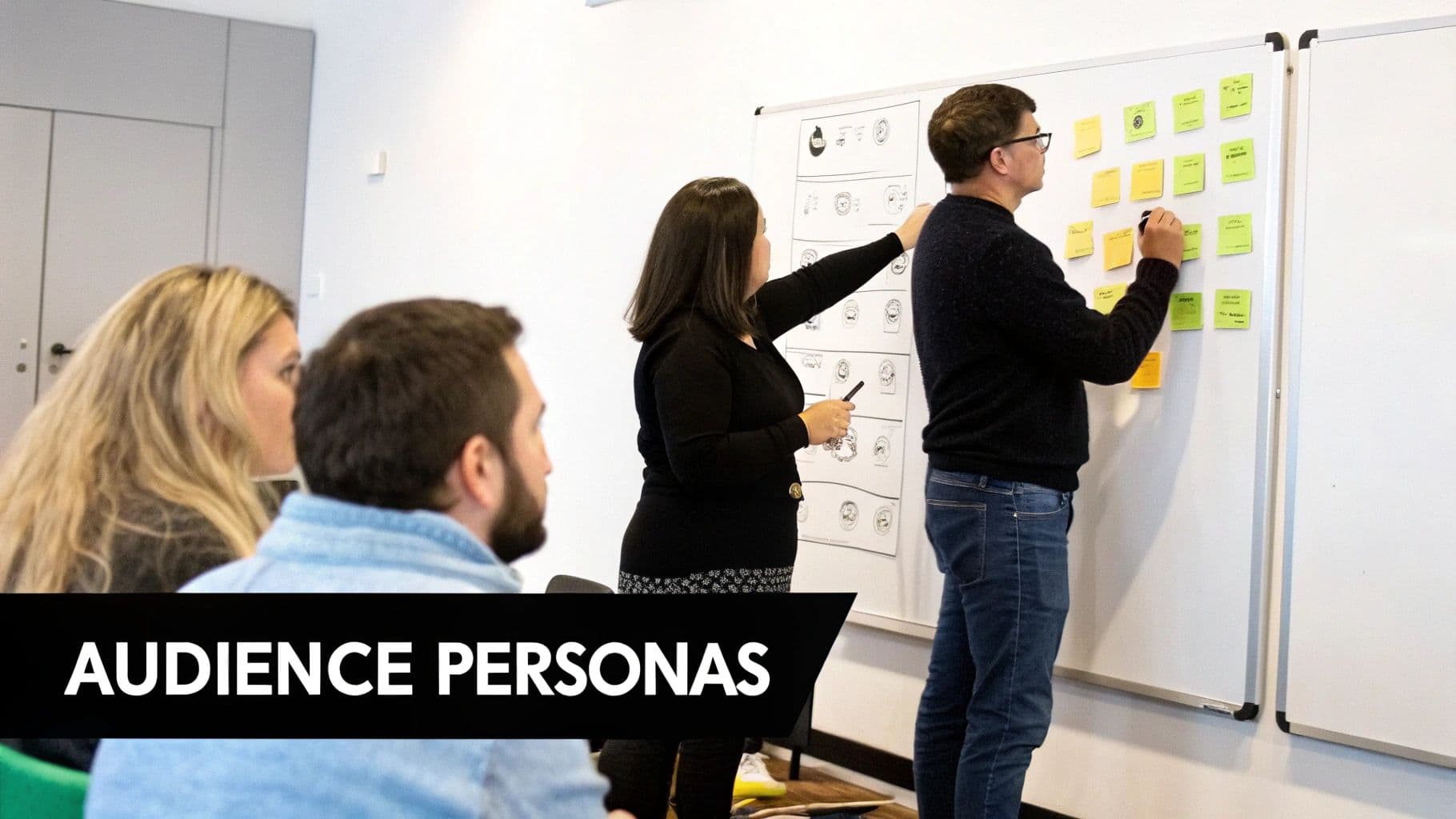
Before you spend a single dollar or minute on a campaign, you need to answer two fundamental questions: Who are we talking to, and what do we want them to do?
Trying to build brand awareness without this foundation is like shouting into the void. You’ll make noise, but the right people won’t hear you, and even if they do, they won't care.
Let's ditch the vague descriptors like "millennials in urban areas." That's not an audience; it's a statistic. Real connection—the kind that builds brands—starts when you create detailed personas that feel like actual people.
Go Deeper Than Demographics: Build Real Personas
An effective persona is more than just age and location. It digs into the psychographics—the motivations, frustrations, goals, and online habits that define your ideal customer. You need to get inside their world.
Think about it this way. Instead of targeting "women aged 25-35," you're targeting "Sarah, a 29-year-old freelance graphic designer." You know Sarah feels swamped by project management, loves minimalist design, and unwinds by scrolling through interior design feeds on Instagram. Now that's someone you can talk to.
To build these rich profiles, you need to be a detective.
- Look at your current customers. What are the common threads? Do you see patterns in their job titles, industries, or the problems they’re trying to solve with your product?
- Just ask them. Seriously. A simple survey asking about their biggest challenges, favorite content, and go-to social platforms can give you gold.
- Use social listening. Tools like BuzzSumo are great, but even just paying attention to relevant hashtags will show you the real conversations your audience is having. What words do they use? What questions keep popping up?
This process turns abstract data into a clear picture of a person. You'll stop guessing and start knowing not just who they are, but why they should give a damn about your brand.
From Vague Hopes to Concrete Goals
Once you know who you’re talking to, you can set brand awareness goals that actually move the needle. Too many teams get stuck chasing fuzzy targets like "get more followers" or "go viral." These are outcomes, not objectives. They’re impossible to build a strategy around.
Good goals are specific, measurable, and tied directly to business impact. This is how you prove your marketing is working. Instead of chasing vanity metrics, focus on numbers that signal real brand recognition.
The most powerful goals are those that reflect a change in consumer behavior. When people start searching for your brand by name instead of for a generic solution, you know your awareness strategy is working.
Here’s how to translate those broad ambitions into targets you can actually hit:
-
Instead of: "Get more website visitors."
-
Aim for: "Increase direct website traffic by 15% in Q3." This is a huge signal. It means people remembered you and typed your URL straight into their browser.
-
Instead of: "Be more visible on Google."
-
Aim for: "Increase branded search queries by 20% this quarter." This shows more people are actively looking for you, not just a solution you offer.
-
Instead of: "Make popular videos."
-
Aim for: "Drive 500k total views on our new 'Behind the Brand' video series." A specific content push with a clear viewership target is far more strategic and measurable.
When you set these kinds of goals, every piece of creative has a purpose. You're no longer just making stuff; you're building a system to grow brand awareness in a way you can track, prove, and scale. If social is a big part of your plan, our guide on how to increase social media engagement offers tactics that slot perfectly into this goal-oriented approach. This focus ensures your hard work leads to meaningful, lasting growth.
Choosing the Right Channels for Maximum Impact
Trying to be everywhere at once is a classic recipe for burnout, not brand growth. The goal isn’t to plant a flag on every social media platform out there. It's about being strategic—choosing the channels where your ideal customers already hang out and where your brand’s personality can actually shine.
Honestly, this is one of those choices that separates the pros from the amateurs. Get it right, and you're having intimate conversations with people ready to listen. Get it wrong, and you're just shouting into an empty room. You have to go where your people are, but you also have to show up in a way that feels right for that specific place.
Match the Platform to Your Persona
Every social channel has its own culture, its own unspoken rules, and its own audience expectations. A video that crushes it on TikTok will likely fall flat on LinkedIn. Before you commit a single dollar or minute of your team's time, go back to those audience personas you built.
Where do they go to unwind after work? Where do they search for professional advice? Where do they get inspiration for new products? The answers will give you a shortlist of channels, letting you focus your energy where it'll make a real difference.
Let's break down the main players:
- Visual-First Platforms (Instagram & TikTok): These are absolute powerhouses for brand storytelling, especially if you're in e-commerce, real estate, or any other business with a strong visual hook. They run on short-form video, behind-the-scenes content, and authentic, human-first stories.
- Authority-Building Platforms (Blogs & LinkedIn): This is where you go to build deep credibility and trust. A well-optimized blog helps you answer your audience's biggest questions, pulling in valuable search traffic. For anything B2B, LinkedIn is simply unmatched for networking and sharing industry expertise.
- Community & Conversation Hubs (Facebook Groups & X): These platforms are made for real-time chatter and community building. They're perfect for dropping timely updates, running quick polls, and having direct conversations with your followers.
Take a local real estate agency, for example. Instead of thinly spreading their efforts, they could go all-in on Instagram and TikTok. By creating cinematic property tours and "day in the life of an agent" videos, they can completely own their local market's attention, connecting with homebuyers in a way that’s both compelling and memorable.
The Undeniable Power of Social Channels
Social media isn't just a broadcast tool anymore; it has fundamentally changed how brands and people connect. It's now a primary driver for discovery, trust-building, and ultimately, sales. In fact, research shows that a massive 77% of consumers would rather buy from a brand they follow on social media.
For audiences aged 16 to 34, social ads are now the number one way they discover new brands. This makes platforms like TikTok and Instagram non-negotiable if you want to reach younger demographics. And this isn't passive scrolling—a staggering 64% of consumers have actively tagged a brand or used a branded hashtag. That's genuine engagement.
Your social media presence isn't about just pushing out a message. It's about participating in the culture and building real relationships that lead directly to brand loyalty and revenue.
Prioritize Based on Your Resources
Let’s be realistic. Choosing your channels is also a practical decision. A small marketing team can't be expected to pump out amazing, native content for six different platforms at once. It's so much better to dominate one or two channels than to be painfully mediocre on many.
Be brutally honest about your team's bandwidth and skills.
- Got a killer writer on the team? A blog and LinkedIn strategy could be your best bet.
- Is your team comfortable and charismatic on camera? Then you should be prioritizing video-first platforms like TikTok and YouTube.
- Are you great at firing off quick, witty replies and joining conversations? X could be a goldmine.
Focus your energy where you know you can consistently create high-quality content. That’s how your brand shows up at its best, building a rock-solid reputation on the platforms that truly matter to your audience.
Ready to create video ads?
Turn your photos into scroll-stopping ads in minutes. No video editing skills required.
Try For FreeContent Marketing and Your Owned Channels
While social media is your engine for reach, don't ever forget about your "owned" channels—your website and, most importantly, your blog. Your blog is an asset you control completely. It's a hub where you can build deep expertise and capture organic search traffic for years to come.
Think of your blog as the foundation. It's where you publish long-form, evergreen articles that solve your customers' problems in detail. Social media then becomes your distribution network, driving people back to these high-value resources. To make sure your content gets found in today's search landscape, understanding and implementing essential AI SEO strategies is becoming critical for success.
This creates a powerful feedback loop: you use social for immediate engagement and your blog for sustained, long-term brand building.
Creating High-Impact Content That People Remember
In a world of endless scrolling, the worst thing your content can be is forgettable. To actually build brand awareness, your creative needs to do more than just show up—it has to stop thumbs, earn a few seconds of attention, and ideally, spark a conversation.
This means shifting your mindset. It's time to embrace a video-first approach.
Short-form video isn't just a fleeting trend; it's the undisputed king of brand awareness right now. Platforms like TikTok and Instagram have fundamentally rewired how people consume content, training us to expect dynamic, engaging stories in quick bursts. For brands, this is a massive opportunity if you're willing to play the game.
And the best part? A video-first strategy is more accessible than ever. You don't need a Hollywood budget or a massive production crew. With the right tools and a bit of savvy, even a small marketing team can pump out high-impact videos that stick.
Adopt a Video-First Mindset
A video-first approach is simple: think in motion before you think in static images. Instead of designing a graphic and then wondering, "Can we turn this into a video?" you start with the video concept itself. This small mental flip opens up a ton of creative doors.
Why does it work so well? Video hits on an emotional level that static images and text just can't match. It lets you show, not just tell, which builds much stronger brand memories. When someone sees your product in action or gets a behind-the-scenes glimpse of your team, it forges a real connection that a simple photo rarely can.
This diagram shows how different channels work together, all fueled by a central strategy.
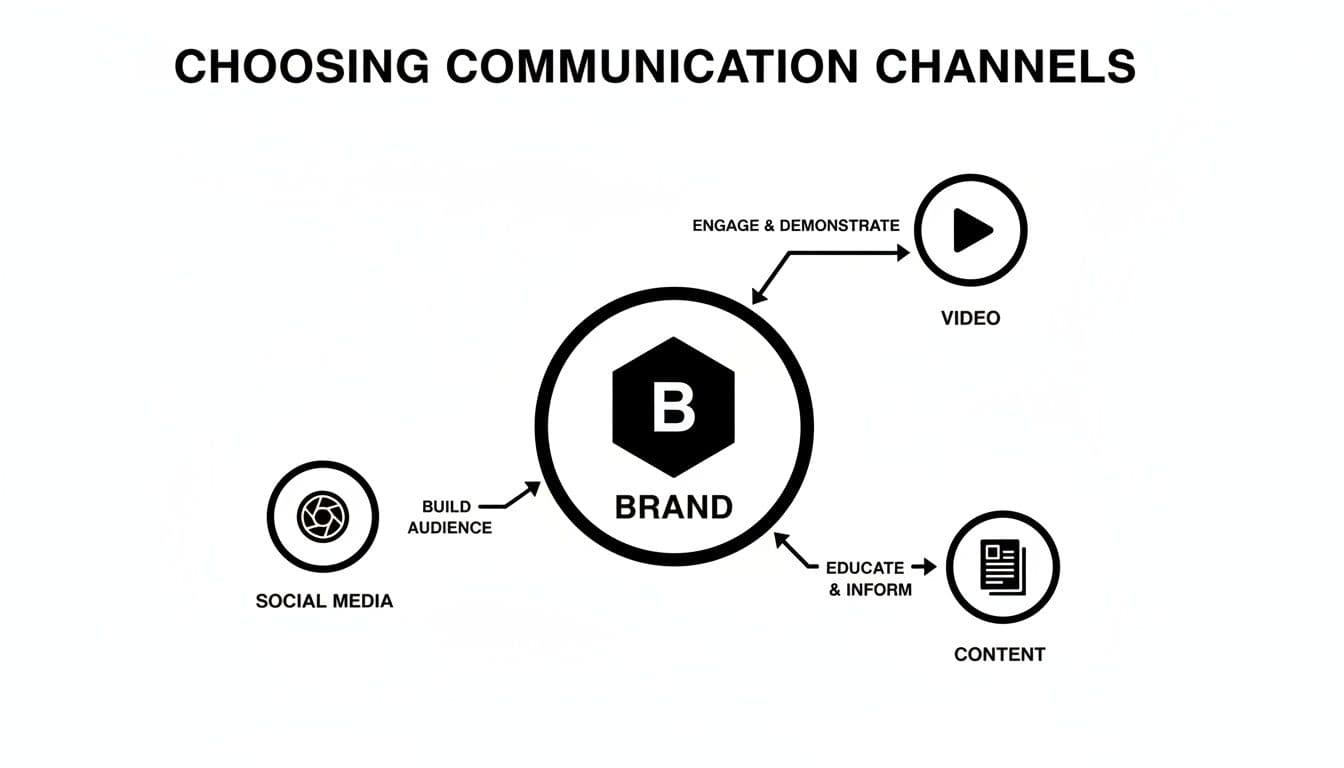
While channels like social media, video platforms, and blogs are distinct, they’re most powerful when they’re all pulling in the same direction.
Practical Video Templates You Can Use Today
The hardest part of getting started with video is often just… starting. To help you get over that initial hurdle, here are a few proven, plug-and-play concepts that work for almost any brand. They're designed to be quick to produce and perfect for social media.
-
The 'Before & After' Transformation: This is a classic for a reason—it's visually satisfying and screams value. Think of a real estate agent showing a gut-renovated kitchen, an interior designer revealing a dramatic room makeover, or an e-commerce brand showing the unboxing and setup of their product. The key is a dramatic, gratifying reveal.
-
The 'Meet the Team' Clip: People connect with people, not just logos. A quick, 15-second video introducing a team member with a fun fact or their favorite part of the job instantly humanizes your brand. It builds trust by showing the real, relatable people behind the curtain.
-
The Quick Tip or Hack: Position your brand as the expert by sharing a quick, valuable piece of advice. A software company could show a time-saving keyboard shortcut. A fashion brand could demonstrate a simple styling trick. These videos provide immediate value and are incredibly shareable.
A quick pro-tip: Authenticity beats perfection every time. A video shot on a smartphone with decent lighting and clear audio will almost always outperform a polished, corporate-style production on social media because it feels genuine and native to the platform.
Quick Wins for Small Teams and Budgets
If you're running a lean team with a tight budget, efficiency is your superpower. You don't need to reinvent the wheel for every single post. Instead, focus on smart, scalable tactics that get the most out of what you already have.
One of the fastest ways to get rolling is by turning your existing static photos into dynamic video shorts. You already have a goldmine of assets: product shots, team photos, maybe even customer images.
This is where a purpose-built tool like Proom AI comes in. Instead of wrestling with complex editing software, you can upload your existing images into a professional template and generate a polished video in minutes.
The table below breaks down just how much more efficient this approach can be compared to the old way of doing things.
Video Production Methods Compared
| Factor | Traditional Video Production | AI Video Platform (Proom AI) |
|---|---|---|
| Time Investment | Weeks to months (pre-production, shooting, post-production) | Minutes per video |
| Cost | High (equipment, crew, software, talent, location fees) | Low (affordable subscription or credit-based plans) |
| Required Skills | Specialized (videography, editing, motion graphics) | Minimal (upload images, select a template) |
| Scalability | Difficult and expensive to scale | Extremely easy; create dozens of variations quickly |
| Flexibility | Re-edits are time-consuming and costly | Instant; change images or text in seconds |
As you can see, leveraging AI for video creation solves two of the biggest roadblocks for small teams: time and cost. You can create a week's worth of high-quality video content in under an hour, making a consistent video strategy an achievable reality.
Another powerful tactic is to embrace user-generated content (UGC). Your happiest customers are your most authentic marketers. Encourage them to share videos using your product, and then feature that content on your own channels (with their permission, of course). If you're new to this, we have a detailed guide that explains how to make UGC work for your brand. UGC is trustworthy, compelling, and a fantastic source of free content that builds incredible social proof.
Measuring Success and Scaling Your Efforts

There's an old saying: "If you can't measure it, you can't improve it." When it comes to brand awareness, that's gospel. Without hard numbers, you’re just throwing content at the wall and hoping something sticks. You're flying blind.
A data-driven approach is what separates guessing from growing. It’s how you prove your work is valuable and get the budget to do more. This is the shift you need to make to scale your brand from a whisper into a roar.
Key Metrics That Truly Matter
It’s easy to get distracted by vanity metrics. Follower counts and post likes feel good, but they don’t pay the bills or prove that your brand is actually sticking in people's minds. To get the real story, you need to track metrics that show a genuine shift in consumer behavior.
Here are the core numbers I watch like a hawk:
-
Branded Search Volume: This is pure gold. It’s the number of people typing your brand name directly into Google. You can track it easily in Google Search Console, and an upward trend is undeniable proof that people know you exist and are actively looking for you.
-
Direct Website Traffic: This is the cousin of branded search. It’s the traffic that comes from people typing your URL directly into their browser. Check it in Google Analytics under
Acquisition > Traffic acquisition. It means they didn't need Google's help—they knew exactly where they were going. -
Social Media Share of Voice (SOV): This metric tells you how much of the conversation in your industry you actually own. It pits your brand mentions against your competitors'. Tools like Brand24 or Sprout Social are great for this. A rising SOV means you’re drowning out the noise.
These aren't just feel-good stats. They signal real, unprompted interest in your brand. They’re your true north for any awareness campaign.
A Simple Framework for A/B Testing Your Content
Once you know what to track, you can start to optimize. A/B testing isn't just for landing pages; it's a killer tool for refining your creative content, especially video. The whole point is to figure out what your audience loves so you can make more of it.
You don't need fancy software to get going. Just stick to this simple framework:
- Isolate One Variable: Seriously, just one. Change the hook in the first three seconds, the call-to-action, the background music, or the headline style. If you change more than one thing, your test is useless.
- Define Your Success Metric: Before you launch, decide what a "win" looks like. For an awareness video, it might be View-through Rate (VTR) or Average Watch Time.
- Run the Test: Launch both versions (A and B) with the exact same budget and targeting. Keep it fair.
- Analyze and Iterate: Once you have enough data, see which version came out on top. Take what you learned and bake it into your next piece of content.
Let's say you're testing a product video on Instagram Stories. Version A opens with a question. Version B opens with a bold, surprising statement. After a few days, you see Version B has a 25% higher average watch time. Boom. That's a clear signal to lean into statement-based hooks for future videos.
This creates a feedback loop that makes your creative better every single time.
Scaling Your Brand Awareness Investments
All this data isn't just for spreadsheets; it’s about making smarter bets with your money. And the stakes are high. The combined value of the world's 5,000 biggest corporate brands is projected to top USD 14 trillion in 2025. That’s a testament to massive, sustained investment.
With 92% of marketers planning to keep or increase their brand awareness spending, you can't afford to fall behind. You can dig into more branding statistics to see just how enterprises are playing the game.
Your data is the roadmap for scaling. It tells you which channels are killing it, which content formats get shared the most, and which messages actually land.
This is what empowers you to double down on what works. If your data shows that "Meet the Team" videos on LinkedIn consistently crush product demos, you can confidently shift your budget and creative energy in that direction. This is how you turn your brand awareness efforts into a predictable, reliable engine for growth.
Common Brand Awareness Questions Answered
When you're ready to get serious about brand awareness, a lot of practical questions start to pop up. Let's tackle the most common hurdles with direct, actionable answers that build on everything we've covered, helping you get—and keep—your momentum.
How Long Does It Take to See Results?
This is the big one, isn't it? The honest answer: brand awareness is a long game, not an overnight fix.
While you might see little spikes in engagement within a few weeks of launching a consistent campaign, the really meaningful shifts—the kind you can take to the bank—typically take 6-12 months to show up. We're talking about metrics like branded search volume or unaided brand recall. People need time and repetition to truly remember you.
The absolute key is consistency. A steady drumbeat of high-quality content, like weekly social videos or a couple of solid blog posts a month, builds momentum. Think of it like planting a tree. You do a lot of work upfront, but consistent watering is what leads to real, compounding growth down the line.
In the short term, keep an eye on leading indicators like reach and engagement. For the long haul, your true north stars are lagging indicators like direct traffic and brand recall. That's how you know it's really working.
Brand Awareness vs. Lead Generation
It's easy to get these two tangled up, but they're distinct goals that work together. Think of them as different stages of a relationship with a customer.
- Brand Awareness: This is your first impression—top of the funnel. The goal is simply to make your target audience familiar with who you are, what you stand for, and what you offer. Success here is measured by recognition.
- Lead Generation: This is asking for their number—middle of the funnel. Here, the goal is to capture contact info from potential customers who've already shown they're interested.
Here's the magic: a great brand awareness campaign makes lead generation way easier and cheaper. Why? Because your audience already knows and trusts you.
For example, a viral TikTok video (awareness) might get someone to follow your page. When you later post about a free guide in exchange for an email (lead gen), that follower is far more likely to convert.
How to Improve Brand Awareness with a Small Budget
A tight budget isn't a roadblock; it's a mandate to be more creative and efficient. You have to get scrappy, and honestly, that often leads to more authentic marketing.
First off, prioritize organic channels where your main investment is time, not ad spend. Think SEO and social media. Create genuinely helpful blog content that answers the exact questions your audience is typing into Google.
Second, get smart about content creation. Forget expensive, all-day video shoots. Use tools that can turn existing assets—like product photos or short clips—into professional-looking video ads in minutes. This lets you pump out a high volume of content without a Hollywood budget.
A small budget forces you to focus on what truly matters: building a real community. Engaging directly with followers, responding to every comment, and fostering genuine conversations builds loyalty and turns customers into powerful brand advocates—for free.
Finally, lean into user-generated content (UGC) and partnerships. Encourage your customers to share photos and videos with your product. You can also team up with micro-influencers who might be happy to work for free products instead of big fees, giving you authentic content and a direct line to their trusting audience.
Which Metrics Are Most Important?
There's no single "best" metric. The clearest picture comes from looking at a combination of indicators. I like to organize measurement into three tiers to see the whole story.
Tier 1: Direct Impact
- Direct Traffic: Check this in Google Analytics. It shows people know you well enough to type your URL right into their browser.
- Branded Search Volume: Monitor this in Google Search Console. This is a huge signal that people are actively looking for you by name.
Tier 2: Audience Growth
- Social Media Reach: Are more unique eyeballs seeing your content over time?
- Follower Growth: This shows that the people discovering you are choosing to stick around.
Tier 3: Engagement
- Social Media Engagement Rate: Is your content actually resonating and starting conversations?
- Website Time on Page: Once they get to your site, is your content compelling enough to make them stay?
For a more advanced view, you could run simple brand recall surveys or start monitoring your "Share of Voice" against your direct competitors to see how much of the conversation you own.
Ready to create high-impact video content without the high costs? With Proom AI, you can turn your existing photos into professional, cinematic video ads in just minutes. Choose a template, upload your images, and let our AI handle the rest. Start your free trial and see how easy it is to scale your brand awareness today!
Ready to create video ads?
Turn your photos into scroll-stopping ads in minutes. No video editing skills required.
Try For Free