2026 Marketing Video Examples: 12 High-Impact Ads
12 marketing video examples that drove 500K+ views each. See what worked, why it converted & how to recreate them for your brand in 2026 →

Video marketing isn't just about going viral; it's about driving real business results. From stopping the scroll on social media to closing a deal on your website, the right video can transform your entire marketing funnel. But which types of videos deliver the highest return on investment? And how do you create them without a massive budget or a dedicated production team? Guesswork and imitation won't cut it. To succeed, you need a proven blueprint based on strategies that are working right now.
This is that blueprint. We've analyzed thousands of campaigns to curate 12 essential marketing video examples that are dominating today’s platforms. This guide moves beyond simple descriptions to offer a deep strategic analysis of each format.
For every example, you'll find:
- The Goal: Is it for awareness, conversion, or retention?
- Why It Works: A breakdown of the creative and psychological triggers.
- Actionable Blueprint: A quick script or timing guide to replicate the structure.
- How to Recreate It: A fast-track guide to producing a similar video with tools like Proom AI.
We’ll cover everything from high-converting product demos and compelling client testimonials to engaging short-form social content and cinematic brand stories. Forget theory and generic advice. This is a tactical playbook designed to help you move from inspiration to execution, turning powerful concepts into professional, conversion-focused videos that deliver measurable growth. Let's get started.
1. Product Demo Videos
Product demo videos are short-form showcases that demonstrate a product's features, functionality, and real-world benefits. These marketing video examples are essential for e-commerce, as they bridge the gap between browsing and buying by showing the product in action. They answer customer questions visually, reduce purchase hesitation, and significantly boost conversion rates by focusing on the value delivered.
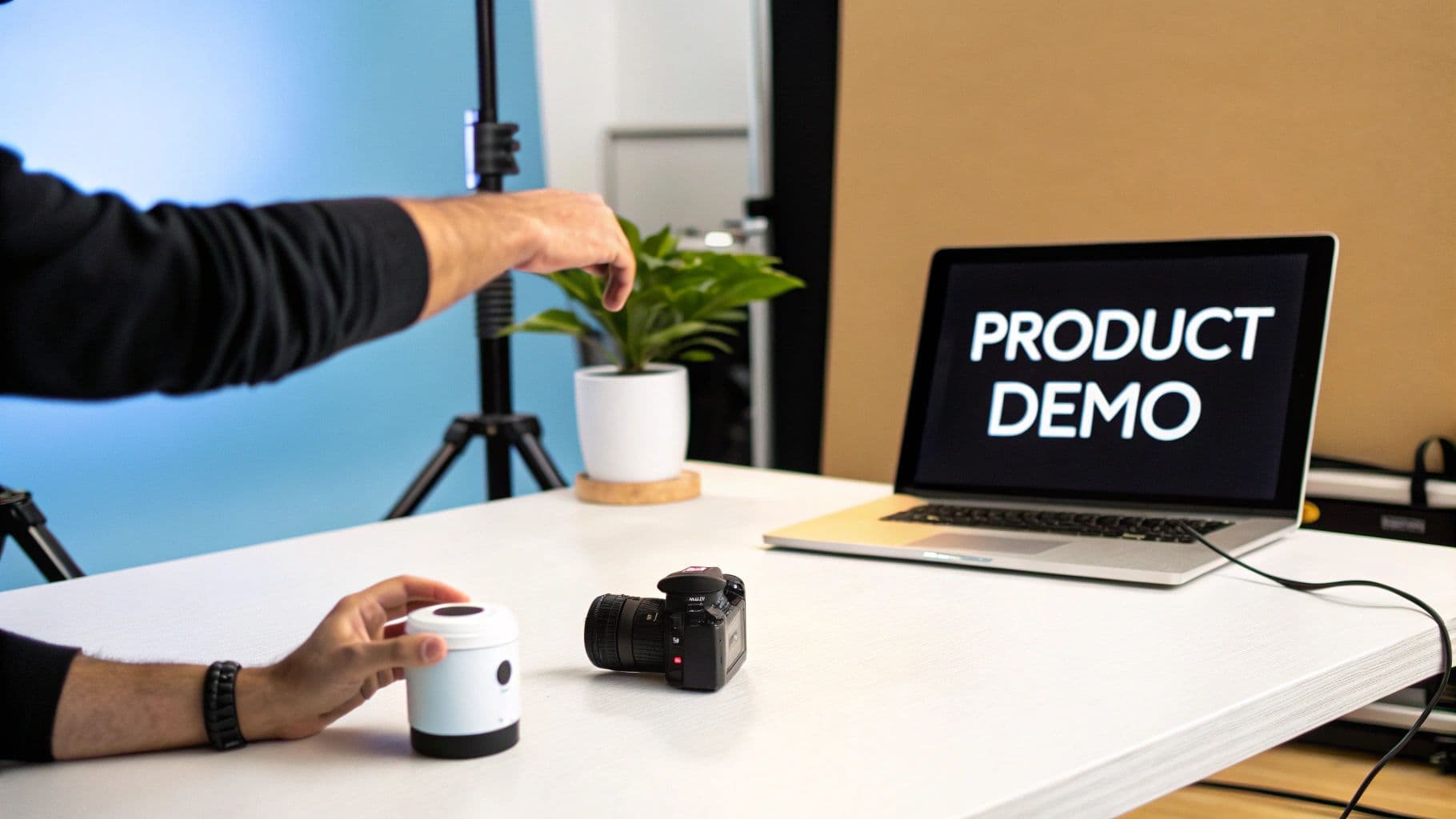
This format excels at making complex products understandable and tangible products more desirable. By highlighting the transformation a customer experiences, demos move beyond simple features to showcase a better outcome. Iconic examples like Dollar Shave Club’s viral launch video and Dyson’s sleek vacuum showcases prove how effective a well-executed demo can be.
Strategic Breakdown & How-To
- Goal: Conversion. The primary objective is to turn viewers into customers by clearly demonstrating value and building trust.
- Why It Works: It directly addresses the "how does it work?" and "what's in it for me?" questions. Visual proof is far more compelling than static text or images.
- Actionable Tips:
- Start with the problem: Frame the demo around a common customer pain point your product solves.
- Keep it brief: Aim for under 60 seconds for social media, focusing on one or two key benefits.
- Highlight the result: Show the satisfying "after" state, not just the "during" process.
- Add a human element: Use Proom AI's presenter feature to guide viewers through the demo, adding a personal touch. Learn how to make AI videos to streamline this process.
2. Before & After Transformation Videos
Before and after transformation videos are a powerful storytelling format that visually contrasts an initial state with a final, improved result. This type of marketing video example excels in industries like home improvement, beauty, fitness, and real estate, where the change is tangible and dramatic. They create a strong emotional impact by showcasing a satisfying resolution, making the value proposition instantly clear and highly shareable on social media.
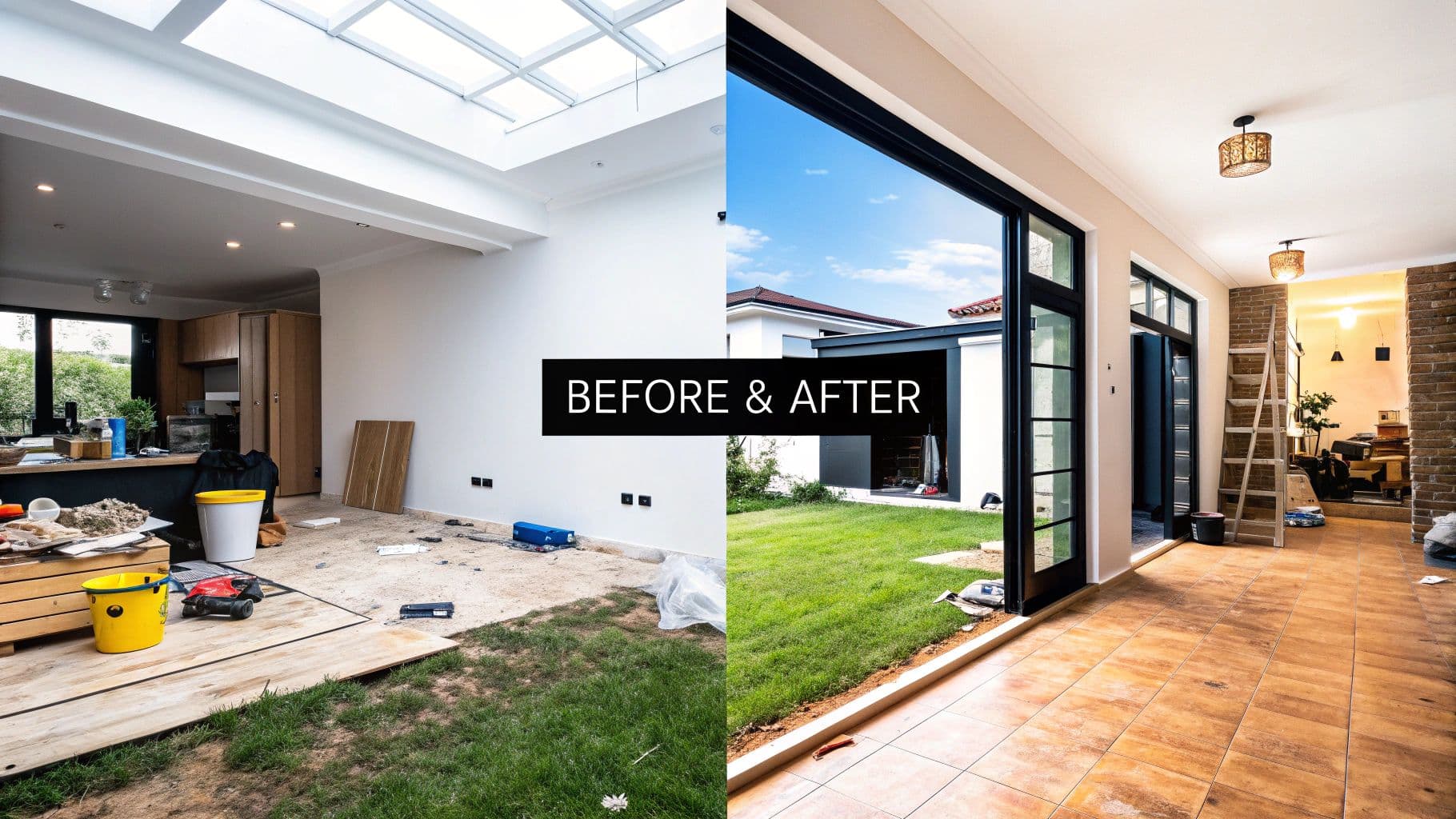
This format thrives on its simplicity and universal appeal. The "reveal" generates anticipation and delivers a gratifying payoff that resonates with viewers. Brands like Studio McGee on Instagram and shows like Property Brothers have built entire empires on this concept, demonstrating how a well-documented transformation can captivate an audience and build brand authority by proving expertise and delivering on a promise.
Strategic Breakdown & How-To
- Goal: Engagement and Consideration. The objective is to stop the scroll with a visually compelling narrative that showcases your service's capabilities and inspires viewers.
- Why It Works: It provides undeniable proof of value. The dramatic contrast between "before" and "after" is inherently engaging and makes the benefit of your product or service easy to grasp.
- Actionable Tips:
- Maintain camera consistency: Shoot the "before" and "after" shots from the exact same angle and distance to maximize the impact of the transformation.
- Focus on the reveal: Use dynamic transitions, like a quick slide or wipe, and time your music to build excitement for the final result.
- Show the journey: A quick montage of the "in-between" process can add context and showcase the hard work involved, increasing the perceived value.
- Optimize for platform: Create square or vertical versions for Instagram Feeds, Reels, and TikTok to ensure the video fills the screen and captures attention.
3. Carousel/Slideshow Videos
Carousel or slideshow videos transform a series of static images or short clips into a dynamic, flowing narrative. These marketing video examples are perfect for showcasing product collections, multi-step processes, or brand mood boards without needing complex video production. They function like an animated lookbook, guiding viewers through a story with transitions, music, and text overlays.
This format excels at creating an immersive, aesthetic experience from existing assets. It’s highly effective for fashion brands like Anthropologie presenting new collections, real estate agents showcasing property highlights, or restaurants displaying their menu. The goal is to package multiple ideas into a single, digestible, and visually engaging asset for social media feeds.
Strategic Breakdown & How-To
- Goal: Engagement and Awareness. These videos are designed to stop the scroll and communicate a multi-faceted message quickly, building brand aesthetic and showcasing variety.
- Why It Works: It leverages the brain's preference for motion over static images, turning simple photos into a compelling story. It's cost-effective and efficient for brands with strong photography.
- Actionable Tips:
- Tell a story: Arrange your images in a logical sequence, such as a "get ready with me" flow or a project "before and after."
- Set the mood: Choose background music that aligns with your brand's voice and the narrative of the slideshow.
- Guide the viewer: Use text overlays or captions to add context to each image or scene.
- Automate with AI: Use a Proom AI video template to instantly arrange your images into a professional slideshow with branded transitions. Learn how to make AI videos to simplify your workflow.
4. Social media Ad Videos
Social media ad videos are short, punchy clips engineered for paid distribution on platforms like Instagram, TikTok, Facebook, and LinkedIn. These marketing video examples are designed to stop the scroll, grab attention in under three seconds, and drive a specific action. They prioritize strong hooks, rapid pacing, and clear calls-to-action to convert viewers in a fast-moving, often sound-off, environment.
This format is the lifeblood of direct-to-consumer brands and performance marketing. It excels at turning passive browsers into active customers by presenting a compelling offer directly in their feeds. Success stories from brands like Allbirds and Glossier demonstrate how platform-native video ads can build a massive audience and generate significant revenue by meeting customers where they are.
Strategic Breakdown & How-To
- Goal: Conversion and Lead Generation. The aim is to get an immediate response, such as a purchase, a sign-up, or a website click.
- Why It Works: It leverages the massive reach and precise targeting of social platforms, interrupting user behavior with a high-impact, value-driven message.
- Actionable Tips:
- Hook in 3 seconds: Your first frame and opening line determine success. Start with a question, a bold statement, or visually striking movement.
- Design for sound-off: Use prominent on-screen text and captions throughout, as most users watch videos without audio.
- Test and iterate: Create 3-5 variations of your ad to test different hooks, visuals, and CTAs to identify the top performer.
- Keep it concise: Aim for 15-30 seconds. Get to the point quickly and make your call-to-action unmissable.
- Use AI for speed: Generate compelling hooks and scripts instantly with Proom AI's writer. Discover how to create video ads that convert without needing a full production team.
5. Client Testimonial/Case Study Videos
Client testimonial and case study videos are powerful marketing assets that build social proof by featuring real customer stories. This type of marketing video example moves beyond a brand's claims and shows authentic experiences, measurable outcomes, and transformation stories. They let satisfied clients become your most effective advocates, building trust and credibility with prospects in a way that traditional advertising cannot.
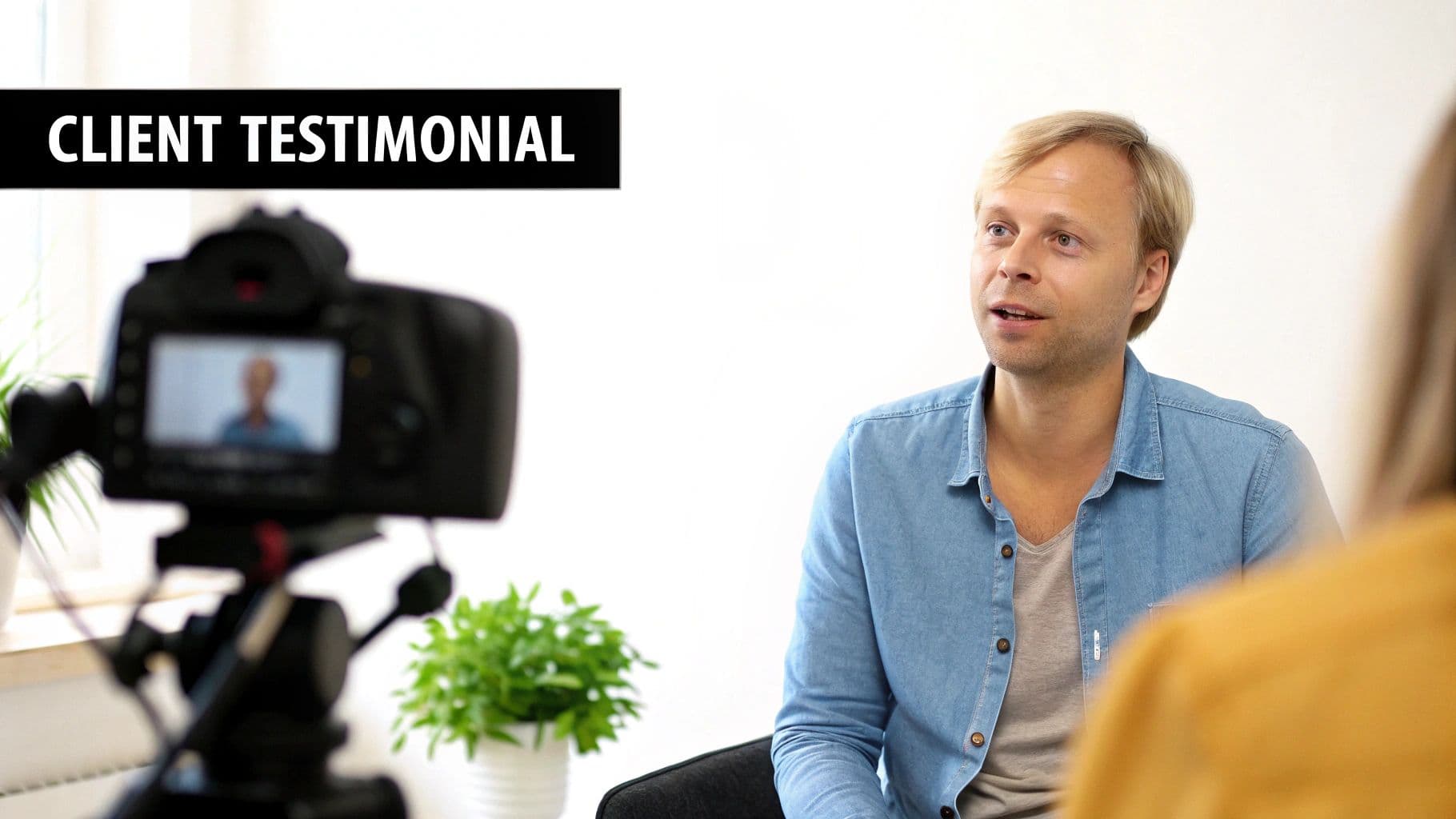
This format is especially effective for B2B SaaS companies, service providers, and high-consideration products where trust is a major factor in the purchasing decision. Success stories from brands like HubSpot, Slack, and Zendesk demonstrate how to turn customer results into compelling narratives. By showcasing relatable challenges and data-backed solutions, these videos resonate deeply with potential customers facing similar issues.
Strategic Breakdown & How-To
- Goal: Build Trust & Credibility. The main objective is to provide third-party validation and social proof, making your brand's promises more believable.
- Why It Works: It leverages the power of storytelling and authenticity. Viewers trust peers more than brands, and seeing real people achieve real results with your product is incredibly persuasive.
- Actionable Tips:
- Focus on the transformation: Structure the story around the customer's journey: their problem before, the solution with your product, and the positive result after.
- Use specific data: Ask for measurable outcomes like "30% increase in leads" or "5 hours saved per week" to add weight to the testimonial.
- Keep it authentic: Avoid over-scripting. Capture genuine emotions and reactions by asking open-ended questions about their experience.
- Narrate with AI: Use Proom AI’s presenter feature to professionally narrate the case study's context and data points over b-roll footage. Explore these powerful testimonial ad examples for more inspiration.
6. Explainer Videos
Explainer videos are educational assets designed to simplify complex products, services, or concepts into easily digestible visual narratives. These marketing video examples are crucial for tech, SaaS, and service-based industries, as they answer the fundamental "what is it?" and "how does it help me?" questions. They build customer confidence and accelerate the consideration phase by making abstract ideas tangible.
This format thrives on clarity and simplicity, often using animation, screen recordings, and clear voiceovers to guide the viewer. By breaking down a complicated process into a simple, step-by-step story, explainers empower potential customers with knowledge, reducing friction in the sales funnel. Think of Asana's clear product walkthroughs or TurboTax's simplified tax-filing guides; they educate to convert.
Ready to create video ads?
Turn your photos into scroll-stopping ads in minutes. No video editing skills required.
Try For FreeStrategic Breakdown & How-To
- Goal: Education and Lead Generation. The primary objective is to clarify your value proposition to inform potential customers and encourage them to take the next step.
- Why It Works: It tackles confusion head-on, transforming a complex idea into an "aha!" moment for the viewer. This builds authority and trust by demonstrating expertise and transparency.
- Actionable Tips:
- Structure as Problem-Solution: Open with a relatable pain point, introduce your product as the solution, and explain how it works.
- Keep narration clear and concise: Use Proom AI's scriptwriting tools to generate a simple, jargon-free script. Aim for a moderate pace to ensure comprehension.
- Focus on the "why": Don't just list features. Explain the benefit behind each feature and how it improves the customer's life or workflow.
- Localize for global reach: Use Proom AI’s multilingual AI voiceovers to create versions of your explainer for different international markets, expanding your audience effortlessly.
7. Short-Form Social Content (Reels, TikTok, Shorts)
Short-form social content refers to vertical videos optimized for rapid consumption on platforms like TikTok, Instagram Reels, and YouTube Shorts. These marketing video examples, typically 15-60 seconds long, prioritize entertainment, trend-relevance, and high engagement to capture attention within ever-scrolling feeds. They blend brand messaging with native platform culture, making marketing feel less like an ad and more like organic content.
This format thrives on authenticity and speed, leveraging trends to achieve massive reach. Successful examples range from Duolingo’s unhinged mascot antics on TikTok to e-commerce brands showcasing product hauls and styling tips. The key is to provide value or entertainment first, subtly weaving in the product or brand as part of the narrative rather than the sole focus.
Strategic Breakdown & How-To
- Goal: Awareness & Engagement. The main objective is to increase brand visibility, build a community, and stay top-of-mind by participating in cultural conversations.
- Why It Works: It taps into platform algorithms that favor consistent, engaging, and trend-aligned content, offering a powerful opportunity for viral reach.
- Actionable Tips:
- Hook in the first frame: Use a strong visual, a bold text overlay, or an unexpected element to stop the scroll immediately.
- Leverage trending audio: Use sounds from the platform's audio library to increase your content's discoverability.
- Maintain a fast pace: Keep edits quick, with new information or visuals appearing every 1-2 seconds to hold attention.
- Use AI for efficiency: Use Proom AI to batch-create multiple short-form videos from one longer piece of content, saving significant time. You can make AI videos that are perfectly formatted for each platform’s unique audience.
8. Educational Tutorial Videos
Educational tutorial videos are a powerful content marketing format that teaches an audience how to accomplish a specific task or better understand a concept related to your product. These marketing video examples build trust and establish authority by providing genuine value, moving beyond direct sales pitches. They guide viewers through a process step-by-step, positioning your brand as a helpful expert.
This format is incredibly effective for software companies (like Adobe’s detailed feature guides), DIY brands, and any business with a product that has a learning curve. By empowering customers to succeed, you create a loyal community that sees your brand as an indispensable resource, which drives long-term retention and advocacy.
Strategic Breakdown & How-To
- Goal: Engagement and Retention. The primary objective is to educate your audience, build brand authority, and reduce customer churn by ensuring they know how to use your product effectively.
- Why It Works: It addresses user pain points directly and provides a clear solution, fostering goodwill and demonstrating product value in a practical context. This builds a relationship based on help, not just hype.
- Actionable Tips:
- Outline first: Plan your content with a clear beginning, middle, and end to avoid rambling and ensure every step is covered.
- Optimize for search: Use keywords like "how to" or "tutorial" in your title and description to capture high-intent search traffic on platforms like YouTube.
- Keep it scannable: Use chapter markers and timestamps in your video description to help viewers find the exact information they need quickly.
- Create a clear narrative: Use Proom AI’s voiceover feature to add crisp, step-by-step narration, making complex instructions easy to follow.
9. User-Generated Content (UGC) & Community Videos
User-Generated Content (UGC) consists of authentic videos created by customers, employees, or brand fans. These marketing video examples leverage social proof and peer-to-peer influence, showcasing real people using products, sharing unboxing experiences, or participating in branded challenges. This strategy transforms passive consumers into active brand advocates, building a powerful sense of community and trust that professionally produced content often cannot replicate.
This format thrives on authenticity, turning customer stories into your most compelling marketing assets. By encouraging and curating content from your community, you generate a constant stream of relatable, high-impact visuals. Iconic examples include GoPro's entire YouTube channel built on customer adventures, Glossier's #GlossierIRL campaigns that showcase product use on diverse skin tones, and viral TikTok brand challenges that drive massive engagement.
Strategic Breakdown & How-To
- Goal: Awareness & Trust. The primary objective is to build brand credibility and community by showcasing genuine customer experiences and fostering a sense of belonging.
- Why It Works: It is the ultimate form of social proof. Viewers trust recommendations from real people more than polished brand messages, making UGC feel more authentic and persuasive.
- Actionable Tips:
- Launch a clear hashtag: Create a simple, memorable hashtag (e.g., #BrandChallenge) to easily track and collect submissions.
- Incentivize participation: Offer rewards like discounts, prizes, or a chance to be featured on your official channels to motivate creators.
- Always credit the creator: When reposting content, always ask for permission and give proper attribution by tagging their account.
- Compile the best clips: Use Proom AI to quickly edit raw UGC footage, add branded overlays, and create polished compilation videos for ads or social media posts. Discover how to make AI videos to streamline your content curation.
10. Portfolio & Showreel Videos
Portfolio and showreel videos are curated compilations that showcase a creative professional's best work, projects, or services in a polished, cinematic format. These marketing video examples establish credibility by demonstrating skill level, style consistency, and creative range to prospective clients. They are a visual resume, proving capability rather than just stating it, which is crucial for service-based businesses in design, architecture, and photography.
This format excels at making talent tangible. Instead of describing your design aesthetic or architectural vision, a showreel puts your results front and center. Iconic showreels from creative agencies and design firms like Studio McGee prove that a well-produced portfolio video can be a primary driver for attracting high-value clients and setting a premium brand standard.
Strategic Breakdown & How-To
- Goal: Build credibility and attract clients. The main objective is to provide visual proof of expertise and win the trust of potential customers or employers.
- Why It Works: It consolidates your best work into a powerful, easily shareable asset. A dynamic video is far more engaging and impressive than a static PDF portfolio.
- Actionable Tips:
- Curate ruthlessly: Select only your absolute best 20-30 projects; quality over quantity is key.
- Keep it focused: Aim for 2-3 minutes max for your main reel and create a 60-second version for social media.
- Showcase the results: Use subtle text overlays to name the project and highlight successful outcomes or client names.
- Add a professional touch: Use Proom AI’s showreel templates to ensure a cohesive look and feel, and pair it with music that reflects your brand’s personality. Learn how to make AI videos to quickly assemble your clips.
11. Cinematic Brand Story Videos
Cinematic brand story videos are high-production-value films that communicate a company's origin, mission, or core values through a compelling narrative. These marketing video examples build deep emotional connections and foster brand loyalty by positioning the company within a larger story of purpose, innovation, or community impact. They go beyond selling products to sell a vision or an identity.
This format is powerfully human-centric, focusing on the people, passion, and purpose behind the brand. It elevates the company from a mere commercial entity to a meaningful movement that customers want to be a part of. Iconic examples include Patagonia’s environmental mission films and TOMS’ origin story, which masterfully weave purpose into their brand identity to inspire and retain a loyal following.
Strategic Breakdown & How-To
- Goal: Brand Loyalty. The primary objective is to forge a lasting emotional bond with the audience, turning customers into advocates by sharing a powerful, authentic story.
- Why It Works: It taps into the universal human desire for connection and purpose. A great story is memorable, shareable, and builds a powerful "why" that transcends product features.
- Actionable Tips:
- Find your core narrative: Identify your authentic brand story, whether it’s your origin, mission, or social impact.
- Structure like a film: Use a three-act structure: the problem or opportunity (Act 1), the journey and solution (Act 2), and the resulting impact (Act 3).
- Show, don't just tell: Feature real team members, founders, or customers to add authenticity and a human touch.
- Leverage AI for visuals: Use Proom AI to create polished montage sequences from brand photos and B-roll, adding a cinematic feel to your narrative. Learn how to make AI videos to easily compile these powerful visuals.
12. Live Stream Repurposed Videos
Live stream repurposed videos transform raw, authentic live broadcast moments into polished, shareable short-form content. This strategy maximizes the value of a single live event by editing its most impactful segments into engaging clips for wider distribution. By adding professional editing, captions, and music, brands can extend the reach of their live content and capture the attention of audiences who missed the original broadcast.
This format is a powerhouse for building community and demonstrating expertise with minimal new content creation. Examples range from Twitch streamer highlight compilations and key moments from Instagram Live Q&As to impactful snippets from YouTube conference broadcasts. These marketing video examples make long-form content accessible and give audiences a compelling reason to tune into future live events.
Strategic Breakdown & How-To
- Goal: Engagement and Reach. The primary objective is to amplify key messages from live content and engage a broader audience across multiple platforms.
- Why It Works: It leverages the authenticity of live video while packaging it in a digestible, algorithm-friendly format. It provides immense value from a single recording session.
- Actionable Tips:
- Flag moments live: During the broadcast, make a note of quotable, surprising, or high-emotion moments to easily find them later.
- Add context with captions: Since clips are viewed out of context, use on-screen text to quickly explain the topic or question being addressed.
- Vary clip lengths: Create 15, 30, and 60-second versions of key moments to fit the requirements of Reels, Shorts, and TikTok.
- Enhance with narration: Use Proom AI's voiceover tool to add clarifying narration or context to clips, making them more understandable as standalone videos. Learn how to make AI videos to quickly add these professional touches.
12 Marketing Video Types Comparison
| Video Type | Implementation complexity | Resource requirements | Expected outcomes | Ideal use cases | Key advantages |
|---|---|---|---|---|---|
| Product Demo Videos | Medium — staged shoots and edits | Product samples, multi-angle photography, moderate editing | Higher conversions; fewer support questions | E‑commerce, SaaS, product launches | Demonstrates functionality, builds trust, strong conversion lift |
| Before & After Transformation Videos | Low–Medium — photo sequencing and pacing | Before/after photos, consistent lighting/angles | High engagement and shareability; credibility boost | Interior design, real estate, beauty, fitness | Emotional reveals, portfolio showcase, easy social virality |
| Carousel/Slideshow Videos | Low — image assembly and transitions | High-quality photos, music/voiceover optional | Versatile reach; scalable, low-cost output | Fashion, product collections, mood boards | Leverages existing assets, easy to produce at scale |
| Social Media Ad Videos | Medium–High — short-form performance creative | Fast edits, captions, multiple variants for testing | Strong direct-response results; measurable ROAS | Paid campaigns, DTC, performance advertisers | Hook-optimized, mobile-first, A/B friendly for conversions |
| Client Testimonial / Case Study Videos | Medium–High — interview capture and editing | Customers, release forms, interview footage, editing time | Increased trust and higher conversion rates | B2B SaaS, agencies, professional services | Authentic social proof, repurposeable clips, credibility driver |
| Explainer Videos | High — scripting + motion graphics | Scriptwriting, animation/motion graphics, voiceover | Improved understanding; reduced support load; better onboarding | SaaS, fintech, healthcare, complex products | Simplifies complex ideas; strong for onboarding and landing pages |
| Short-Form Social Content (Reels, TikTok, Shorts) | Low–Medium — rapid, trend-driven editing | Vertical shoots, trending audio, frequent production cadence | Highest organic reach; rapid discovery and growth | Creators, lifestyle, e‑commerce, brands seeking virality | Algorithm-friendly, quick to produce, drives discovery |
| Educational Tutorial Videos | Medium–High — structured long-form content | Screen recording/demo footage, clear scripting, longer runtime | Authority building; evergreen search traffic and leads | Software tutorials, DIY, coaching, education | Builds expertise, reduces support, monetizable evergreen content |
| User-Generated Content (UGC) & Community Videos | Low — curation and moderation focus | Community incentives, moderation, rights management | High trust and engagement; large volume of content | Lifestyle brands, community-led campaigns, DTC | Authenticity, low production cost, strong social proof |
| Portfolio & Showreel Videos | Medium — curation and cinematic polish | Curated project assets, color grading, music, editing | Greater credibility; increased client inquiries | Creatives, designers, agencies, freelancers | Showcases range and quality; evergreen marketing asset |
| Cinematic Brand Story Videos | High — narrative film production | High budget, professional crew, longer production timeline | Deep emotional connection; long-term brand loyalty | Purpose-driven brands, luxury, startups with a story | Powerful brand differentiation and emotional resonance |
| Live Stream Repurposed Videos | Low–Medium — clip extraction and polish | Recorded livestream archive, fast editing workflow, captions | Multiple short assets from one event; timely engagement | Streamers, educators, events, coaches | Efficient content multiplier; authentic unscripted moments |
From Inspiration to Impact: Your Next Steps in Video Marketing
We've journeyed through a comprehensive playbook of 12 powerful marketing video examples, each one a testament to the fact that high-impact video is no longer the exclusive domain of brands with massive budgets. The core lesson threaded through every example, from the raw authenticity of UGC videos to the polished narrative of a cinematic brand story, is one of strategic alignment. Success isn't about creating the flashiest video; it's about deploying the right video format to achieve a specific, measurable business goal.
The true power lies in understanding this connection. You saw how a well-crafted product demo can shatter purchase barriers, how a before-and-after transformation video provides undeniable proof of value, and how a client testimonial builds a fortress of social proof around your brand. These aren't just creative ideas; they are strategic assets designed to move your audience through the customer journey, from initial awareness to loyal advocacy.
Key Takeaways for Immediate Action
The strategic diversity of these marketing video examples reveals a clear path forward for any brand. Instead of feeling overwhelmed by the possibilities, focus on these core principles that emerged across multiple successful campaigns:
-
Goal-Format-Platform Alignment: Your first decision should always be strategic. Are you trying to drive conversions? A direct, benefit-focused Social Media Ad Video on Meta is your tool. Need to build trust and authority? A detailed Client Testimonial Video for your website and sales outreach is the answer. Always match the video type to the objective and the platform where your audience lives.
-
Authenticity Trumps Production Value: User-generated content, simple testimonial clips, and screen-recorded tutorials consistently outperform overly polished productions in engagement and trust-building. Audiences crave connection and relatability. Your focus should be on a clear message and genuine delivery, not Hollywood-level cinematography.
-
Repurposing is a Superpower: One high-value asset, like a live stream or a detailed case study, can be sliced, diced, and repurposed into dozens of smaller content pieces. A single webinar can become a series of educational Reels, a carousel video for LinkedIn, and a quote-based ad, maximizing your ROI and content calendar with minimal extra effort.
Your Strategic Path to Video Mastery
The barrier to entry for professional video production has officially crumbled. The examples in this article prove that you likely already possess the raw materials for your next great marketing video: project photos, client reviews, screen recordings, and brand assets. The challenge is no longer about creating assets from scratch, but about strategically transforming them into compelling video narratives.
This is where the paradigm shifts from costly, time-consuming production to smart, efficient creation. You don't need a film crew to bring these concepts to life. You need a clear understanding of the strategy behind each format and a tool that can execute your vision quickly. Your next step isn't to hire a videographer; it's to audit your existing content library.
Pick one immediate goal for your business. Is it generating more leads this quarter? Increasing social media engagement? Reducing customer support tickets? Now, select the one video format from this list that directly serves that goal. Gather your best photos, your strongest testimonials, or your most impressive project results, and commit to creating that one video. This focused, strategic approach is how you turn inspiration from these marketing video examples into measurable impact for your brand.
Ready to stop scrolling and start creating? The strategies and video formats detailed in this guide are built directly into Proom AI. Transform your static photos and project assets into dynamic, professional videos in minutes using AI-powered templates, scripts, and voiceovers. Turn inspiration into action and create your first high-impact marketing video today at Proom AI.
Ready to create video ads?
Turn your photos into scroll-stopping ads in minutes. No video editing skills required.
Try For Free