How to Make Promotional Videos That Actually Convert
How to make promotional videos that drive 5X ROI. Strategy framework, AI production shortcuts & distribution playbook. Launch in 48 hours →
Learning how to make promotional videos isn't the monumental task it used to be. The whole process really boils down to four key phases: strategy, scripting, creation, and distribution. With the right tools, you can take a handful of photos and spin them into a polished video ad in just a few minutes, complete with music and a surprisingly human-sounding AI voiceover. Professional results are no longer out of reach.
Why Your Business Needs Promotional Videos Now
Not that long ago, video was a "nice-to-have" on the marketing checklist. Today? It's the engine driving digital engagement and a non-negotiable part of any real growth strategy.
The online world doesn't just prefer video anymore; it runs on it. Your customers now expect to see video content from brands. It's how they discover, research, and ultimately connect with products and services. This isn't just some fleeting trend—it's a massive shift in how people behave and where marketing dollars are going. The global appetite for digital video has absolutely exploded, and businesses that don't adapt will get left behind.
The Undeniable Impact of Video
A good promotional video does more than just show off your product. It builds an emotional bridge between you and your audience, and that connection is what builds trust and drives people to act. Unlike a static image or a block of text, video combines visuals, motion, and sound to tell a compelling story—fast.
Here’s a quick look at why it’s so effective:
- Boosts Conversions: Slap a video on a landing page, and you’ll almost always see a lift in conversion rates. It’s the quickest way to explain your value.
- Builds Trust: Video lets you show, not just tell. Authentic, well-made content makes your brand feel more human and credible.
- Improves Engagement: People are far more likely to share, comment on, and remember video content, which gives your reach a nice organic boost.
The numbers don't lie. In 2025, U.S. businesses are on track to spend $85 billion on digital video ads. That figure officially overtakes the $59 billion spent on traditional TV advertising for the very first time. This isn't a random shift; it's a direct reflection of where your customers are spending their time.
A Strategic Asset for Growth
At the end of the day, figuring out how to create promotional videos is a strategic investment in your business. It's about meeting your customers where they are and speaking their language. For smaller businesses, especially, the right tools and a solid understanding of https://proom.ai/blog/video-marketing-for-small-businesses can completely level the playing field.
A great promotional video isn't just a piece of content; it's a strategic asset designed to achieve a specific business goal. Whether you're driving sales, generating leads, or building brand awareness, video is one of the most powerful tools in your marketing arsenal.
If you're ready to jump in and turn your ideas into ads that actually convert, this complete step-by-step guide on how to create video ads is a fantastic starting point. It’ll help you get off on the right foot.
Building Your Video Strategy Before You Hit Record
Jumping straight into making a video without a plan is the fastest way to get a promotional video that falls completely flat. I've seen it happen time and time again. The best videos—the ones that actually get results—are built on a solid strategy, not just cool visuals. This prep phase is your playbook for success, turning a hopeful shot in the dark into a targeted, effective campaign.
Before you even think about templates or music, you need to lock down one specific, measurable goal. Seriously, just one. What, exactly, do you want this single video to accomplish? Vague goals like "get more engagement" are useless here. You have to get specific.
Are you aiming for a 20% increase in email sign-ups for your next webinar? Or maybe you want to drive 50 direct sales of a specific product this week? Whatever it is, having a single, clear goal will dictate every other decision you make, from the script's call-to-action to the platform you ultimately choose.
Nail Down Your Audience and Message
With your goal set, it's time to get laser-focused on who you're talking to. A deep understanding of your target audience—their real pain points, what motivates them, even the kind of humor they respond to—is everything. You aren't making a video for everyone; you're making it for them.
For example, a fast-paced, meme-filled video might absolutely crush it on TikTok with a Gen Z audience but would be a total cringefest on LinkedIn in front of B2B professionals. Knowing that difference is the key to crafting a core message that actually lands.
Your core message is the one thing you want your audience to remember. If they forget everything else, what's the single idea that should stick? Keep it simple, clear, and tied directly to that primary goal you just set.
Choose the Right Platform for Your Goal
The final piece of your strategy puzzle is picking the right platform. Don’t just blast your video everywhere and hope for the best. Place it where it has the best chance to win, because each platform has its own unwritten rules, audience expectations, and technical quirks.
A polished, two-minute explainer video that walks through your software features is perfect for your website's landing page or a targeted LinkedIn ad campaign. On the flip side, a raw, 15-second vertical clip showing a behind-the-scenes moment is tailor-made for Instagram Stories or TikTok.
Think about how your goal connects to each platform's strengths:
- Brand Awareness: Platforms like YouTube and Facebook are fantastic for broad reach and telling a bigger story.
- Lead Generation: LinkedIn is a B2B powerhouse, while Instagram can be incredibly effective for driving traffic to lead magnets and sign-up pages.
- Direct Sales: Instagram Shopping, Pinterest, and TikTok ads can link straight to product pages, closing the gap between discovery and purchase in an instant.
Matching Your Video Goal to the Right Platform
Use this guide to align your promotional video's objective with the platforms and formats most likely to deliver results.
| Primary Goal | Recommended Platform | Key Metrics (KPIs) | Best Video Format |
|---|---|---|---|
| Increase Brand Awareness | YouTube, Facebook, Instagram | Views, Reach, Impressions, Watch Time | Cinematic Brand Story (1-3 min), Short-form Teaser (15-60 sec) |
| Drive Website Traffic | Instagram (Stories/Reels), TikTok, Pinterest | Click-Through Rate (CTR), Landing Page Views | Vertical Video with clear CTA, Product Demo (30-90 sec) |
| Generate High-Quality Leads | LinkedIn, Website Landing Page | Conversion Rate, Cost Per Lead (CPL) | Explainer Video (2-3 min), Webinar/Event Promo (60 sec) |
| Boost Direct Sales | Instagram (Shopping Ads), TikTok (Spark Ads), YouTube | Return On Ad Spend (ROAS), Sales Conversion, Add to Carts | Shoppable Video Ad, User-Generated Content (UGC)-style Ad |
| Educate & Nurture Audience | YouTube, Blog/Website | Audience Retention, Subscribers, Comments | How-To Tutorial, "Behind the Scenes" Featurette |
This strategic groundwork is easily the most important part of learning how to make promotional videos that deliver a real return. With a clear goal, a defined audience, and the right platform, your video is already set up for success before you even hit record.
Scripting a Hook That Stops the Scroll
In an endless social feed, you don't have minutes to make an impression. You have three seconds. Tops. This is where your script becomes your most powerful weapon. Flashy visuals are great, but a killer promotional video is built on a foundation of words that grab a viewer by the collar and refuse to let go.
Without a strong opening, even the most beautiful video is just another piece of digital noise, swiped away without a second thought.
Your first line has to do the heavy lifting. It needs to hit them with a question they can't ignore, a stat that makes them lean in, or a pain point they feel deep in their bones. Think of it as the headline for your entire video—if it fails, nothing else matters.
This is where storytelling frameworks come in. They aren't rigid rules; they're proven recipes for persuasion that take the guesswork out of crafting a compelling story.
Ready to create video ads?
Turn your photos into scroll-stopping ads in minutes. No video editing skills required.
Try For FreeUse Proven Frameworks Like PAS
One of the most ruthlessly effective frameworks for short-form video is Problem-Agitate-Solve (PAS). It’s direct, psychologically powerful, and built for a world with zero attention span.
Here’s the breakdown:
- Problem: Hit them with the exact problem they're facing. Use their language. Make them nod in agreement. Example: "Tired of spending hours trying to turn property photos into a compelling video tour?"
- Agitate: Now, twist the knife. Don't just state the problem—remind them why it’s so frustrating. Spell out the consequences. Example: "You're losing potential buyers who expect dynamic video, and your listings are getting buried under a mountain of static images."
- Solve: Time to be the hero. Introduce your solution as the clear, obvious, and almost laughably easy way to make all that pain go away. Example: "With Proom AI, you can transform those same photos into a professional video ad in under two minutes."
This structure works so well because it mirrors how we make decisions. It starts with empathy, builds urgency, and then delivers sweet, sweet relief. It’s a classic for a reason. For a deeper dive, our guide on crafting the perfect script for an advertisement has even more frameworks you can steal.
The goal of your script isn't just to inform; it's to persuade. A strong framework like PAS helps you build a logical and emotional argument that guides the viewer from their current pain to your desired solution.
Writing for the Ear, Not the Eye
Remember, video scripts are meant to be heard, not read on a page. This fundamentally changes how you need to write. Ditch the complex sentences, industry jargon, and formal language that sounds like it was written by a robot.
Here’s a simple test: read every line out loud.
Does it flow? Or do you sound like you’re reading a corporate memo? If it’s the latter, slash and burn. Use short sentences. Use simple words. You're aiming for clarity and impact, not a Pulitzer Prize.
Finally, every great script drives toward one thing: a powerful and crystal-clear Call-to-Action (CTA). Don't be vague. "Learn more" is lazy and ineffective. Tell them exactly what to do next. "Click the link to generate your first video for free." "Download our guide to get started." A specific CTA is what turns a passive viewer into an active lead.
Right, you've got your strategy mapped out and a killer script ready to go. Now for the fun part: bringing it all to life. This is where AI video tools completely change the game. Forget about booking a film crew or wrestling with complicated editing software. With a tool like Proom AI, you can turn your existing assets into a polished, professional video in just a few minutes.
First things first, you need to pick the right foundation. Don't just scroll through templates and pick one that looks cool. Think about your industry and the story you're telling. A real estate agent showcasing a luxury condo needs a different vibe than an e-commerce brand launching a new sneaker. Your template sets the entire tone and structure, so choose one that feels like a natural fit for your message.
Once you’ve locked in a template, it's time to upload your assets. This is where all that planning pays off. Start dropping in your images and video clips, arranging them to match the narrative flow of your script. You're essentially building a visual storyboard that walks the viewer through that Problem-Agitate-Solve framework you worked so hard on.
Assembling the Core Components
With your visuals laid out, you can start layering in the elements that turn a simple slideshow into a compelling video. This is where the creative magic happens, and AI tools make it incredibly simple.
- Captions and Text: Drop in text overlays to emphasize the key points from your script. Keep them short, sweet, and to the point. Since over 85% of social media videos are watched on mute, clear, punchy captions are absolutely essential for grabbing and holding attention.
- Brand-Appropriate Music: Music is a shortcut to emotion. Pick a track that matches the mood you want to evoke. Is your brand energetic and exciting? Or is it more calm and reassuring? The right background track can make a massive difference in how your message lands.
- AI Voiceover: Don't have a professional microphone or a quiet place to record? No problem. You can generate a crystal-clear AI voiceover directly from your script. Most tools let you pick from different voices and languages until you find one that sounds just right for your brand.
This simple flow is the key to a story that connects.
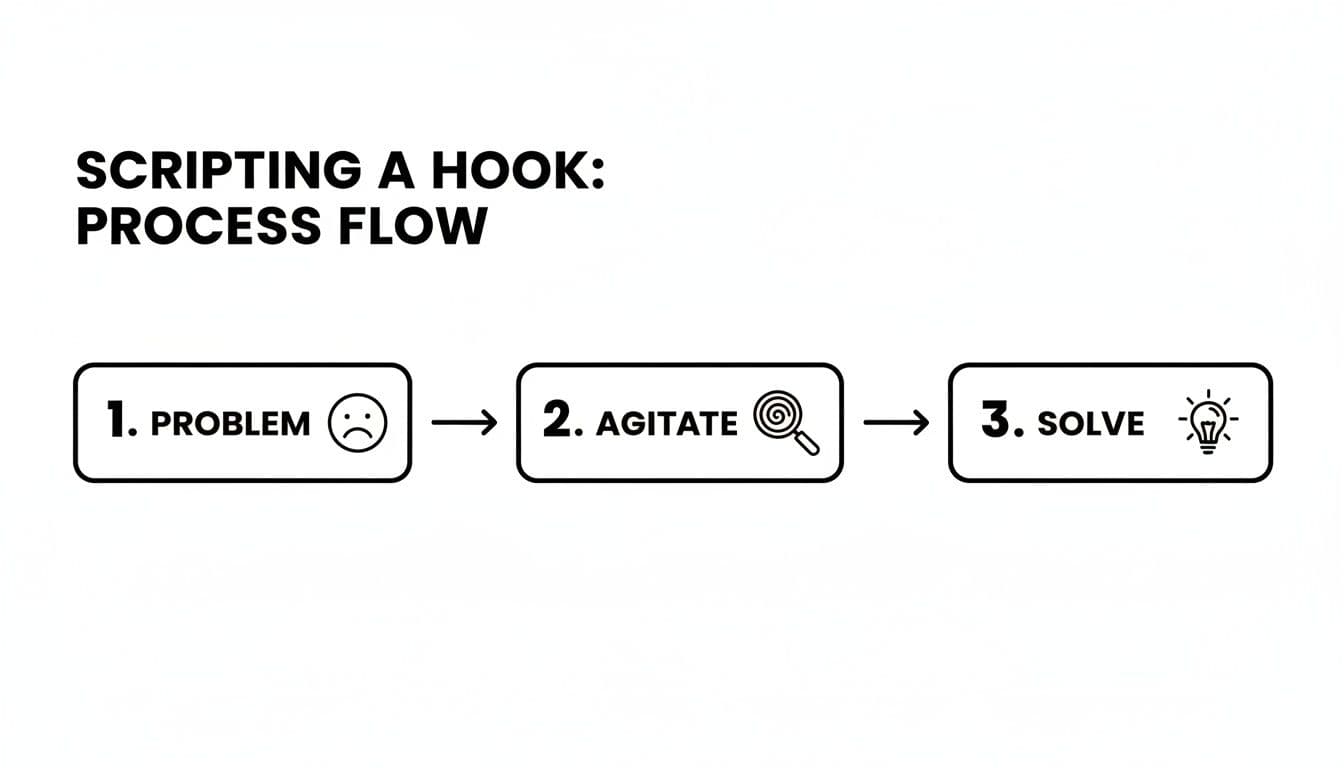
This is the classic narrative arc: you identify the viewer's pain point, poke at it a little to make them feel the urgency, and then swoop in with your product as the perfect solution.
By combining your own high-quality images with AI-generated voice and music, you create a polished, professional video without ever touching a camera. This approach ensures brand consistency and saves an incredible amount of time and resources.
If you want to dive even deeper into the nuts and bolts, our complete guide on how to make AI videos is packed with more advanced techniques.
Fine-Tuning and Repurposing Your Content
The first AI-generated draft is rarely the final version. Think of it as a starting point. Watch it a few times and look for small things you can tweak. Does an image linger for too long? Is a caption hard to read? Make those little adjustments until every second of the video feels tight and purposeful.
Once you’ve got a final cut you love, don't just post it once and call it a day. A single promotional video is a content goldmine. A smart move is to learn how to create YouTube Shorts from existing video to multiply your reach. You can easily tweak the dimensions for different platforms—a square version for the Instagram feed, a vertical cut for TikTok, and the standard 16:9 for YouTube—all from the same set of assets. This is how you work smarter, not harder, and get the most mileage out of your creative efforts.
Distributing Your Video for Maximum Reach
You’ve created a killer promotional video. That’s a huge win, but it's only half the battle.
A brilliant video that nobody sees delivers exactly zero return on your time and effort. Now comes the final, critical phase: distribution. It's time to get your masterpiece in front of the right eyeballs and drive the results you planned for from the very beginning.
This process really starts with the export. Different platforms have their own technical quirks, and exporting your video with the right settings is what makes it look crisp and professional everywhere. A high-resolution 16:9 video is perfect for YouTube, but you’ll absolutely need a 9:16 vertical cut for Instagram Stories or TikTok to give people that native viewing experience they expect. Keep an eye on file size and format, too—they can make or break your video's quality.
Optimizing for Engagement on Each Platform
Once your video files are ready, it's time to wrap them in content that actually convinces people to watch. Each social platform is its own unique ecosystem, so a one-size-fits-all approach to your copy and creative is guaranteed to fall flat.
- Compelling Copy and Headlines: Your video’s title or the first line of your ad copy is its headline. Make it count. Use action-oriented language, ask a sharp question, or flash the main benefit to stop the scroll cold.
- An Eye-Catching Thumbnail: For platforms like YouTube, the thumbnail is arguably more important than the title itself. Choose a bright, clear, and intriguing image that sparks curiosity while still accurately representing what the video is about.
- Targeted Hashtags: On Instagram and TikTok, relevant hashtags are your best friend for discoverability. Use a smart mix of broad, niche, and branded tags to push your reach way beyond your current followers.
The goal is to make your video feel like it belongs on the platform where it’s being viewed. Native content always outperforms something that feels out of place or generic.
The sheer volume of online video consumption shows why this is so important. Global internet users are on track to watch over 1 trillion minutes of video every single month by 2025, with mobile devices making up over 75% of all those views.
With nearly 92% of internet users watching video content monthly, your audience is already there—you just need to reach them effectively. You can find more compelling data on the rise of video marketing statistics.
Finally, don't be afraid to test and iterate. Create two different thumbnails. Write two versions of ad copy. Run a simple A/B test. The data you get back will show you what truly resonates with your audience, letting you fine-tune your approach and maximize the impact of every single video you launch.
Got Questions? We’ve Got Answers
Jumping into your first promotional video can feel like a minefield of questions. How long should it be? What format works best? Do I really need a camera crew? Getting these basics right from the start saves a ton of time and helps you dodge those common, costly mistakes.
Let’s clear up a few of the questions we hear all the time.
How Long Should My Promo Video Be?
This is the big one, and the answer is always: it depends on the platform. There's no magic number, but there are definitely some smart guidelines to follow.
- TikTok & Instagram Reels: Keep it short and snappy.We're talking 15-30 seconds, max. Your goal is to stop the scroll, deliver a punchy message, and get out.
- Facebook & Instagram Feed: You've got a little more breathing room here, usually around 60-90 seconds. This is perfect for a quick Problem-Agitate-Solve story that hooks the viewer and presents your solution.
- YouTube Ads: For those skippable pre-roll ads, the first 5-15 seconds are absolutely critical. If you're creating longer, value-driven content (like a tutorial or case study), you can stretch to 2-5 minutes, but it has to be packed with useful information to hold their attention.
When in doubt, always favor a tight, focused message. Shorter is almost always better.
A video should be as long as it needs to be to tell its story effectively, and not one second longer. Ruthless editing is your best friend when you're trying to make promotional videos that keep people glued to the screen all the way to your call-to-action.
What’s the Best Format for a Promo Video?
Again, let the platform be your guide. Uploading a horizontal video to a vertical-first platform is a dead giveaway that you're an amateur, and it kills engagement before your first frame even plays.
Here's the simple breakdown:
- Vertical (9:16): This is the undisputed king of mobile. Think TikTok, Instagram Stories, and YouTube Shorts. It fills the entire screen for a totally immersive feel.
- Square (1:1): An old-school but still incredibly effective format for feeds on Instagram and Facebook. It just takes up more visual real estate on the screen as someone scrolls, making it harder to ignore.
- Horizontal (16:9): The classic widescreen format. This is your go-to for YouTube and for embedding videos directly onto your website.
Can I Really Make a Good Video Without Filming a Single Thing?
Absolutely. In fact, this is where AI tools completely change the game. You can create a polished, professional-looking promo video using nothing but the assets you already have—product photos, stock images, or even screenshots.
This is the new workflow. You take those static images, pair them with a great script, add a crisp AI-generated voiceover, and layer in some on-brand music. The result is a dynamic video that tells a compelling story.
This approach isn't just a shortcut; it's often smarter. It's faster, way more affordable, and helps you maintain a perfectly consistent visual style across all your campaigns. For creating ads at scale, it's an incredibly powerful way to get started.
Ready to turn your photos into polished, professional video ads in minutes? With Proom AI, you can choose an industry-specific template, upload your images, and generate a share-ready video complete with AI voiceovers and music. Start creating for free at proom.ai.
Ready to create video ads?
Turn your photos into scroll-stopping ads in minutes. No video editing skills required.
Try For Free