How to Market Architecture Firm: Growth Blueprint
How to market architecture firm: 12 tactics that won 150+ clients in 6 months. SEO templates, portfolio strategies & client acquisition playbook included →
Successful marketing for an architecture firm starts with a simple, foundational truth: you have to know who you are and who you serve before you spend a single dollar. This isn’t about fluffy mission statements; it's about carving out a razor-sharp market position that pulls in your ideal clients and politely repels those who aren’t the right fit.
Build Your Foundation Before Your Funnel

Before you even think about websites, social media, or ads, the smartest firms take a strategic pause. They build a solid foundation that will guide every marketing decision they make down the line.
Without this clarity, your efforts become scattered, expensive, and ultimately, ineffective. You end up chasing every possible lead instead of attracting the right projects—the ones that build your reputation and your bottom line.
This initial phase is about getting past vague statements like "we design beautiful, functional spaces." While that's hopefully true, it does nothing to set you apart in a crowded market. A strong position answers the tough questions that inform everything from your website's headline to the projects you feature in your portfolio.
Identify Your Ideal Client Persona
The first real step is to stop thinking about "clients" in the general sense and start thinking about your ideal client. This goes way beyond just the type of project. You need to build a detailed persona, a portrait of the person or group you’re best equipped to help.
Get specific by considering these factors:
- Project Scope: Are you built for high-end custom residential homes, mid-size commercial developments, or complex public-sector renovations?
- Client Values: Do they prioritize cutting-edge sustainable design, historical accuracy, or are they focused on a rapid, budget-conscious build?
- Communication Style: Do they crave a highly collaborative, hands-on process, or do they prefer to delegate and trust your expertise completely?
- Decision-Making: Are you working with an individual homeowner, a development committee, or a corporate board? Each requires a completely different approach and vocabulary.
A firm that specializes in net-zero energy homes for eco-conscious families will have a totally different message, portfolio, and marketing strategy than one that excels at navigating the bureaucratic maze of historic preservation for municipal governments. Knowing that difference is everything.
Find Your Niche in a Growing Market
Once you know who you want to serve, you have to find your unique space in the market. This means doing some honest analysis of your competition. Look at other firms targeting your ideal client and ask what they do well and where their weaknesses lie. Maybe their portfolio is incredible, but their website gives zero insight into their design process. That’s an opening.
The global architectural services market is projected to hit $275.16 billion by 2029, which means there's a massive opportunity for firms that position themselves correctly. This growth also means clients are increasingly searching for specialists, not generalists. By carving out a niche—whether it’s minimalist Scandinavian-inspired interiors or the adaptive reuse of industrial buildings—you become the obvious choice for a specific type of project. You can dig into the full architectural services market report to see where that growth is happening.
Your unique value proposition isn't just what you do; it's how you do it and for whom. It’s the sweet spot where your deepest expertise meets your ideal client's most pressing needs.
Ultimately, this foundational work all comes together in a clear positioning statement. This isn't for your website homepage; it's an internal document that becomes your firm's North Star. It ensures every piece of marketing material, from your Instagram bio to your final proposal, speaks directly to the clients you are built to serve. This focus doesn't limit your opportunities—it multiplies the right ones.
Before moving on, run through this quick checklist. It's a simple way to confirm your firm has its strategic core locked in before you start launching campaigns.
Core Marketing Foundation Checklist
| Strategic Element | Key Question to Answer | Action Item |
|---|---|---|
| Ideal Client Persona | Who is the exact person or organization we are best equipped to serve? | Create a 1-page document detailing their demographics, values, pain points, and decision-making process. |
| Niche/Specialization | What specific problem do we solve better than anyone else? | Define your niche (e.g., "Sustainable hospitality design," "Historic residential renovations"). |
| Competitive Analysis | What are our direct competitors doing, and where are their gaps? | List 3-5 competitors and identify one key area of opportunity (e.g., poor content, outdated portfolio). |
| Value Proposition | Why should our ideal client choose us over everyone else? | Draft a clear, concise statement combining your "what," "how," and "for whom." |
Having clear, confident answers to these questions is the difference between marketing that feels like shouting into the void and marketing that feels like a magnet, pulling the right projects directly to you.
Building Your Digital Home Base
Let's get one thing straight: your firm’s website isn't a digital brochure. It’s your hardest-working employee, your business development machine that works 24/7 to bring in the right clients. Too many architects pour their budget into a gorgeous but lifeless online portfolio, and in doing so, they miss the entire point. A great website is a lead-generation engine.
A high-performing site does so much more than show off beautiful photos. It has to guide visitors on a journey. It anticipates their questions, builds trust, and makes it incredibly obvious what the next step is. This all starts with good, old-fashioned user experience (UX).
Put yourself in the shoes of your ideal client. When they land on your homepage, what are they truly looking for? They need to see your work, of course, but they also need to understand your process and feel a connection. They need to believe you're the right firm to bring their vision to life. This means your navigation has to be dead simple, your project pages need to tell a story, and your contact info should be impossible to miss.
Getting Found by the Right People
To attract dream clients, they have to be able to find you online. This is where Search Engine Optimization (SEO) comes in, and for architects, it’s not about playing games with generic keywords. It’s about making a direct connection with high-intent prospects in your city and your niche.
A smart SEO strategy boils down to a few key things:
- Go Local With Your Keywords: No one just searches for "architect." They get specific. Your goal is to show up for terms like "custom home architect in Austin" or "sustainable commercial design in Portland." You need to weave these phrases naturally into your homepage, service pages, and project descriptions.
- Turn Every Project Into an SEO Asset: Each project in your portfolio is a fresh opportunity to rank for something new. Ditch the generic titles like "Modern Residence." Instead, use descriptive headlines that tell a story, like "A Net-Zero Passive House in the Rocky Mountains." Be sure to detail the project's location, style, and the unique challenges you solved.
- Mind the Technical Details: A slow-loading, clunky website is a killer. Make sure your site is fast, works flawlessly on a phone, and has a logical structure. Google notices these things, and so do potential clients.
Earning Trust with Backlinks and Content
Your digital reputation isn't just about what you say on your own site; it's also about what other respected sources say about you. This is where backlinks—links from other websites pointing to yours—are pure gold. When a popular design blog or a local industry publication links to you, it’s a massive vote of confidence in Google's eyes.
A single, strategic backlink from a high-authority design publication can be worth more than a hundred social media posts. It sends referral traffic your way and signals to search engines that you're a credible expert.
Start making a list of blogs, online magazines, and industry partners who serve the same clients you do. Offer to write a guest post, share an amazing project for a feature, or collaborate on a case study. The idea is to provide genuine value to their audience, which in turn builds your authority and boosts your SEO.
This entire digital ecosystem—a user-focused website, smart SEO, and a strong backlink profile—creates a system that delivers qualified leads right to your inbox. It's an investment, for sure, but the payoff is a predictable pipeline of the exact projects you want to be working on. This digital foundation works hand-in-hand with your other marketing, and you can get more ideas by exploring effective social media strategies for architects.
Weaving a Narrative with Your Visuals
In architecture, incredible visuals aren't just a nice-to-have; they're the price of admission. But let's be honest, a portfolio full of beautiful, sterile photos of finished projects isn't enough to stand out anymore. The real magic happens when your content tells a story—about your unique process, your design philosophy, and the complex problems you solve for your clients.
This is how you graduate from being just another firm with a pretty website to becoming a sought-after, trusted partner.
Think of every single project as a deep well of content, not just a single photo op. That finished building is also a compelling case study, a blog post detailing how you overcame a gnarly zoning challenge, and a whole series of behind-the-scenes video clips. It’s about pulling back the curtain to show the "how" and the "why" behind the beautiful "what."
When you do this, you’re not just showing off; you're building trust and demonstrating expertise in a way that static images never could. You're inviting potential clients into your world, letting them see the value you bring long before you ever get to the proposal stage.
From Static Shots to Dynamic Stories
Your visual content has to do more than just showcase a finished space; it needs to document the journey. People are absolutely fascinated by the transformation. A simple time-lapse of a construction site or a short video explaining the choice of a specific reclaimed wood can be way more engaging than a dozen perfect, glossy final shots.
Get a simple content calendar going with a few recurring themes that bring your process to life. It doesn't have to be complicated:
- Material Mondays: A close-up, textural shot of the materials for a new project. In the caption, explain why you chose them for both their look and their performance.
- Sketch to Structure: Post an early concept sketch right next to a photo of the completed detail. This is a powerful way to connect the initial spark of an idea to the final, executed reality.
- Site Visit Shorts: Quick, informal video updates from a construction site on your phone. Highlight the progress and explain what’s happening in that particular phase of the build.
This kind of content is gold for visual-first platforms like Instagram and Pinterest, which are fantastic for discovery. For digging deeper and establishing your authority with commercial clients or potential collaborators, LinkedIn is your spot for sharing in-depth case studies and thought leadership articles.
Ready to create video ads?
Turn your photos into scroll-stopping ads in minutes. No video editing skills required.
Try For FreeWhy Video is a Non-Negotiable in Architecture Marketing
Video is no longer optional. It's a critical tool for conveying the feeling, scale, and light of a space in a way photos simply can't. A well-produced video walkthrough gives a potential client a genuine sense of a building's flow and atmosphere before they ever set foot inside.
Now, "professional" doesn't have to mean a Hollywood-sized production budget. Today, a smart digital strategy is what really sets firms apart. In fact, business leaders in architecture are reporting returns exceeding 50% on their digital transformation investments. In a field with over 111,670 companies, a strong video presence is one of the clearest ways to cut through the noise.
This all fits into a simple, proven process for building a digital presence that actually generates business.
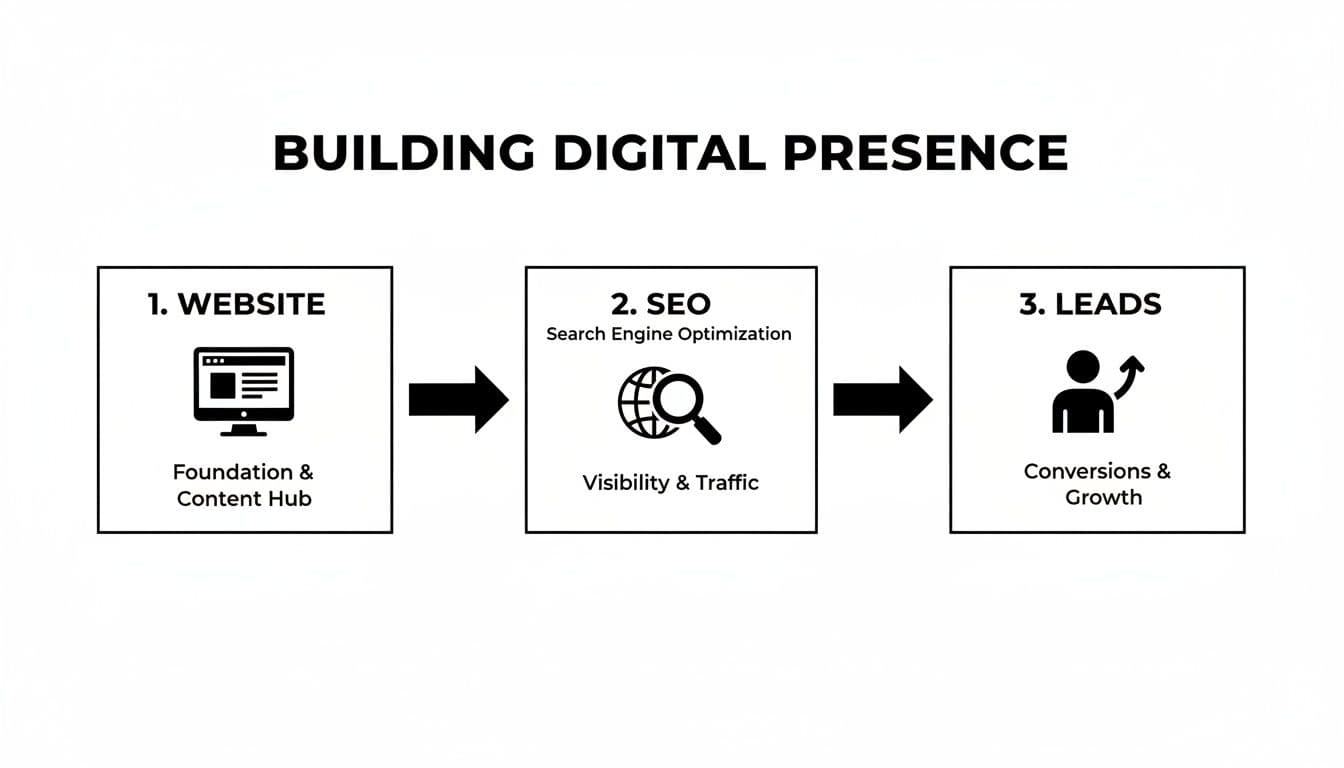
As you can see, a great website and smart SEO are the engines, but it's your compelling visual content—especially video—that converts that traffic into actual, tangible leads.
Streamlining Your Video Workflow
Okay, so creating consistent video content can feel like a massive task, especially for smaller firms. I get it. This is where templates become your secret weapon. Using pre-designed formats lets you produce professional-looking videos in minutes, without needing to become an expert video editor overnight.
The goal is to make video creation a repeatable, efficient part of your marketing system, not a rare, all-consuming project. Consistency is what builds an engaged audience and keeps you top-of-mind.
For instance, platforms now offer specialized templates built specifically for the architecture and design industry. These tools can help you turn your project photos, mood boards, and even material samples into short, cinematic clips perfect for your website or social feed. This efficiency is key to maintaining momentum. You can learn more about getting started in our guide to video marketing for small businesses.
By leaning on these kinds of resources, your firm can elevate its visual storytelling and build a dynamic online presence that truly captures the attention of your ideal clients.
Building Your Reputation Beyond the Screen
While a killer website and a strong social media presence get you in the game, the truly reputation-defining projects—the ones that become cornerstones of your portfolio—are almost always won through real-world relationships and credibility. Think of your digital footprint as the ticket to the dance; your offline reputation is what gets you asked to dance by the best partners.
This is where you move beyond collecting likes and start building tangible trust. It’s about cultivating powerful, third-party validation that speaks volumes more than any ad you could ever run. When you get this right, you create a marketing engine that practically runs itself on referrals and expert positioning.
Getting Your Work in the Spotlight
Seeing your project featured in a respected architectural magazine or an influential design blog is one of the most potent forms of validation you can get. It's more than just an ego boost; it's a stamp of approval from an impartial expert, telling potential clients, "This firm's work is important."
But getting published is far more strategic than just firing off a hopeful email. Editors are drowning in submissions. To stand out, you need a plan.
- Curate Your Target List: Don't just spray and pray. Do your homework. Identify the specific magazines and blogs whose aesthetic and project focus genuinely align with your work. Pitching your minimalist masterpiece to a publication known for traditional, ornate homes is a waste of everyone's time.
- Invest in Professional Photography: This is absolutely non-negotiable. Editorial-quality photos are the price of entry. Editors make snap judgments based on visuals, and amateur shots will get your pitch deleted before they even read your name.
- Craft a Compelling Pitch: Keep your email short, personal, and addressed to a specific editor. Most importantly, it needs to answer one question immediately: "Why is this project newsworthy?" Maybe it’s an innovative use of sustainable materials, a clever solution to a brutal site constraint, or a client story that’s truly unique. Lead with your hook.
Gaining media coverage transforms a project from a line item in your portfolio into a recognized piece of design excellence. This third-party credibility is a powerful asset when you're trying to land high-value clients.
Building a Powerful Referral Network
Here's a secret that isn't really a secret: your next best project will most likely come from someone who already knows and trusts you. Or, just as often, from someone who trusts a person who trusts you. Building a deliberate referral network is one of the most reliable strategies for long-term, sustainable growth.
This isn’t just about knowing people; it's about fostering genuine, mutually beneficial relationships with other professionals who serve your ideal client at different points in their journey.
Who should be in your inner circle?
- High-end general contractors
- Commercial and residential real estate agents
- Landscape architects and interior designers
- Real estate developers
The trick is to make it a two-way street. Don't just wait for them to send work your way. Proactively send good referrals to them, share their projects on your social channels, and go out of your way to be a valuable, reliable partner. That’s how a simple contact evolves into a powerful professional alliance.
Networking with Purpose at Industry Events
Industry events can be a goldmine of opportunity or a complete waste of an evening. The difference is your approach.
Forget trying to collect a mountain of business cards. Your goal isn't to meet everyone in the room. It's to build a handful of genuine connections that could actually lead somewhere.
Instead of flitting from person to person, focus on having a few meaningful conversations. Ask thoughtful questions about their work, their challenges, and what they're excited about. You’ll find that the most effective networking happens when you listen more than you talk.
After the event, follow up. A short, personalized email that references something specific from your conversation is all it takes to stand out from the crowd and start building a real professional relationship.
Turning Inquiries into Signed Contracts

Getting a steady stream of inquiries feels great, but the real win is turning those conversations into signed contracts. This is where the magic happens—where thoughtful lead nurturing and compelling proposals transform potential into profit.
Think of this as the critical bridge between a prospect’s initial curiosity and their final commitment. It’s a journey that rarely happens overnight. You need a process that keeps your firm top-of-mind by consistently providing value, not just a sales pitch. This builds trust and positions you as a helpful expert long before they’re ready to pull the trigger.
Nurturing Leads with Value First
Once a potential client reaches out, resist the urge to jump straight into a hard sell. Instead, treat this phase like an educational courtship. Your goal is to guide them, answer their unspoken questions, and prove your firm is the right partner for their vision.
A simple, automated email sequence can work wonders here. It’s not about spamming their inbox, but about strategically dripping useful content that addresses common client pain points.
- Email 1 (Immediate): Thank them for reaching out and give them a clear timeline for a personal follow-up. Drop in a link to a helpful blog post, like "5 Things to Consider Before Starting Your Custom Home Build."
- Email 2 (2 Days Later): Share a link to a relevant case study from your portfolio that mirrors their project interests. This instantly shows you’ve done similar work and get what they’re trying to achieve.
- Email 3 (5 Days Later): Offer a genuinely valuable, free resource. This could be a downloadable guide on navigating local zoning laws or a checklist for budgeting a commercial renovation.
This "value-first" approach keeps the conversation warm and demonstrates your expertise without ever feeling pushy.
Crafting Proposals That Actually Win
Your proposal shouldn't be a glorified price list. It should be the final, convincing chapter in the story you've been telling. It’s your opportunity to reflect the client's vision back to them and articulate exactly how your firm will bring it to life. A winning proposal makes you the only logical choice.
The key is to make it client-centric. Focus on their goals, their anxieties. Instead of just listing services, frame everything as a solution to a challenge they've shared with you.
Your proposal is more than a document—it's a reflection of the client experience you promise to deliver. It should be as thoughtfully designed and communicated as the spaces you create.
The architecture industry is navigating major shifts. With firm backlogs averaging 6.5 months and economic uncertainty making clients cautious, your proposal must position you as a steady, experienced hand who delivers exceptional value. It has to cut through the noise. You can read more about these architecture market trends and what they mean for firms.
Key Elements of a Compelling Proposal
To elevate your proposal from a simple quote to a persuasive argument, make sure it hits these key points. Each element builds confidence and smooths the path to a "yes."
- Start with a Strong Narrative: Kick things off by summarizing your understanding of the client's vision and goals. It’s a simple but powerful way to show you were listening.
- Tell a Visual Story: Don't just describe your ideas. Include sketches, mood boards, or even short video clips from past projects to help them visualize the potential. If you want to create truly impactful video content, check out this guide on how to create compelling video ads.
- Provide a Clear Scope & Deliverables: Break the project down into clear phases with specific deliverables for each one. This transparency demystifies the process and manages expectations from day one.
- Follow Up Professionally: Don't just hit send and hope for the best. Have a plan. A simple email a few days later asking if they have questions, followed by a phone call a week later, shows you're proactive without being annoying.
Answering the Tough Questions About Marketing Your Firm
Stepping into the world of marketing can feel like learning a new language, especially when your days are spent deep in design and project management. To help clear things up, let's tackle the most common questions I hear from architects who are just starting to get serious about marketing. Think of this as the practical, no-fluff FAQ section you've been looking for.
How Much Should My Firm Actually Spend on Marketing?
For an established architecture firm, a good rule of thumb is to set aside 5-10% of your net revenue for marketing. This isn't just for ads; it’s the total investment covering your website, professional photography, content creation, and any promotional efforts.
Now, if you're a new firm trying to make a name for yourself or you’re in a serious growth phase, you'll want to be more aggressive. Pushing that budget up to 10-15% can give you the momentum you need to build brand recognition and start winning bigger projects.
The most important thing is to stop thinking of this as an expense. It's an investment in your pipeline. Your first dollars should always go toward the non-negotiables: a killer website and stunning project photography. Once those are locked in, you can funnel the rest into ongoing activities like SEO, social media, and building strategic relationships.
The real secret to a smart budget? Tracking everything. You need to know your client acquisition cost (CAC) for every channel. Is LinkedIn bringing in high-value leads? Are your Google Ads paying for themselves? Data lets you double down on what works and confidently cut what doesn’t.
For a Small Firm, What's the Single Most Effective Tactic?
If you only have the time and budget for one thing, make it this: a niche-focused portfolio on a website with rock-solid local SEO. This is the highest-leverage move a small firm can make. Period.
Your portfolio is your most powerful sales tool. It’s tangible proof you can do the work. This means you have to invest in the absolute best architectural photography you can afford. But don't just show pretty pictures—tell the story behind each project. What was the core challenge? How did your design solve it?
Then, you optimize your site for the exact clients you want. Instead of ranking for "architect," you target specific, high-intent phrases like "passive house architect in Boulder" or "historic brownstone renovation in Brooklyn." This approach is incredibly efficient. You're not shouting into the void; you're attracting qualified leads who are already looking for your specific expertise, leading to way higher conversion rates than any broad, expensive ad campaign.
How Do We Get Published in Design Magazines or Blogs?
Getting your work featured in a respected publication is a game-changer. It provides instant third-party validation and builds incredible credibility. It really comes down to three things: a standout project, phenomenal photography, and a smart pitch.
First, do your homework. Identify the magazines and blogs that align with your firm's aesthetic. Don't waste your time pitching a minimalist masterpiece to a publication that celebrates ornate, traditional design. A targeted pitch shows an editor you respect their work.
Next, and this is non-negotiable, you must hire a professional architectural photographer. Editors see hundreds of submissions a day. Mediocre photos will land your email in the trash folder before they even read your pitch. High-quality visuals are simply the price of admission.
Finally, craft a pitch that’s short, sharp, and compelling.
- Get Personal: Find the right editor and use their name. "To whom it may concern" doesn't work.
- Explain the "So What?": Why is this project newsworthy? Did you use an innovative new material, overcome a wild site constraint, or achieve a crazy sustainability goal? Give them a hook.
- Make It Effortless for Them: Include a direct link to a gallery of high-resolution images. No attachments. No friction.
- Follow Their Rules: Every publication has submission guidelines. Find them and follow them to the letter.
Taking this strategic approach will dramatically increase your odds of getting noticed. And as you gather these amazing photos for your pitches, think about how else you can use them. They're perfect for turning into dynamic portfolio videos with tools that offer interior design video templates, which you can then share across your site and social channels. For a deeper dive into visual platforms, check out our full guide on social media for architects.
Ready to turn your stunning project photos into professional, attention-grabbing videos in minutes? Proom AI makes it simple. Choose an industry-specific template, upload your images, and instantly generate cinematic video content perfect for your website, social media, and client presentations. Try Proom AI for free and see how easy it is to elevate your marketing.
Ready to create video ads?
Turn your photos into scroll-stopping ads in minutes. No video editing skills required.
Try For Free